Ten 25-minute blocks. Use exact setup cards, large safe counters, labelled trays and number mat or equivalents. Give the child time to move, point, draw, sign, AAC-compose or direct a scribe. Sample first independent reasoning before a hint; record the exact access route. AC9MFN01/03/04/05 are proposed partial Foundation links, not a judgement that the full descriptions are met. A mathematical count from a fictional card is separate from the science test's observed movement.
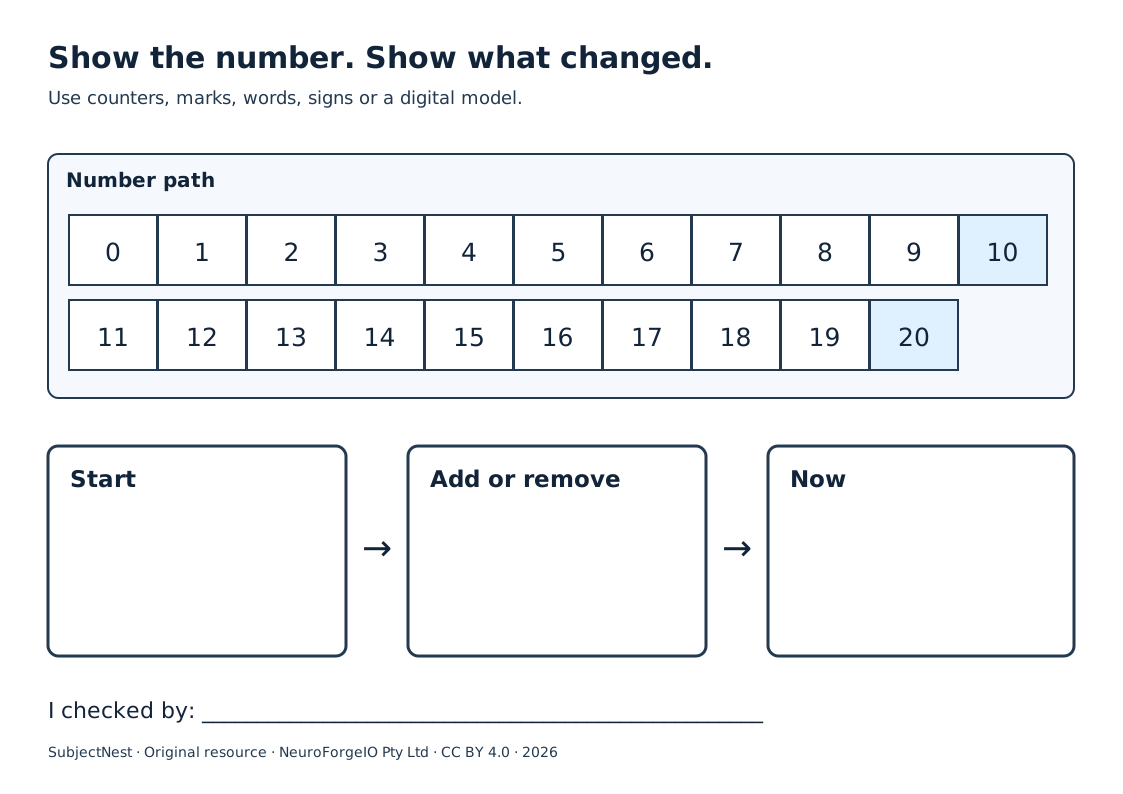
Week 19 · Day 91 — Start, add, now
Goal: represent a practical increase from 5 to 7 and explain what changed. Codes: AC9MFN05, AC9MFN03. Prepare: card A and three labelled trays.
- Retrieve · 3 min. Flash 4 large counters briefly; child names the amount or counts, then checks. Record whether it was subitised or counted.
- Model · 5 min. Place 5 paper ramp marks in Start. Move them to a row, add 2 distinct marks and count each once: 1–7. Say “Five, then two more; seven now.” The number is a card count, not the toy's movement.
- Guide · 5 min. Repeat with 3 then 2 on a new tray; child says, signs or selects “add” and shows 5. Check by pairing each count word to one object.
- Independent · 7 min. Child uses new 5 then 2 with card A, chooses objects/digital marks and records 7 or shows a seven collection. Ask “How do you know?” before demonstrating. Exact expected total: 7.
- Compare · 3 min. Ask whether adding paper marks proves the toy will travel farther. Expected no; numbers model the setup only.
- Exit · 2 min. Give 4 then 1; expect 5. Next day reteach one-to-one counting if any mark was skipped or counted twice.
Week 19 · Day 92 — Remove from a paper plan
Goal: model taking away while preserving the starting count. Codes: AC9MFN05, AC9MFN03. Prepare: card B, eight large plant-picture cards.
- Retrieve · 3 min. Show yesterday's 5 + 2 as objects and ask for the result before giving any numeral.
- Model · 5 min. Count 8 paper plants into a row. Move 3 into a labelled removed tray, leaving 5 visible. Say “Eight in the paper plan; three removed; five remain.” Do not call them living plants.
- Guide · 5 min. Use 6 then remove 2. Child moves exactly two and checks 4 remain; point out that removed cards still exist but are outside this plan.
- Independent · 7 min. Present a new 8-card set. Child removes 3 and shows/records 5. Ask for a reason using their objects, not a memorised fact.
- Transfer · 3 min. With 5 art paper squares remove 1; expect 4. Note whether the child recounts all or counts back accurately.
- Exit · 2 min. Ask “Did we add or remove?” and point to the start count. Reteach the starting state if the child reports only the final five.
Week 19 · Day 93 — Another setting, same structure
Goal: recognise addition in a made-up library card scenario and represent 6 + 4 with objects. Codes: AC9MFN05, AC9MFN03. Prepare: card C and ten book-picture cards.
- Retrieve · 3 min. Give 7 then remove 2 with counters; expect 5, check with visible objects.
- Model · 4 min. Place six book cards in a drawn tray, then four more. Group six as five and one if helpful, then count all: 10. Say this is a fictional return tray.
- Guide · 6 min. Child builds 5 then adds 3, counts 8, and explains how they avoided recounting a card twice.
- Independent · 7 min. Child models the new 6-and-4 card, writes/selects 10, then checks by one-to-one recount. If the child uses a valid count-on strategy, record it exactly.
- Compare · 3 min. Show ten as two groups of five; ask if moving cards into a different shape changes the total. Expect no if none added/removed.
- Exit · 2 min. Give 3 then 4 large counters; expect 7. Tomorrow ask for a direct removal setup if addition is secure.
Week 19 · Day 94 — Take away, then check by replacing
Goal: show 9 − 2 as a change and verify by returning the removed objects. Codes: AC9MFN05, AC9MFN03. Prepare: card D, nine frame cards and a separate removed tray.
- Retrieve · 3 min. Ask child to show 6 then 4 with counters and say the resulting ten.
- Model · 5 min. Count 9 paper art frames, take away 2, count 7 left, then put 2 back and recount 9. Say the return checks the starting collection; it is not a new art event.
- Guide · 5 min. Child starts with 7, removes 1, shows 6, replaces it and checks 7. Use exact matching rather than guessing.
- Independent · 7 min. Child performs card D with new cards; expected 7 left and 9 after replacing two. Record first result before verbal help.
- Explain · 3 min. “If I kept the two removed cards in the same count row, what mistake could happen?” Expected: count them as still on the wall/model, giving nine instead of seven.
- Exit · 2 min. 8 take away 3 leaves 5. Group missed one-to-one/removal children for a fresh concrete recheck.
Week 19 · Day 95 — Two parts can make one total
Goal: combine and partition 7 in a new context; distinguish a part from the whole. Codes: AC9MFN04, AC9MFN05. Prepare: card E, two textured or labelled trays.
- Retrieve · 3 min. Show a 9-card paper model, remove two, ask the child to demonstrate seven left.
- Model · 5 min. Put 4 game markers in tray A and 3 in tray B. Slide together without losing any: 7 whole. Separate again: 4 and 3 are parts of 7.
- Guide · 5 min. Build 7 as 5 and 2 using seven counters; child names both parts and checks by recombining.
- Independent · 7 min. Child receives seven blank counters and two trays. Find another split, such as 6 and 1, and show that all seven are present. Record the split actually made; more than one answer is correct.
- Transfer · 3 min. Ask whether 4 + 3 markers tells how far a ramp toy went. Expected no; it is a marker count.
- Exit · 2 min. Show 3 in one tray and 4 in the other, ask for whole 7 and one alternative part split. If whole and part were confused, start Week 20 with a five-object version.
Week 20 · Day 96 — A full ten and some more
Goal: represent and name 14 as ten and four. Codes: AC9MFN01, AC9MFN03. Prepare: card F, a ten-frame and four separate large counters.
- Retrieve · 3 min. Make 7 as 5 and 2; ask which is the whole and check all seven are present.
- Model · 5 min. Fill ten spots, then place four beside the frame. Count “ten, eleven, twelve, thirteen, fourteen”; show numeral 14. Say the 1 names one ten, not one loose counter.
- Guide · 5 min. Give one full ten-frame plus 2 separate counters; child names 12, then shows the numeral card.
- Independent · 7 min. New one full ten-frame plus 4; child builds/chooses 14, points to the ten and four, and recounts if needed. Record whether the child shows a matching collection.
- Compare · 3 min. Place numeral 41 beside 14; ask which matches ten and four. Expected 14. Avoid a place-value lecture beyond this concrete distinction.
- Exit · 2 min. Full ten plus one; expect 11. If teen naming is uncertain, retain the full frame tomorrow.
Week 20 · Day 97 — Order is a claim we can check
Goal: order selected numerals from 0 to 20 and verify with matching collections. Codes: AC9MFN01, AC9MFN03. Prepare: card G and numeral path.
- Retrieve · 3 min. Build ten and four and match 14.
- Model · 5 min. Place 0, 7, 12, 16, 20 on the number path in order. Make seven with counters, then ten and two for twelve; explain why twelve comes after seven.
- Guide · 5 min. Give mixed 0, 5, 10, 15 cards; child places them increasing and checks with path positions or collections. Zero represents none in an empty tray, not missing data.
- Independent · 7 min. Shuffle card G; child orders 0, 7, 12, 16, 20, points to one matched collection, and says which is just before/after 16 in this selected list (12/20). Do not confuse list neighbours with consecutive integers.
- Reason · 3 min. Compare 12 and 16 as one ten plus two versus one ten plus six; expect 16 greater.
- Exit · 2 min. Ask child to show 0 with an empty tray and name a card greater than 12. Reteach numeral–collection matching if necessary.
Week 20 · Day 98 — Same total, different useful pictures
Goal: represent 10 as two parts and explain that arrangements do not change the whole. Codes: AC9MFN04, AC9MFN01. Prepare: ten counters and two labelled trays.
- Retrieve · 3 min. Ask which is greater, 14 or 12, using a ten-frame if needed.
- Model · 5 min. Split ten into 6 and 4, then 5 and 5. Count all ten each time. “The parts changed; no counter was added or removed from the whole.”
- Guide · 5 min. Child makes 8 and 2, slides together and checks ten. If a counter falls, pause and restore the exact collection.
- Independent · 7 min. Child chooses a new split of ten, records both parts with marks/digital tiles and proves total ten by one-to-one count or an accurate known composition.
- Explain · 3 min. Show two layouts of the same ten. Ask whether a long row has more than a compact group; expected same if one-to-one matches.
- Exit · 2 min. Show seven and three; expect whole 10. Tomorrow use fresh parts if the child relied on copying.
Week 20 · Day 99 — Choose and explain a number sample
Goal: explain one dated number model and identify what it does and does not show. Codes: AC9MFN01, AC9MFN03, AC9MFN04. Prepare: two invented adult examples and optional consented child sample.
- Retrieve · 3 min. Use ten and four counters; child names 14 and shows ten/four.
- Model · 5 min. Show an invented card with 8 dots and numeral 8. Say “This shows one collection of eight; it does not prove I can order every number to twenty.”
- Guide · 5 min. Show a second invented card with a full ten-frame plus seven; ask what it shows (17) and what to check (all ten filled, seven extras).
- Independent · 7 min. Child chooses a previously made sample or builds a new 13 as ten and three; explains how the collection matches the numeral. Preserve the child's first representation.
- Feedback · 3 min. Ask “What could you add to help a new viewer?” Child may add a numeral, ten-frame boundary or spoken label. Record revision separately.
- Exit · 2 min. One child-selected next target is written as a teaching action, not a trait label.
Week 20 · Day 100 — Fresh number and change check
Goal: independently show number, order, compare and add/remove reasoning with new objects. Codes: AC9MFN01, AC9MFN03, AC9MFN04, AC9MFN05. Prepare: unseen assessment, ten-frame, large counters, blank trays.
- Welcome · 3 min. Explain this helps choose tomorrow's practice; no race or public rank.
- Number · 6 min. Give new ten-frame and counters; child shows 15 as ten and five and names numeral. Then compare 13 and 15 with representations.
- Change · 6 min. Give the fresh 6-plus-3 and 9-remove-2 setups from the assessment, one at a time. Keep the first response before a hint.
- Parts/order · 5 min. Ask for a fresh split of 8 and the selected 0/9/14/20 order. Let the child show the reasoning physically or digitally.
- Explain · 3 min. Child states or selects one way they checked. Record exact strategy and any prompt.
- Close · 2 min. Choose a concrete next lesson from the rubric. A task inaccessible under the provided route is not observed and needs another route.
Continue daily counting in meaningful contexts after this sample. The integrated portfolio conversation records other learning separately; do not derive a whole-child label from these four mathematical items.