Use large, safe counters or a tactile/digital equivalent. Show a new collection at the independent check, not the worked model. Keep the total within the child's current access and record child control. The labels below are everyday fictional scenarios, not claims about a real school, shop, garden or child. Food is represented by paper cards; no food handling is needed.
| Card | Exact action | Key and question |
|---|---|---|
| A · test station | Start with 5 large paper ramp-mark cards. Add 2 more. | 7 cards. “What changed in our card count?” Do not infer what a toy will do. |
| B · garden plan | Place 8 large plant-picture cards, then remove 3 from the paper plan. | 5 remain. The cards are not real plants. |
| C · library return tray | Start with 6 large book-picture cards in the paper tray. Add 4 more returned book cards. | 10 in tray. This is a made-up count, not a live library record. |
| D · art wall | Show 9 paper frames; take down 2 on the paper model. | 7 stay. No real wall attachment is required. |
| E · play markers | Put 4 large markers in one tray and 3 in another; combine. | 7 altogether; parts 4 and 3. Use two colours or two textures, with labels. |
| F · review row | A ten-frame is full and 4 separate counters sit beside it. | 14; ten and four, not forty-one. |
| G · order path | Place numeral cards 0, 7, 12, 16, 20 in a mixed order. | 0, 7, 12, 16, 20 increasing. Build selected numbers to verify. |
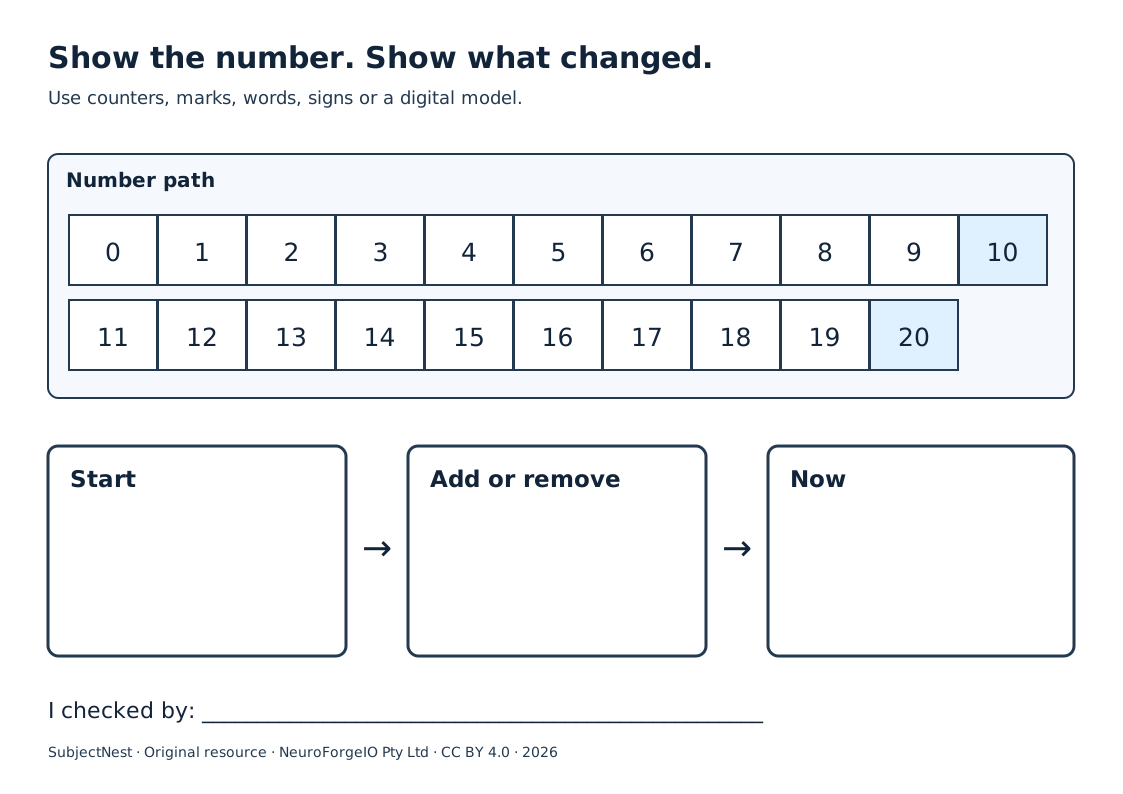
Mat text alternative: The print mat is an A4 landscape page. At top is a path of twenty-one labelled boxes 0 through 20, read left to right across the first row 0–10, then the second row 11–20; ten and twenty have a pale blue background. Beneath are two outlined boxes labelled Start and Add or remove, pointing to a third box Now. Beneath that is a blank line I checked by .... The labels, sequence and box boundaries carry the meaning; colour is decorative. For a nonvisual route, lay tactile numerals 0–20 in the same order and use three raised trays with the spoken labels. Do not use the path as a replacement for counting an actual collection.
Adult prompt bank: “Show me the start before we change it.” “Did you add or take away?” “How can we check each object was counted once?” “Could the same total have different parts?” “What does the zero card mean in this setup?” “Show ten, then the extra ones.” “What would change if we used a different object?” Use only the prompt that fits the exact task. Preserve a first attempt before modelling again.
Print rights: © 2026 NeuroForgeIO Pty Ltd, CC BY 4.0. All scenarios and vector elements are original. Suggested credit appears in README.md.