Foundation / Queensland Prep · five optional 35-minute integrated blocks, Days 151–155. Pair with the authored English Days 151–155 and mathematics Days 151–155. The subject packs carry their own fresh checks and worked feedback. Run Day 155 below after both checks. This shared activity is practice and does not provide an independent assessment result.
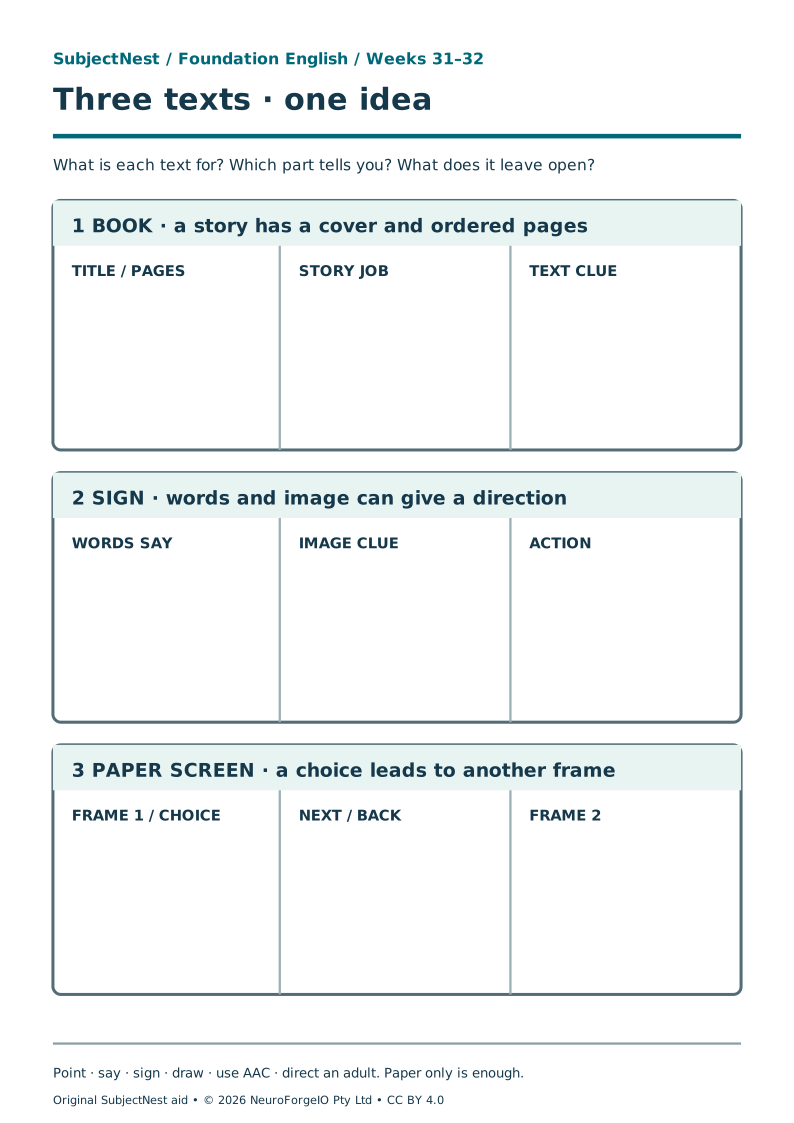
The story in reach: The three original English sources tell one fictional book-return idea differently. In the book story, Miri keeps a book and its loose page together, asks an adult and places both in a wide return box. A sign gives a short action and time. A paper model of a screen has labelled choices, Next and Back. None of these is a real school rule, damaged book, working app or evidence about a child. The adult handles any actual damaged book under school procedure. We do not collect names, borrowing records, images or logins.
Ready in five minutes: Print or display the three complete texts and book/sign/paper-screen aid. Prepare 20 broad numbered paper rectangles, a 0–20 track, thick markers and blank A4 sheets. The paper screen works without a device, account, sound or connection. An optional self-contained button version mirrors the same two frames and has the complete linear transcript on the page. A school must approve any device use and check its own accessibility and data rules first; this pack makes no Digital Technologies hardware/software claim from pretending on paper. Actual approved exploration may be separately observed against the school's program.
| Day | Thirty-five-minute sequence | Keep this evidence; use it for the next move |
|---|---|---|
| 151 · What stays the same? | 5 min adult reads the story, sign and paper screen in that order; 7 min child finds the book with its page and the helpful action in each, pointing to exact words or full-word strips; 8 min child makes 11 broad paper book labels and represents 11 on a 0–20 track, checking each label once; 10 min child chooses one of the three forms to tell a new fictional reader where to put the model book and explains the choice; 5 min compare one useful detail and one missing detail in that form. | Keep the labelled 11 and the child's source-backed reason. If a form seems to say a different action, return to its exact words. An adult reading aloud gives access to meaning but does not by itself establish independent reading. |
| 152 · A sign has little room | 5 min compare the story's event order with the sign's short instruction; 7 min child directs an adult to arrange WHO / FIRST / ACTION / THEN strips for Miri, retaining the ask-an-adult step; 8 min count 13 broad paper return slips once, spread them and recount to see that spacing did not change the total; 10 min child makes a large-print sign for a different imaginary shared box, choosing an action, a helpful cue and a real option to ask an adult; 5 min a consenting listener tells what action they understood. | Save first and revised sign plus count strategy. The child selects wording; the adult may scribe with that support labelled. Do not treat a sign the child only copied as evidence of an authored choice. |
| 153 · A paper screen can offer a route | 5 min trace the supplied Next/Back paper frames with complete spoken/text labels; 7 min ask where a reader could stop or ask for help, and what a frame alone cannot prove about a person; 8 min place 8, 12 and 17 large number cards on the 0–20 track with a reason for each position; 10 min child draws a two-frame paper storyboard for the imaginary box, labels both choices and directs one frame change to make the route clearer; 5 min child states which audience may find the order helpful and why. | Keep the ordered numerals and the child's frame, label and audience decision. This is an opportunity for Media Arts making when the child intentionally represents an idea for an audience; copying a ready screen does not supply that evidence. It is still not device use. |
| 154 · Let the audience tell us | 5 min child selects their story, sign or paper storyboard and predicts one thing a reader may understand; 7 min practise asking “What would you do next?” with a genuine pass option; 8 min child represents 15 broad page cards in two arrangements and explains why there are still 15; 10 min child shares with a consenting adult/peer or uses a private paper-listener role, receives the listener's exact response where one exists and revises one detail; 5 min compare first/revised versions and name what remains uncertain. | Keep both versions, child's reason and actual listener comment only if a person really responded. A paper-listener role rehearses audience thinking but does not establish that sharing occurred. If the count changes, recount by moving each card once. |
| 155 · Move the idea to a new place | 5 min after the separate fresh subject checks, propose a fictional class-game return shelf rather than another loose-book example; 7 min choose book-note, sign or two-frame paper message for its imaginary user; 8 min order 9, 11 and 16 broad paper number cards on a 0–20 track and check one position by counting from zero; 10 min make and revise the message after a voluntary listener or private audience rehearsal; 5 min say which detail the chosen form makes easiest to find and which would need another source. | Save one explicit form/audience decision, number reason and before/after message. This is a supported transfer rehearsal, not a second Day 155 test. Do not reuse the held-out check cards or borrow their answers. |
Curriculum and honest limits: The English and mathematics packs give exact ACARA v9 descriptions and their taught/deferred rows. This integrated route proposes partial Mathematics AC9MFN01 (represent/order to at least 20) and AC9MFN03 (quantify/compare with counting and reasoning) only where the child actually names, places, counts and explains the separate paper sets. The child-created storyboard can sample Media Arts AC9AMAFD01 (develop an idea), AC9AMAFC01 (communicate an idea in an arts work) and, only after a real audience encounter, AC9AMAFP01 (share an arts work). Comparing form and purpose is English work; it does not automatically satisfy every English description or the whole achievement standard. Paper frames alone do not show AC9TDIFK01 digital-system exploration. Check the official ACARA v9 workbook and QCAA's Queensland v9 implementation guidance against the school's adopted plan. Workbook retrieved 29 September 2026, SHA-256 db446882d2c00cf7c085a03e250e2442fda6c44011fc114680c46c1dc7a822c3 (Learning areas rows 17151, 17160, 20976, 20986 and 20995). These are proposed learning opportunities, not local approval or formal grades.
Access and care: Offer the same full words in large print, plain text, a child-directed strip arrangement or spoken/AAC composition. Use broad cards and a reachable desk; a learner may decline touch, a device or an audience. Record what the child decided and what an adult supplied. The text version carries all screen labels, and no colour, tap or visual cue is the sole instruction. No child has to describe their own borrowing, reading level, disability or family access to a device. Original SubjectNest script, cards and scenarios © NeuroForgeIO Pty Ltd 2026, CC BY 4.0; credit, link and indicate changes. ACARA and QCAA material retains its own terms. Educator, accessibility and classroom review remain due.