Foundation / Queensland Prep · five optional 35-minute connecting sessions, Days 196–200. Pair these with English Days 196–200 and mathematics Days 196–200. This is a bounded handover, not an invented end-of-year achievement level. Run Day 200's subject-held checks before its different connecting case and preserve their first responses.
Prepare and attribute: Use broad original paper shapes or the exact spoken list. The story and sign below are fictional sources; neither records a real event. Only a child's available dated work can go into a handover. If a piece, feedback or direct comparison is unavailable, write NOT AVAILABLE. Offer private, spoken, signed, AAC, drawn and child-directed routes. Adult reading, scribing and prompting stay visible in the record. No home return, device, purchase, family disclosure or public performance is required.
| Day | Thirty-five-minute sequence | Keep and teach next |
|---|---|---|
| 196 · A story and a direction card do different jobs | 5 min read an original pretend story, “A paper display had seven blue cards. Three yellow cards were added. The maker smiled at the finished ten”; 7 min separately read the instruction, “Put seven blue cards and three yellow cards on the mat”; 8 min child says which text reports an imagined event and which gives a possible action, then shows 7+3=10 as two parts; 10 min child retells the fictional start/change/end and labels what the instruction alone cannot prove happened; 5 min retain one clear source-bound sentence and the counted part–whole model. | Record ten as a checked paper model, not a real display result. Adult-read story meaning is not independent reading. |
| 197 · A whole pattern unit can guide another maker | 5 min show a fictional border curve–curve–corner / curve–curve–corner as a spoken or broad-card list; 7 min ask the child to identify the entire three-card part that repeats; 8 min model a fixed BOARD marker below the border and describe a circle above it with a curved-boundary reason; 10 min child gives a full next three-card instruction, tests it with a willing mover or marks MODEL, and uses an adult-read short sign or locally taught print only where appropriate; 5 min keep original/revised words and the next whole unit. | A guessed next single card is insufficient. A paper place is not the child's movement in a real classroom; adult-read sign words are not child decoding. |
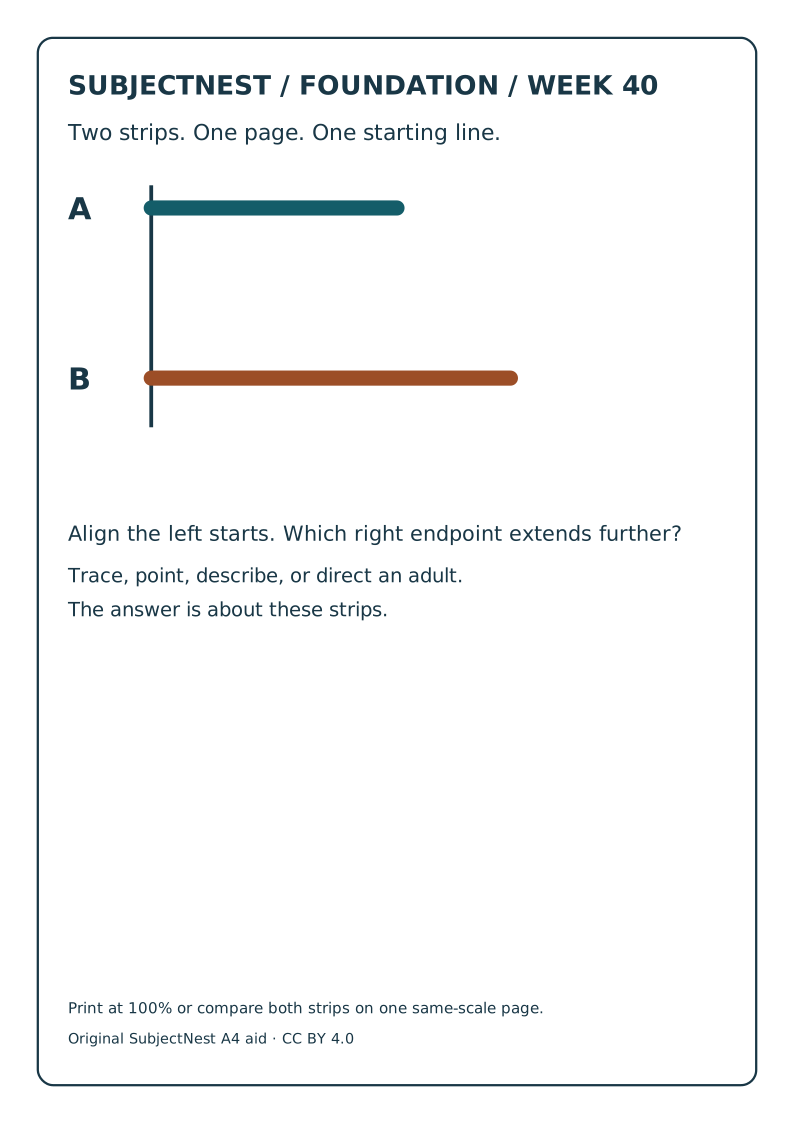
| 198 · Compare only what was put on the same scale | 5 min read an original fictional story about choosing a paper banner and have the child retell its beginning, problem and ending; 7 min show two original straight strips on one A4 page, one 65 mm and one 95 mm at 100% print, with a common marked left start; 8 min child predicts then aligns/traces the starts and checks the right endpoints; 10 min child says B extends further on this page, describes how the comparison was made and changes one imagined story detail without calling it a real result; 5 min keep source, scale, first prediction, checked endpoint and whether the story change was adaptation. | If equal-scale strips cannot be supplied, use the exact text/geometry description for explanation only and record DIRECT COMPARISON NOT AVAILABLE. The fictional banner was never made. |
| 199 · Handover means actual evidence and a next move | 5 min show a new paper source with twelve broad tokens grouped two per box; 7 min child checks six equal groups and explains how each token was used once; 8 min give a separate invented picture sheet of eight labels, five dotted and three plain, with the given question “Which is more on this sheet?”; 10 min child answers 5/3, then selects one actually available dated response from English or maths, names adult help and proposes one next try; 5 min mark any missing work NOT AVAILABLE rather than generating a substitute. | Keep group evidence, separate picture-data evidence and any genuine work sample apart. An imagined portfolio entry cannot demonstrate growth. |
| 200 · A different paper case after both checks | 5 min after the held English and maths checks, show a new fictional festival-flag page with eight green-outline and four blue-outline flags and a separate adult-read sign, “Ask before moving the flags”; 7 min give “Which outline appears more on this paper page?” and ask whether the sign proves anyone actually moved a flag; 8 min child tracks 8/4 and explains that the sign gives an instruction, not an event; 10 min child makes one source-bound caption, identifies an actual first response from the subject checks if permitted, or records NOT AVAILABLE, and chooses a specific next learning move; 5 min close with one thing the source showed and one thing no source here could show about the whole year. | The held English post-desk story/sign and held maths part/add/pattern/length sheet do not appear here. This is after-check practice, not a second independent assessment or a year-end certificate. |
Curriculum and limits: The English crosswalk limits claims about adult-read texts, retelling, taught-point reading and authentic samples. The mathematics crosswalk pins AC9MFN04/05/06, AC9MFA01, AC9MFM01, AC9MFSP01/02 and AC9MFST01 only for the specific visible paper work. Time ordering, full measurement breadth and an annual achievement standard are not established by these five sessions. The examples are invented. Source: official ACARA v9 workbook, retrieved 29 September 2026, local SHA-256 db446882d2c00cf7c085a03e250e2442fda6c44011fc114680c46c1dc7a822c3; QCAA Queensland v9 entry. Local school assessment, access and teacher review remain open.
Original SubjectNest scripts and fictional paper sources © NeuroForgeIO Pty Ltd 2026, CC BY 4.0: credit SubjectNest, link the licence and indicate changes. ACARA and QCAA retain their own rights. No classroom, child, family, translation or cultural-authority trial is claimed.