Every display label below is a fictional teaching context, not a tested sample, measured spectrum, safety claim or material recipe. The element symbols, atomic numbers and example isotope mass numbers were independently checked against CIAAW's tables; the arithmetic is audited in the worked key. A model is useful without being a literal picture of electron paths.
Card A · what this early atom model can and cannot show
An atom's nucleus contains protons (positive) and neutrons (no charge); electrons (negative) are outside it. For this starter, represent electrons in distinct energy levels, as the QCAA first atomic-structure point says. A drawn ring is a teaching convention, not a measured circular orbit or a full orbital/electron-configuration description. The element's identity follows its proton count, not the colour, context name or the number of drawn dots.
Card B · count rules for one isotope or ion
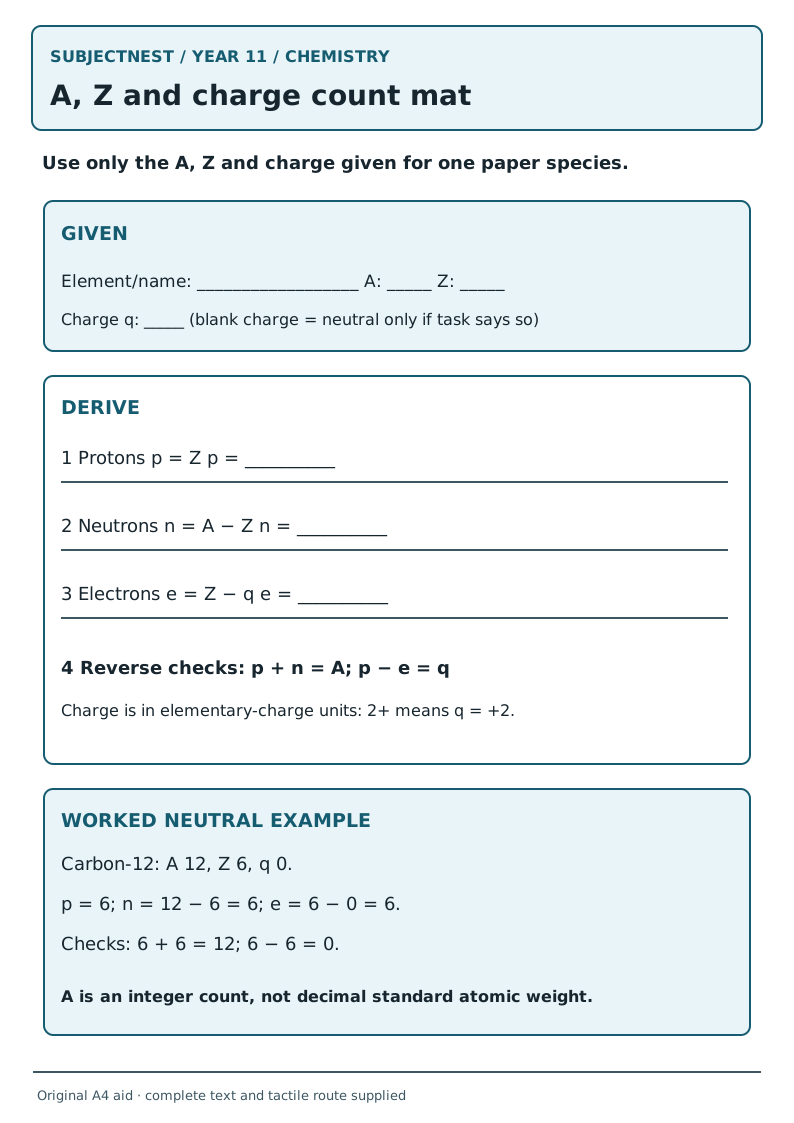
- Atomic number Z = number of protons. Find the element symbol from Z; changing protons means changing element.
- Mass number A = protons + neutrons for one nuclide; therefore neutrons = A − Z. A is a whole number, not the decimal standard atomic weight in a periodic-table tile.
- A neutral atom has electrons = protons = Z.
- A positive 1+ ion has lost one electron from that neutral atom; electrons = Z − 1. A 2+ ion has Z − 2 electrons.
- A negative 1− ion has gained one electron; electrons = Z + 1. A 2− ion has Z + 2 electrons.
- In these electron-only changes, proton and neutron counts, Z, A and isotope name stay fixed. Count = bookkeeping, not a claim about an actual reaction or a stable free ion.
Card C · how to read a nuclear symbol
Write A above Z to the left of the element symbol X: ^{A}_{Z}X in plain text, and put charge at the upper right if needed: ^{24}_{12}Mg^{2+}. Read the first as “magnesium-24, atomic number 12, charge two plus.” The accessible full-word alternative is always symbol/name, A, Z, charge. In this pack, a missing charge means a neutral atom by the task's explicit convention, not a claim that every printed isotope symbol in science implies an atom rather than a nuclide.
Card D · original comparison inventory
| Label for a fictional display | Symbol/name and given status | Count to derive |
|---|---|---|
| Recycled carbon-fibre exhibit | carbon-12, Z 6, neutral | p 6, n 6, e 6 |
| Archive paper-fibre exhibit | carbon-13, Z 6, neutral | p 6, n 7, e 6 |
| Wetland oxygen-label panel | oxygen-16, Z 8, neutral | p 8, n 8, e 8 |
| Coastal salt-ion card | chlorine-35, Z 17, 1− ion | p 17, n 18, e 18 |
| Bicycle-frame metal card | magnesium-24, Z 12, neutral | p 12, n 12, e 12 |
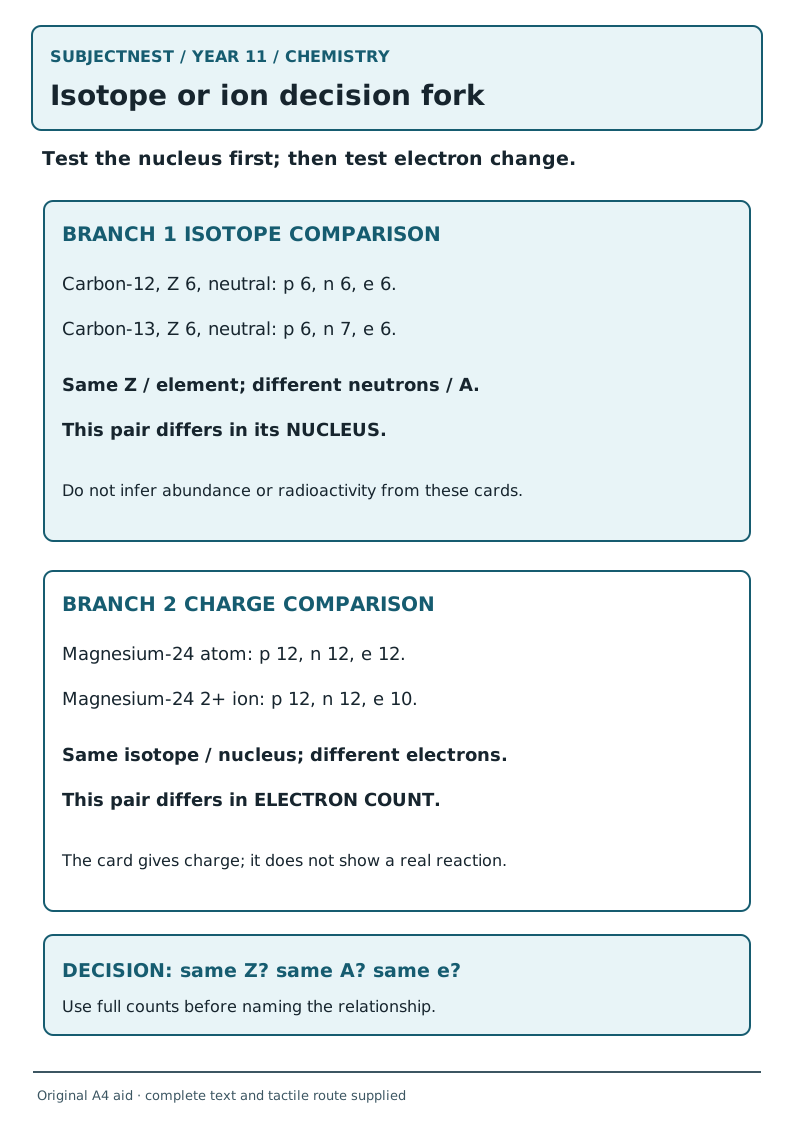
| Same isotope, charged model | magnesium-24, Z 12, 2+ ion | p 12, n 12, e 10 |
The context names are story labels only. They do not prove the composition, safety, manufacturing route or origin of a real fibre, wetland, salt or frame. The rows are not abundance data. For a quick classroom set use the count mat and isotope/ion fork.
Card E · same element, different isotope; same isotope, different charge
Carbon-12 and carbon-13 both have Z 6, so both are carbon; their neutron counts 6 and 7 differ, so they are isotopes. Neutral carbon atoms each have six electrons in this task. Magnesium-24 atom and magnesium-24 2+ ion both have 12 protons and 12 neutrons, so they are the same isotope; their electron counts 12 and 10 differ. Calling these two magnesium records “different isotopes” would mistake charge for a change in nucleus. A third example, chlorine-35 versus chlorine-37, has Z 17 and neutron counts 18 versus 20.
Card F · model claim discipline
given symbol/status → Z and A → proton/neutron/electron count → bounded claim. Do not infer isotope abundance from one sample card, a material's composition from a context label, safety from an element symbol, or real electron trajectories from a ring diagram. A correct count can still be paired with a false claim if it silently changes neutral to ion, uses a rounded decimal atomic weight for A or treats a story as a laboratory result.
SubjectNest original model cards © NeuroForgeIO Pty Ltd 2026, CC BY 4.0.