Every day uses 2 + 4 + 5 + 7 + 4 + 3 = 25 minutes. Prepare the model cards, clean learner pages, daily switchable routes, three original print aids and public teacher key. Seven minutes is an initial response window, not a speed criterion; add time locally. “Display,” “sample” and “file” below are fictional, paper-only contexts, never collected laboratory materials.
Day 1 · A ring model is a model
Target: describe the nucleus/electron energy-level model and state one limit of drawn rings. Prepare: Cards A/F and atom model mat.
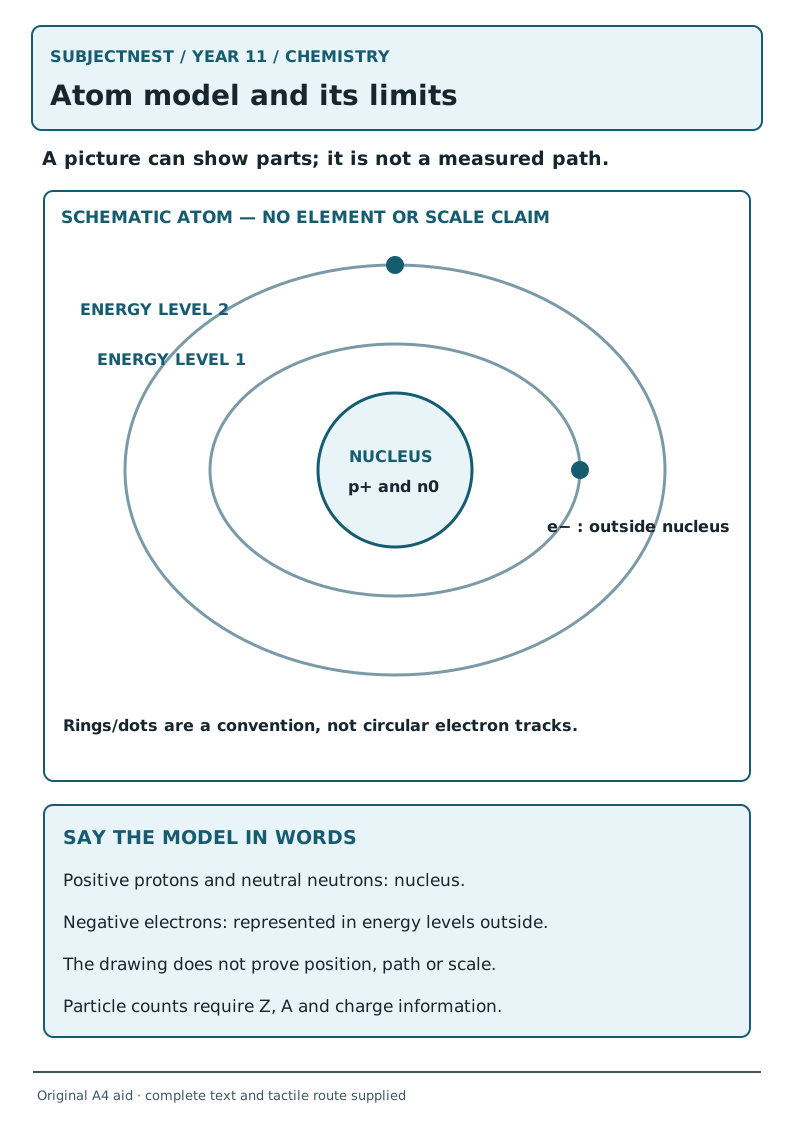
- Launch · 2 min. Show the mat's unlabelled circle/dot convention and ask what a line around a nucleus might mean; do not accept “literal track” as observation.
- Model · 4 min. Mark nucleus inside and electrons outside on a word diagram. Explain that distinct energy levels are the teaching representation; the rings are not measured paths.
- Guided reading · 5 min. Read Card A in pairs. Distinguish a proton's positive charge, neutron's zero and electron's negative charge; keep actual energy/orbital calculations outside this session.
- Practice route · 7 min. Choose Day 1 route. Annotate/build/explain a fictional museum atom model with the three particle locations/charges and one diagram limit.
- Audit · 4 min. Partner says “electrons drive around the drawn circle.” Learner replaces it with an appropriately bounded model statement.
- Exit · 3 min. “What is inside the nucleus?” Key: protons and neutrons in this model; electrons are represented outside at energy levels.
Day 2 · Z decides the element
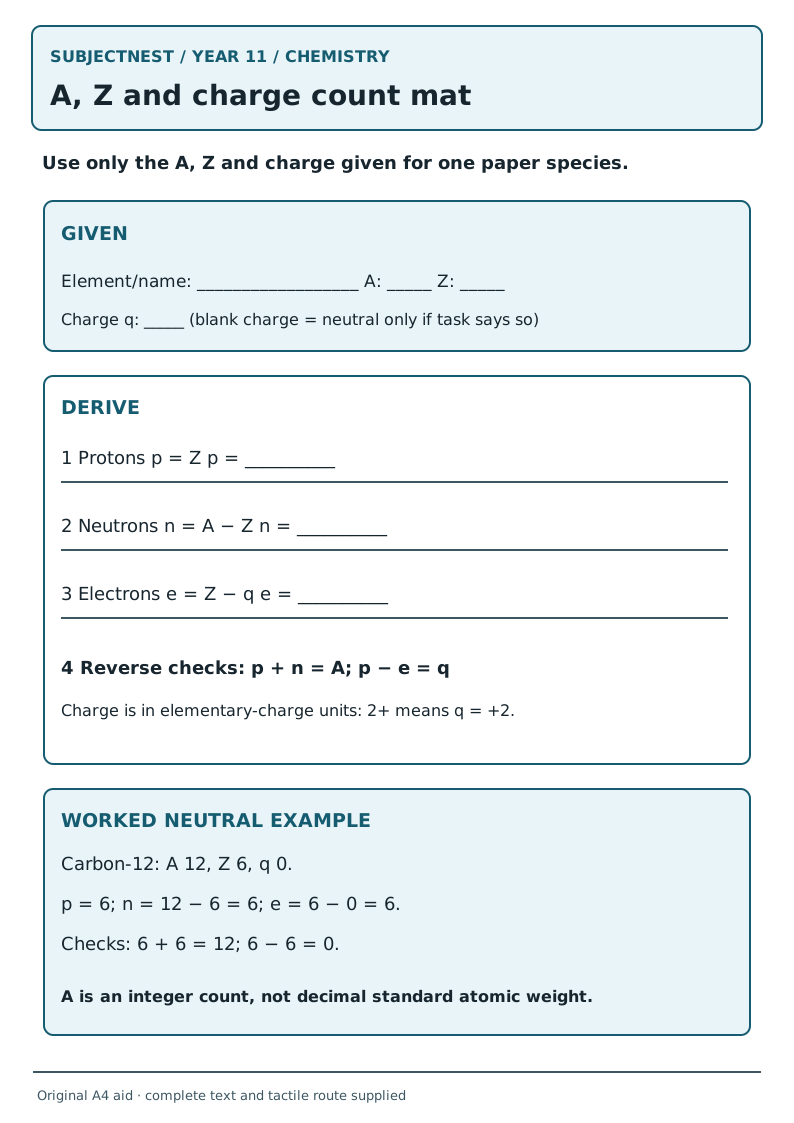
Target: use atomic number Z to find proton count and identify carbon Z 6, oxygen Z 8 and magnesium Z 12. Prepare: Cards B/D, count mat and the three given Z values; no full periodic table needed.
- Launch · 2 min. Put two anonymous paper tokens marked Z 6 and Z 8 on a recycling-display mock-up. Ask whether colour or proton count decides the element.
- Model · 4 min. Write
Z = protons; carbon Z 6 has six protons even if the display calls it fibre. Oxygen Z 8 has eight. - Guided reading · 5 min. Use the given symbol/Z pairs C 6, O 8, Mg 12. If proton count becomes 12 rather than 6, the element is magnesium, not a changed isotope of carbon.
- Practice route · 7 min. Choose Day 2 route; classify the three given labels by Z and explain why a story label is not chemical evidence.
- Audit · 4 min. Peer swaps the words carbon/oxygen while retaining Z; learner repairs by checking the source Z/symbol pair.
- Exit · 3 min. “A neutral atom has Z 6; how many protons?” Key: six; Z alone does not give neutrons.
Day 3 · A counts two nuclear particles
Target: calculate neutrons using A − Z and distinguish mass number from standard atomic weight. Prepare: Cards B/D, count mat; examples carbon-12 (A 12 Z 6), oxygen-16 (A 16 Z 8), magnesium-24 (A 24 Z 12).
- Launch · 2 min. Offer
A = protons + neutronsand ask which count must be known before subtraction. - Model · 4 min. Carbon-12: p 6, n 12 − 6 = 6. A is an integer count for this isotope, not a decimal average from a periodic-table tile.
- Guided reading · 5 min. Work oxygen-16: n 16 − 8 = 8. Let learners check by adding p + n = 16, then inspect magnesium-24 without supplying its answer.
- Practice route · 7 min. Choose Day 3 route; derive all three p/n counts and explain which number a rounded periodic weight cannot substitute for.
- Audit · 4 min. Partner proposes n = A + Z; learner tests carbon-12 and repairs with reverse-addition evidence.
- Exit · 3 min. “Magnesium-24 with Z 12: neutrons?” Key: 12; explain 12 + 12 = 24.
Day 4 · Isotopes share identity, not neutrons
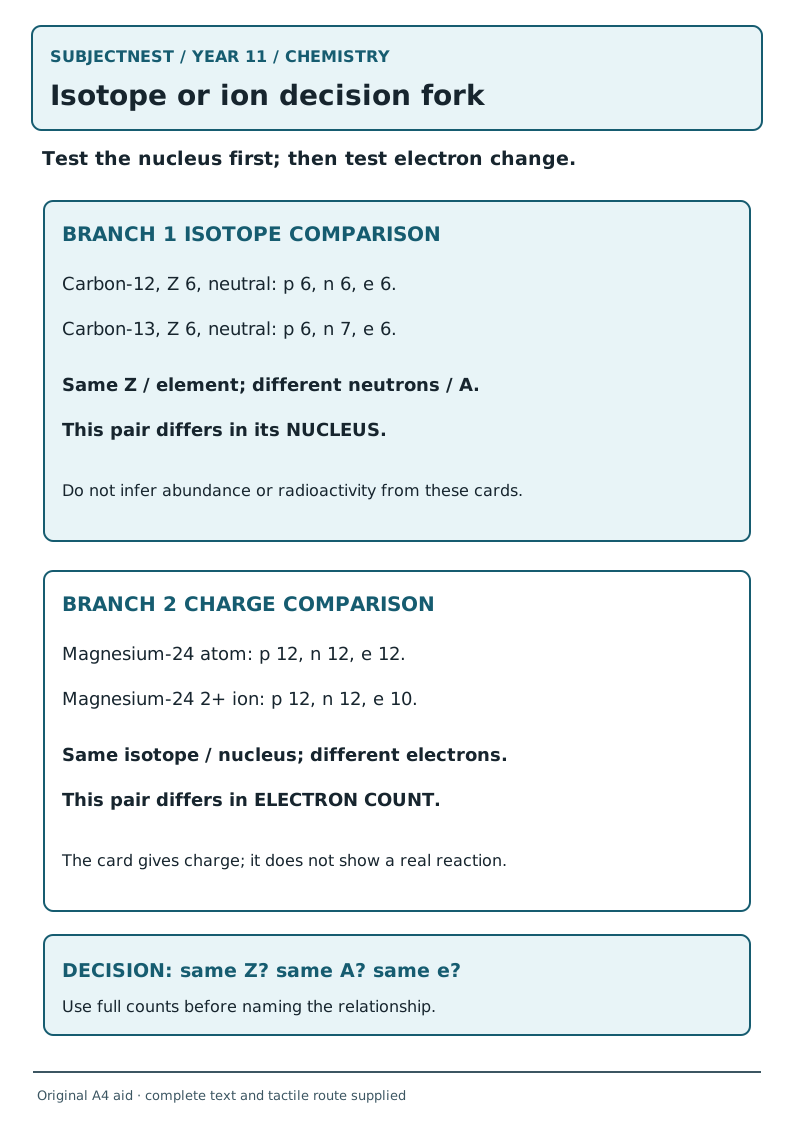
Target: compare neutral carbon-12/carbon-13 and chlorine-35/chlorine-37 by Z, A and neutron count. Prepare: Cards D/E and isotope/ion fork; give chlorine Z 17.
- Launch · 2 min. Ask whether carbon-13 must have more protons than carbon-12 because “13 is larger.”
- Model · 4 min. Same carbon Z 6 means six protons. Carbon-12 has 6 neutrons; carbon-13 has 7. Isotope difference is nuclear neutron count.
- Guided reading · 5 min. Contrast chlorine-35/37: both Z 17, neutrons 18/20. These are isotope names, not evidence of their natural abundance or chemical safety.
- Practice route · 7 min. Choose Day 4 route; compare both pairs using a shared-Z statement, two neutron calculations and a bounded conclusion.
- Audit · 4 min. Peer calls carbon-12 and magnesium-24 isotopes because both are “atoms”; learner repairs by testing Z.
- Exit · 3 min. “Which count differs within an isotope pair?” Key: neutron count (and A), while proton count/Z stays the same.
Day 5 · Public fresh check A: a new isotope archive
Target: independently transfer Z/A and isotope comparison to new Files R/S. The check and worked key are public, so it is formative only. Prepare: new case, neutral count mat, support log.
- Launch · 2 min. State the task: derive counts, compare two records, and refuse one unsupported claim.
- Source access · 4 min. Release Files R/S without the key; note read-aloud, scribing or other access support.
- Independent plan · 5 min. Learner marks each given Z/A/status, identifies the subtraction, and notes one claim the files cannot prove.
- Independent response · 7 min. Choose Day 5 route and capture a first response; do not supply worked counts during this window.
- Self-audit · 4 min. Learner checks
p+n=A, neutrale=pand same-Z isotope reasoning. - Submit · 3 min. Collect first response/support log; consult the public key for the next teaching move.
Day 6 · Read a nuclear symbol without guessing mass
Target: read/write the left A-over-Z symbol as full words and derive a neutral magnesium-26 and sodium-23 count. Prepare: Card C and count mat; give Mg Z 12 and Na Z 11.
- Launch · 2 min. Show
^{26}_{12}Mgbeside “magnesium-26, Z 12, neutral.” Ask which is isotope mass number versus element identifier. - Model · 4 min. Translate top-left A 26 and bottom-left Z 12; p 12, n 14, neutral e 12. The written convention is a model/notation, not a physical picture.
- Guided reading · 5 min. Read
^{23}_{11}Naas sodium-23, Z 11, neutral for this task. Derive p 11, n 12, e 11. Model an accessible spoken sequence: “name, A, Z, charge.” - Practice route · 7 min. Choose Day 6 route; translate both symbols in both directions and check derived counts.
- Audit · 4 min. Partner reads 26 as number of protons. Learner identifies position and verifies n = 26 − 12.
- Exit · 3 min. “Where does A sit in nuclear notation?” Key: upper left of X; Z lower left.
Day 7 · A positive ion has fewer electrons
Target: keep the nucleus fixed while finding electron counts for sodium-23 1+ and magnesium-24 2+. Prepare: Cards B/C/D, count mat and isotope/ion fork.
- Launch · 2 min. Place two paper cards “neutral sodium-23” and “sodium-23 1+.” Ask what changed if the isotope name stayed fixed.
- Model · 4 min. Sodium Z 11: neutral e 11; 1+ has e 10. Protons remain 11, neutrons 23 − 11 = 12. One electron lost produces net positive charge.
- Guided reading · 5 min. Magnesium-24 Z 12: neutral e 12; 2+ has e 10, while p/n remain 12/12. Do not teach a mechanism for a real reaction from this count alone.
- Practice route · 7 min. Choose Day 7 route; compare both neutral-to-ion pairs and state what stayed fixed.
- Audit · 4 min. Peer subtracts one proton to make 1+. Learner corrects: electron loss changes charge, proton loss changes element.
- Exit · 3 min. “Magnesium-24 2+: electrons?” Key: 10, with 12 protons and 12 neutrons.
Day 8 · A negative ion has more electrons
Target: calculate electron gain for chlorine-35 1− and oxygen-16 2−, preserving A/Z. Prepare: Cards B/D and count mat; O Z 8, Cl Z 17.
- Launch · 2 min. Compare neutral chlorine-35 with a 1− card. Ask whether adding one electron changes its isotope name.
- Model · 4 min. Chlorine-35: p 17, n 18, neutral e 17; 1− e 18. Addition of an electron leaves A 35 and Z 17 fixed.
- Guided reading · 5 min. Oxygen-16 2−: p 8, n 8, e 10. Use charge as a check: eight positive protons against ten negative electrons gives net 2−.
- Practice route · 7 min. Choose Day 8 route; derive both full count triples, then describe electron gain with a qualifier that this is a paper species card.
- Audit · 4 min. Peer uses 2− as “lose two neutrons”; learner repairs with p/n/e and charge bookkeeping.
- Exit · 3 min. “What stayed the same from neutral oxygen-16 to its 2− ion?” Key: p 8, n 8, Z 8, A 16 and element/isotope name.
Day 9 · Catch four attractive wrong claims
Target: detect and correct isotope, ion, notation and evidence errors across new story labels. Prepare: Cards B/C/E/F and isotope/ion fork.
- Launch · 2 min. Show “A plus sign means add a proton.” Ask learners to reserve judgement until they check the model rule.
- Model · 4 min. Correct to “for a monoatomic 1+ ion of the same isotope, one electron has been lost.” Explicitly state that an actual process cannot be inferred from a printed symbol alone.
- Guided reading · 5 min. Audit three more statements: “C-12 and C-13 are different elements,” “23 on sodium is its atomic number,” and “a material label proves purity.” Mark rule or evidence source for each repair.
- Practice route · 7 min. Choose Day 9 route; produce four corrected claim/evidence/limit triples. Use a fictional bicycle-parts catalogue label as a story, not a product specification.
- Audit · 4 min. Partner checks each correction against
Z→identity,A−Z→n, andcharge→ewhile watching for unsupported product inference. - Exit · 3 min. “What extra information is required to know neutron count from Z alone?” Key: A of a particular isotope.
Day 10 · Public fresh check B: two new charged species cards
Target: independently transfer nuclear-symbol, isotope and charge bookkeeping to new Files T/U. Both prompt and key are public. Prepare: new case, blank count mat and support log.
- Launch · 2 min. State task: derive p/n/e twice, read status from the symbol, and explain one distinction and one limit.
- Source access · 4 min. Release T/U without the key; record any reading/communication support.
- Independent plan · 5 min. Learner marks left A/Z and right charge separately; calculates n = A − Z and electron change.
- Independent response · 7 min. Choose Day 10 route; capture first work before feedback. More time can follow for instruction.
- Self-audit · 4 min. Learner checks p+n=A and p−e=charge for each record; avoid any real safety inference.
- Submit · 3 min. Retain first response/support record, then use public key for targeted next move. No QCAA unit grade follows.
SubjectNest original teacher scripts © NeuroForgeIO Pty Ltd 2026, CC BY 4.0.