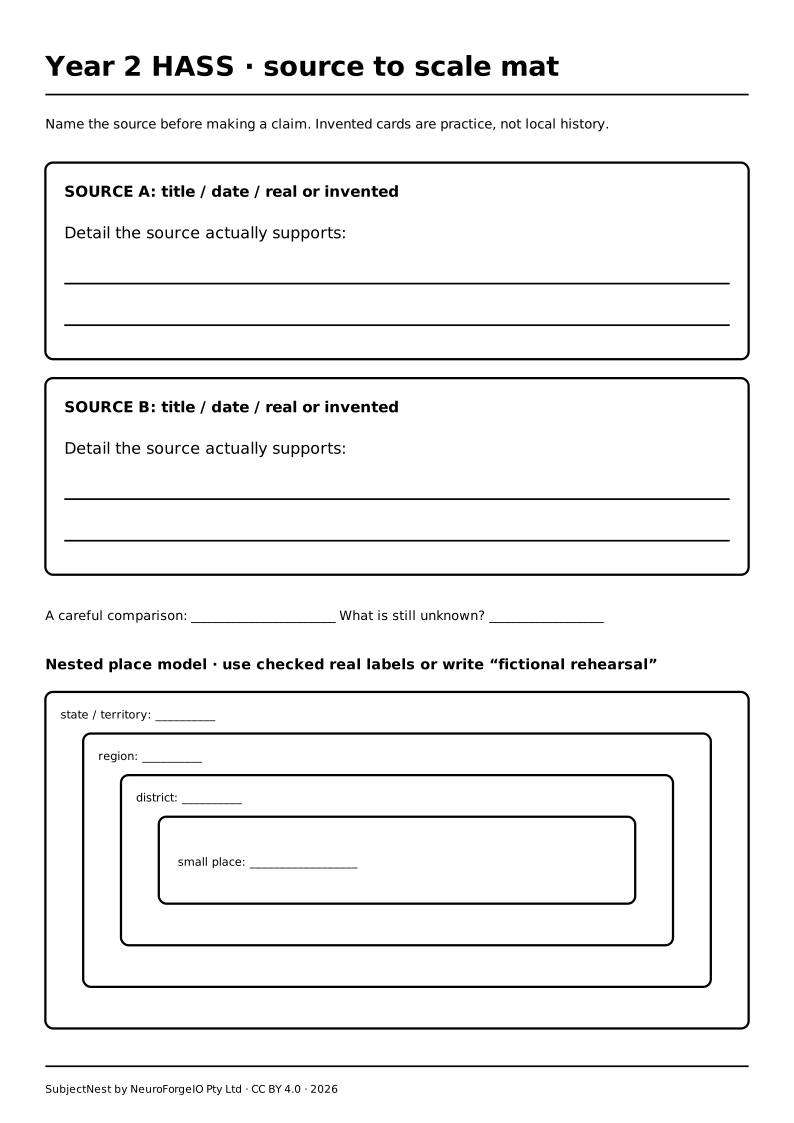
Your own family, devices, home, route and beliefs are never needed. An adult can read every card. You may point, sign, use AAC, draw, type or dictate. Write whether a sentence came from a museum, a class demonstration, an invented practice card or a source still to be checked. Use the blank source-to-scale mat or text route. The answers are on a separate teacher page.
Day 1 · Museum note
Real source, paraphrased: The National Museum of Australia typewriter page explains that a typewriter pressed letters directly onto paper. Its teaching material contrasts this with editing on a computer, including the computer's undo action. This note describes a tool; it does not say who owned one in your family or town.
What could a typewriter key do? Name the source. Ask one question about correcting a mistake.
Day 2 · Two ways to edit
Museum note: a typewriter placed letters directly on paper. Current-tool description: in a word processor, a writer can change text before printing. Your teacher may also show a current document on an approved device.
Write or show: “The museum says . The current description or demonstration shows .” What aim do both tools have?
Day 3 · Invented voices
Invented Jori: “I value a physical copy I can hand to someone.” Invented Mara: “I value changing a word before I print.” These are made-up speakers, not real historical witnesses.
Match each reason to a speaker. What else might a worker need? What can these two voices not prove?
Day 4 · Four claims
Sort each under supported by museum note / needs another source / invented voice:
- A. A typewriter could print letters directly on paper.
- B. Every Australian household owned a typewriter.
- C. Invented Mara values changing a word before printing.
- D. A real worker in our town used this exact model.
Choose one claim to rewrite more carefully.
Day 5 · New source pair
Source 1: the Day 1 museum note about direct marks on paper. Source 2: your teacher's current classroom document demonstration, if available. Otherwise Source 2 is this printed description: “A writer can edit words in a word processor before printing.”
Tell a short first/now account about correcting a word in these two examples. Name both sources. What cannot be concluded about all workers?
Day 6 · Invented nesting map
This is a made-up map model: a parcel desk is inside Lumo district; Lumo is inside Weri region; Weri is inside Tava state. These are invented names and make no claim about a real Australian place.
Draw four nested boxes, smallest to largest. Put a dot for the desk. What detail might a map of a larger area leave out? What real source would you need for your school area?
Day 7 · Real-source or rehearsal mat
Your teacher may supply an approved map with a title, date and public, safe labels. If so, record its title/date, one small place and its larger region and state or territory. If no map is supplied, use the Day 6 fictional boxes and write rehearsal only. Never mark your home.
Day 8 · Invented parcel route
In a made-up service, a parcel token moves from a desk in Lumo district → a sorting point in Weri region → a desk in another invented district. The arrow does not tell us distance, time, cost or the real route.
Trace the arrows. Name one question a sender might ask and one a receiver might ask. What information is missing?
Day 9 · Invented visitor comments
Visitor A, invented: “The label could be easier for me to find.” Visitor B, invented: “I would like a quieter waiting place.” Choose one small improvement for this imaginary parcel desk. Which comment supports it? What would you need to check before making a real change?
Day 10 · Source-aware inquiry plan
Teacher-approved real public source, if supplied: title/date: _. Otherwise write source to seek. My question about a place or service: _. One respectful next source or observation: _. What I cannot yet claim: _. No private place, family account or community-held story is required.
Original invented notes, map names and cards © NeuroForgeIO Pty Ltd 2026, CC BY 4.0. Museum information is paraphrased and linked, with no copied image or video.