Use: Five short respectful-relationship/permission blocks and five fair-movement blocks. Each is notice 2 + try 7 + show 3 minutes. Give learner cards and the original ask–choose–move mat or text equivalent; keep keys/next moves private. These are partial band links, not a physical-education program or a safeguarding lesson replacement. Follow school child-safety, space, supervision and individual access plans. Never invite disclosure of a real unsafe experience in a group.
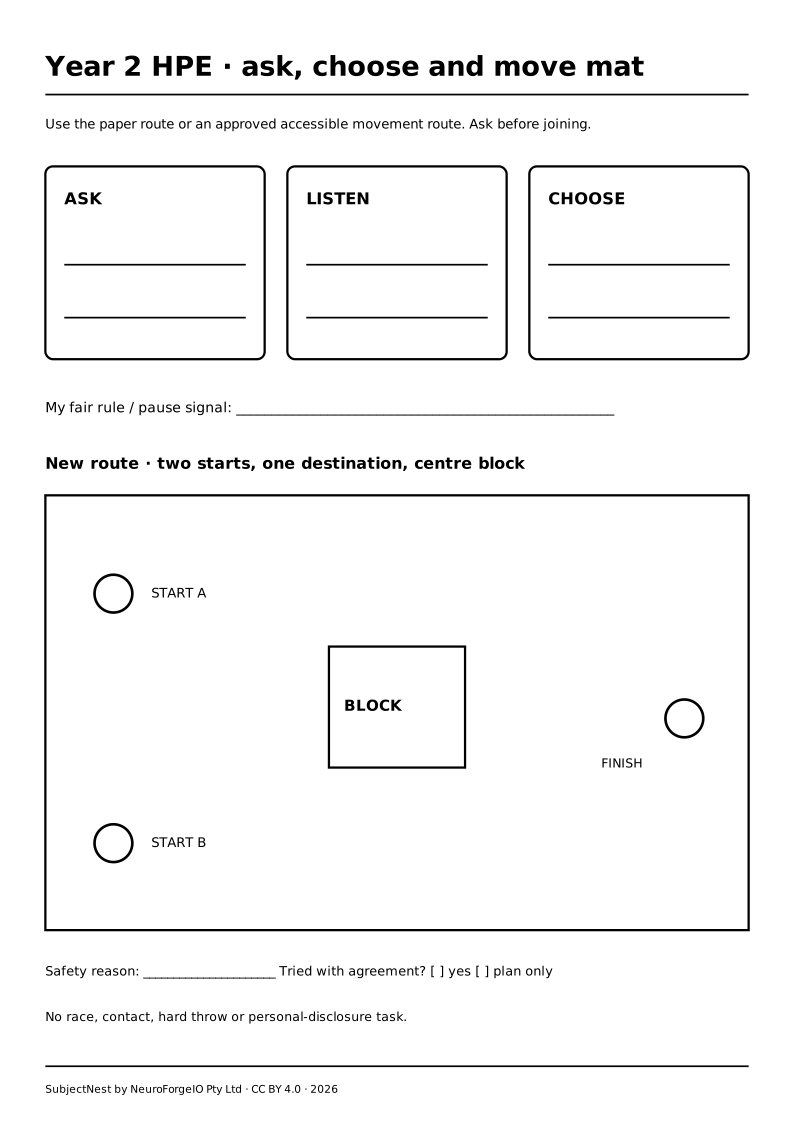
Week 1 domains: sharing a classroom game, choosing a partner, borrowing a prop, asking for help and a new queue scenario. Week 2 domains: a cooperative delivery route, a soft target, turn rules and inclusion. Use a level, approved space; no races, contact, blindfolds, thrown hard objects, public body comparison or required touch. A tabletop token or paper route is a full reasoning route, but does not demonstrate physical movement skills. Learners may stand, roll, move seated, gesture, use assistive equipment, point, sign, use AAC or direct an adult; record the actual action, choice and support. Respect a learner's “no” to an optional activity. Codes and conditional evidence are in the crosswalk.
Day 1 — An invitation leaves a choice
Codes: AC9HP2P02, AC9HP2P04. Prepare: invented two-person game card.
- Notice · 2 min. Say, “In our made-up game, Ari asks Bo to join. Bo may say yes, no or later.” Model a calm invitation once.
- Try · 7 min. With puppets or name cards, learners practise ask once → listen → accept the answer. Swap who invites. If the answer is no, choose a different game or partner without demanding a reason.
- Show · 3 min. Child gives one respectful invitation and one response to a refusal. Record the script, not willingness to join.
Home/low-material: Move two name scraps; one person can voice both fictional roles.
Day 2 — Feelings can differ in the same scene
Codes: AC9HP2P03, AC9HP2P02. Prepare: invented game-space scene and feeling word choices.
- Notice · 2 min. “A noisy game starts nearby. Could two people feel differently?” Do not ask children to reveal their own reactions.
- Try · 7 min. Children choose two possible responses for invented players—interested, unsure, annoyed or calm—and a respectful check-in such as “Would you like a quieter space?” No emotion is assigned from someone's face alone.
- Show · 3 min. Child names the situation, two possible feelings and one way to ask rather than assume.
Home/low-material: Read the scene and point to two words; no personal story.
Day 3 — Borrowing a game prop
Codes: AC9HP2P04. Prepare: a paper disc as imaginary prop.
- Notice · 2 min. Ask, “Could Jo take Sam's game disc without asking?” Keep it fictional.
- Try · 7 min. Practise “May I use it?” with possible yes, not now and no. Model “Okay, I will choose another prop” and “I changed my mind; please give it back.” Children may use AAC or point to script cards.
- Show · 3 min. Child demonstrates asking, receiving/denying permission and respecting a changed answer.
Home/low-material: Draw a disc; no real possession needs to change hands.
Day 4 — Get help when a game space feels unsafe
Codes: AC9HP2P05. Prepare: invented blocked-path scenario and school-approved helper roles.
- Notice · 2 min. “A fictional child sees a loose box blocking the play route. What can they do before moving?” No child needs to describe a personal hazard.
- Try · 7 min. Practise stop in a safe place → move away if possible → tell a trusted, available adult using a clear message. Use the school's actual help process; do not name a stranger or assume one adult is always available.
- Show · 3 min. Child says/points “The path is blocked. I need help,” then names the next approved helper if the first is unavailable.
Home/low-material: Draw the blocked route and helper choices; no real obstacle required.
Day 5 — Fresh permission and help choice
Codes: AC9HP2P02, AC9HP2P04, AC9HP2P05. Prepare: new fictional two-part Card 5 and separate key.
- Notice · 2 min. Read: “Mia wants to join a paper-target game. Ren says not today. A marker then rolls into a busy path.” Keep both parts imaginary.
- Try · 7 min. Child independently chooses a respectful response to Ren and a safe response to the marker, including help if needed. Do not prompt with the answer.
- Show · 3 min. Collect exact words or selections. Never turn the scenario into a personal-disclosure question.
Home/low-material: Adult reads the two sentences; no game or marker needed.
Day 6 — Two routes, one safe destination
Codes: AC9HP2M01, AC9HP2M02 for observed accessible movement. Prepare: approved clear route with two wide turns, or tabletop path.
- Notice · 2 min. Ask which route has a wider turn and what needs checking before moving. Review stop signal and personal space.
- Try · 7 min. Learner chooses a safe walking, rolling or seated upper-body path and tries two approved routes, or directs a tabletop token. Ask which route was easier for this attempt and why. No timer or comparison of bodies.
- Show · 3 min. Child explains one adjustment. Record movement evidence only when bodily movement actually occurred; paper route shows planning.
Home/low-material: Finger or token on paper, with no exercise requirement.
Day 7 — Slide a soft disc to a zone
Codes: AC9HP2M01, AC9HP2M02 for observed action. Prepare: soft paper disc, two floor/table zones, clear space.
- Notice · 2 min. “A near zone and far zone are both empty. How might you change a gentle slide?” No disc is aimed at a person.
- Try · 7 min. From an agreed starting mark, child slides or directs a soft disc toward each zone. Change direction or effort one at a time; compare only their own attempts. A partner may place or retrieve under the learner's direction.
- Show · 3 min. Child names the changed action and actual result, including misses. Avoid “harder always goes farther” from one attempt.
Home/low-material: Paper circle and two marks on a table; optional motor participation.
Day 8 — Make a fair turn rule
Codes: AC9HP2M04, AC9HP2M05 when a rule is actually tried with another participant. Prepare: fictional two-player delivery game and paper disc.
- Notice · 2 min. “Two players need to deliver one token to a zone. Who gets to choose a route or take a turn?”
- Try · 7 min. Group co-writes a rule such as one turn each; either player can request a pause; change the route if blocked. Try it with two willing participants or a child directing an adult. Revise if a player cannot take part.
- Show · 3 min. Child states the rule, an actual turn it changed and one revision. A solo paper plan is preparatory, not observed collaboration.
Home/low-material: Two people move a paper disc in turns; solo learner may plan without collaboration claim.
Day 9 — Change the game so more people can join
Codes: AC9HP2M04, AC9HP2M05. Prepare: Card 9 invented game with a narrow route and fixed turn speed.
- Notice · 2 min. Ask what might make this fictional game hard for some players; never name a classmate as the problem.
- Try · 7 min. Pairs propose two adjustable rules—e.g. wider route, no speed limit, choice of slide/direct/gesture—and try at least one with consent. Ask both participants whether the rule helped them take part; no child speaks for a whole group.
- Show · 3 min. Child names a tested adjustment and the feedback received, or labels it untested plan.
Home/low-material: Widen a pencil path on paper; actual collaboration needs a willing partner.
Day 10 — New cooperative route check
Codes: AC9HP2M01, AC9HP2M02, AC9HP2M04, AC9HP2M05 only for the elements actually observed. Prepare: Card 10 unfamiliar route, clear approved space or paper mat, key.
- Notice · 2 min. Show two starting positions, a blocked centre and a destination. Ask the child to plan before any movement.
- Try · 7 min. Learner chooses an accessible route, object action and fair partner rule, then tries it if safe and agreed. A paper-only choice is valid planning evidence; it does not prove movement or collaboration.
- Show · 3 min. Collect one safety reason, one actual/untested result and a fair-rule reason before teacher feedback.
Home/low-material: Use pencil tokens and a willing adult; no obstacle course, ball or purchase.
Original SubjectNest HPE scenarios and prose © NeuroForgeIO Pty Ltd 2026, CC BY 4.0.