Read teacher materials, lay out counters, bundled tens/hundreds and place-value mat, then use the numbered day. Every lesson follows 2 + 5 + 6 + 7 + 3 + 2 = 25 minutes. The exit is a whole-class attempt while you watch 2–3 named focus learners; rotate the roster. A copied group response is not independent evidence. Record a route, prompt and exact child action in the assessment sheet. A calculator is not needed for these opening models. Codes are partial teaching links to Year 2 ACARA v9, not achievement claims.
Day 1 — A number has places
Codes: AC9M2N01, AC9M2N02. Goal: represent 134 as one hundred, three tens and four ones. Prepare: bundled paper strips/sticks, 134 card, mat; use 234 as an extension.
- Invite · 2 min. Say: “A number can tell us how many objects, even when counting them one by one would take a long time. How might we pack 134?” Allow a guess without correction yet.
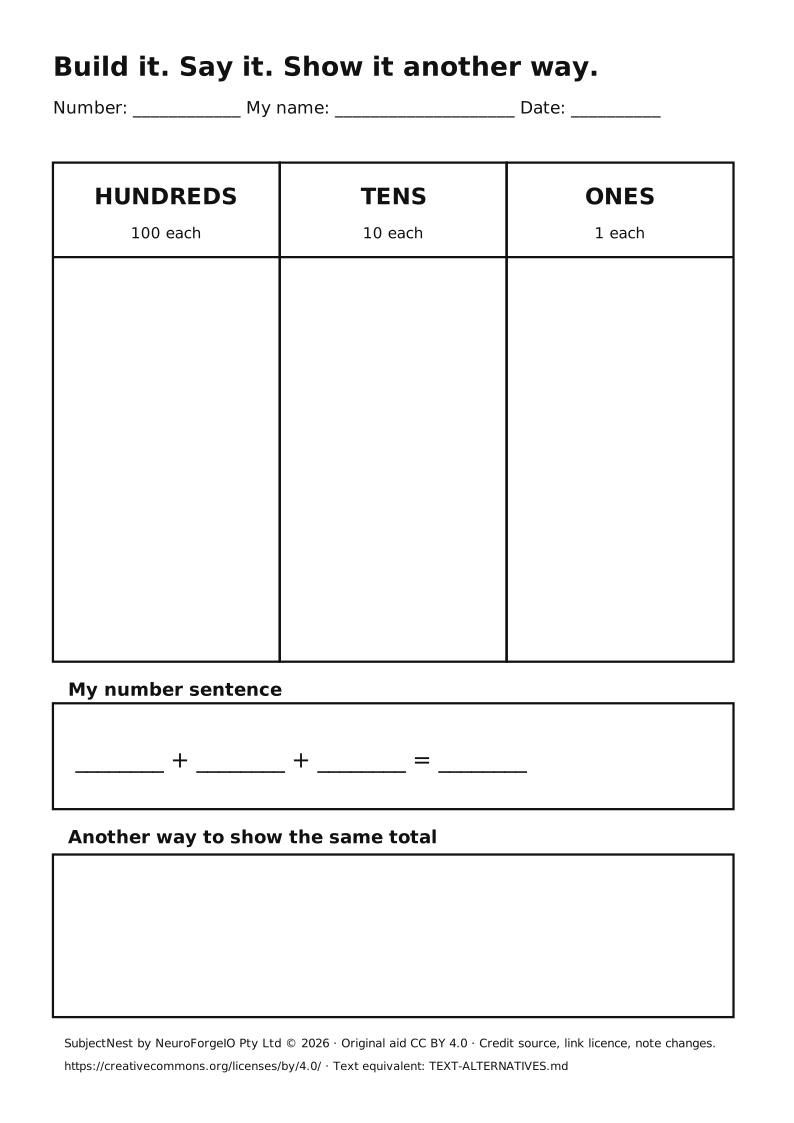
- Model · 5 min. Put one hundred-sheet, three ten-strips and four single counters in the three columns. Say: “One hundred is 100. Three tens are 30. Four ones are 4. Together they are 134.” Point to each digit as it names a place; read “one hundred and thirty-four.”
- Guided build · 6 min. Together rebuild as 142, then ask: “Which part changed?” Place one hundred, four ten-strips and two singles; show
100 + 40 + 2. Ask a learner to point to the digit that tells the tens. - Partner make and check · 7 min. Give partners 123 and 205 on separate cards. One builds; the other reads and checks by counting bundles. For 205, leave the tens column empty and say: “Zero tens matters; 25 would mean something else.” Swap roles. Offer 234 to a pair ready for it.
- Everyday link · 3 min. Say: “A library box has 1 full hundred-pack, 2 ten-packs and 3 single bookmarks. How many?” Let children show 123 with objects, sketch or numeral; ask where the number comes from.
- Check · 2 min. Everyone shows 205. Closely watch planned focus learners explain what the zero tells us. If the hundred or zero disappears, next lesson rebuild 205 and 25 side by side.
Access routes: physical bundles, raised/large digit cards, place labels as text as well as shape, speech/AAC/pointing. Keep the quantity and place goal even when an adult handles pieces.
Day 2 — The zero keeps a place
Codes: AC9M2N01, AC9M2N02. Goal: distinguish 206, 260 and 26; rename one hundred as ten tens. Prepare: mat, number cards, 10 ten-strips that can become a hundred-sheet.
- Invite · 2 min. Show
206and26. Say: “They use the same 2 and 6. What does the zero do?” Collect two hypotheses. - Model · 5 min. Build 206: 2 hundreds, no tens, 6 ones. Then build 26: no hundreds, 2 tens, 6 ones. Say: “The empty tens place in 206 cannot just vanish.” Contrast 260 with 2 hundreds, 6 tens, no ones.
- Guided rename · 6 min. Exchange one hundred-sheet for ten ten-strips without changing quantity. Say: “206 is 2 hundreds, 0 tens, 6 ones. It can also be 1 hundred, 10 tens, 6 ones.” Count the tens together; record
2 × 100 + 6 = 100 + 10 × 10 + 6. Ask what stayed the same. - Sort and explain · 7 min. In pairs match the cards
206, 260, 26to three builds. One explains the zero position; partner checks with place labels. Add a non-standard challenge: make 260 as 26 tens. - Use it · 3 min. Read a “supply cabinet” note: “2 hundreds, 6 tens, 0 singles.” Children write/select 260 and explain why it cannot be 206.
- Check · 2 min. Everyone selects the build for 206 among two. Focus learners identify the empty column. If confusion remains, revisit place labels before bigger numbers.
Access routes: clear text labels; tactile empty-column marker; wide-spaced numerals; adult moves groups on instruction. Do not use colour alone to encode place.
Day 3 — Which number is farther along?
Codes: AC9M2N01, AC9M2N02. Goal: compare and order three-digit numbers using place value and a number line. Prepare: cards 318, 381, 308, 329 and a long blank strip marked 300 and 400.
- Invite · 2 min. Ask: “Which is larger, 318 or 381? Tell me why without counting to either one.”
- Model · 5 min. Align 318 and 381 in the mat. Say: “Both have 3 hundreds. Now I compare tens: 1 ten versus 8 tens. So 381 is larger.” Put 318 near 300 and 381 nearer 400 on the strip; placements are approximate within the interval.
- Guided compare · 6 min. Compare 318 and 308. Name equal hundreds, then 1 ten versus 0 tens. Ask learners to put 329 between 318 and 381; have them justify tens and ones.
- Partner order · 7 min. Pairs arrange
308, 318, 329, 381from least to greatest and place them on the number strip. One reads the order, another points to the first different digit in each neighbour comparison. Reorder the cards and repeat without copying. - Life example · 3 min. “The class has counted 329 recycled sheets; another class counted 318. Which stack count is greater, and by how many? Today explain which and why; the difference can wait.” Do not imply a count was actually collected.
- Check · 2 min. Everyone circles the larger of 309 and 390 and points to the deciding place. Focus learners explain. If ones dominate their choice, rebuild both and compare tens first.
Access routes: floor-sized number strip, desk strip, tactile tick marks or spoken ordered choices. Position alone is not the only proof; ask for place-value reasoning.
Day 4 — Same amount, another grouping
Codes: AC9M2N02, AC9M2A01. Goal: rename 134 in standard and non-standard groups, then extend a +10 pattern. Prepare: exchangeable bundles and cards 134, 144, 154, __, 174.
- Invite · 2 min. Build 134 and ask: “Could it still be 134 if I open the hundred bundle?”
- Model · 5 min. Exchange 1 hundred for 10 tens: now 13 tens and 4 ones. Say: “The pieces changed; the count did not.” Record
1H 3T 4O = 13T 4O; count 130 + 4. Explain that 13 tens is a useful non-standard grouping. - Guided exchanges · 6 min. Make 120, exchange its hundred, and have learners say 12 tens. Return to 134; exchange one ten for ten ones to show
1H 2T 14O. Ask how to check the total with objects and a number sentence. - Pattern task · 7 min. Display
134, 144, 154, __, 174. Say: “Tell the rule in words before filling the gap.” Learners add a ten-strip at each step, predict 164 and explain why ones stay 4. Try the reverse pattern174, 164, __. - Use it · 3 min. “A stationery box has 13 packets of 10 and 4 loose pencils. What number?” Learners model or sketch 134; this is a fictional counting context.
- Check · 2 min. Everyone completes
205, 215, __and shows the grouping for 225. Focus learners name what increased. If they write 216, repeat with ten-strips.
Access routes: pre-bundled pieces, partner handling, calculator-free verbal reasoning, high-contrast labels and non-motor response. Keep addition of 10 distinct from adding 1.
Day 5 — Explain a place-value choice
Codes: AC9M2N01, AC9M2N02, AC9M2A01. Goal: show and justify a three-digit number and choose a next practice step. Prepare: check A, mat, cards.
- Set purpose · 2 min. Say: “Show how you know, not just your answer. I will use your example to choose our next lesson.”
- Warm model · 5 min. Build 241 together and name 2 hundreds, 4 tens, 1 one. Make clear this is rehearsal; the check numbers below are new.
- Station A · 6 min. Everyone represents 306 with objects, sketch or digits on the mat. Ask: “What does zero mean here?” Observe 2–3 focus learners privately while others compare their model with a partner.
- Station B · 7 min. Learners order 317, 371, 307 and complete
317, 327, __, 347. Ask partners to justify; independently sample focus learners at a quiet station or later in the day. Avoid scoring a child from a partner's explanation. - Feedback · 3 min. Offer task-based feedback: “Your hundreds matched. Let's check the tens column in 307.” Invite one correction and record the prompt used.
- Close · 2 min. Children choose the model that helped. Record
secure today / after prompt / not yet observedper prompt, then use next moves.
Access routes: oral explanation, AAC, tactile/place cards, a private check or adult scribe. Keep a learner's own reasoning separate from a group display.
Day 6 — One fact, three relatives
Codes: AC9M2A02, AC9M2N04. Goal: use a known addition fact within 20 to derive related subtraction facts. Prepare: 20 counters and part-part-whole circles.
- Invite · 2 min. Show 8 blue and 5 plain counters. Ask: “How many altogether? How could knowing the total help if some are hidden?”
- Model · 5 min. Move 8 and 5 into a total circle. Count on from 8: 9, 10, 11, 12, 13. Write
8 + 5 = 13, then cover the 5:13 − 8 = 5. Say: “The same 13 counters make both true.” - Guided family · 6 min. With counters show
6 + 7 = 13,7 + 6 = 13,13 − 6 = 7,13 − 7 = 6. Ask which quantity stays whole and which two are parts. Correct the misconception that subtraction always means physically losing objects. - Partner build · 7 min. Pairs choose parts 9 and 4, build 13, and write/tell four related sentences. Swap to 10 and 6 if ready. One partner checks by rebuilding, not by simply agreeing.
- Use it · 3 min. “There were 13 pencils in a pot. Nine are on desks. How many remain in the pot?” Draw all 13 in two parts; answer 4, if the stated total is trusted.
- Check · 2 min. Everyone fills
7 + 5 = 12; 12 − 7 = __and shows the part. Focus learners explain. If they count from zero, next session rehearse count-on or part circles.
Access routes: tactile counters, enlarged sentence strip, speech/AAC, written numbers or object selection. Exact written notation can follow a correct concrete explanation.
Day 7 — Make ten before you add
Codes: AC9M2N04, AC9M2A02. Goal: solve 28 + 5 using a ten bridge and explain the split. Prepare: 10-frame, two ten-strips and ones.
- Invite · 2 min. Say: “28 is close to a new ten. How many ones fill it?” Invite finger/counter answers.
- Model · 5 min. Make 28 as 2 tens and 8 ones. Move 2 of the 5 new ones to complete 30; 3 remain. Say and write
28 + 5 = 28 + 2 + 3 = 33. Point out 5 was split into 2 and 3, not doubled. - Guided example · 6 min. Solve 47 + 6 together: 47 needs 3 to reach 50; 3 remain; answer 53. Learners show the split with fingers or counters and say why both parts total 6.
- Partner attempts · 7 min. Try 36 + 7 and 59 + 4. One partner builds/marks tens, the other explains and checks by counting on or reversing with subtraction. Answers: 43 and 63. If a learner is still learning facts to 20, use 8 + 5 first with the same bridge.
- Context · 3 min. “A shelf has 28 paper sheets and gets 5 more. What does 33 mean?” Learners state the unit and check whether 33 is reasonable.
- Check · 2 min. Everyone solves 18 + 4 with a marked split. Focus learners show
2 + 2, total 22. If a learner writes 14, rebuild 18 before asking them to explain.
Access routes: ten-frame and paper groups, high-contrast split marks, enlarged numerals, AAC explanation or adult scribe. Do not require mental speed as the only evidence of strategy.
Day 8 — Subtraction can use the missing part
Codes: AC9M2N04, AC9M2A02. Goal: solve a two-digit subtraction with part-part-whole reasoning. Prepare: 42 counters in bundles, part circles, number line.
- Invite · 2 min. Ask: “42 counters were packed. 17 are used. How many are still packed? Could an addition fact help?”
- Model · 5 min. Show 42 as 4 tens and 2 ones. To remove 17, exchange one ten for ten ones; remove 7 ones and 1 ten. Three tens become two tens, five ones remain: 25. Check
25 + 17 = 42by making 10 from 5 + 7 and the tens. Name the exchange, not “borrowing.” - Guided missing part · 6 min. Place 42 in the whole circle, 17 in one part, blank in the other. Count from 17 to 20 (3), 20 to 40 (20), 40 to 42 (2); total jump 25. Match both models.
- Partner practice · 7 min. Solve 34 − 8 and 53 − 21. Offer objects or a number line. Partners check by adding the answer back: 26 + 8 = 34; 32 + 21 = 53. Ask which model they trust and why.
- Context · 3 min. “There are 53 library labels; 21 have been used. How many remain?” Learners say 32 labels, not just “32”.
- Check · 2 min. Everyone solves 31 − 6 using objects/line and writes or says the checking addition
25 + 6 = 31. Sample focus learners. If exchange is uncertain, return to 3 tens/1 one with actual pieces.
Access routes: tactile bundles, movable number line, oral/AAC part names, adult moves pieces at learner direction. Record strategy separately from notation.
Day 9 — Model a useful problem, then check it
Codes: AC9M2N04, AC9M2N06. Goal: represent a practical additive situation, choose a strategy and interpret the answer. Prepare: original problem cards in materials, counters, sketch paper.
- Invite · 2 min. Say: “A problem has a story, a model and an answer that must make sense in that story.”
- Model · 5 min. Read: “A class made 27 paper tags in the morning and 8 after lunch. How many tags altogether?” Underline quantities and “altogether”; draw 27 as tens/ones, add 8 by making 30 + 5 = 35. Say: “35 tags. I can check: 35 − 8 = 27.”
- Guided compare · 6 min. Show a second model that says 27 − 8 = 19. Ask: “Why does it not match made 8 more?” Invite a child to revise the model, not label the child wrong.
- Choice problems · 7 min. Partners choose one: A, “32 cards, 9 handed out; how many stay?” (23); B, “18 seats, 7 more placed; how many now?” (25). They choose objects, drawing or number line, write a sentence, and explain the unit. Teacher asks: “Which part is unknown? Does your answer fit?”
- Another domain · 3 min. Offer a gardening variant: 24 plant labels plus 6 new labels is 30. Explain that the arithmetic structure is the same although the objects differ.
- Check · 2 min. Everyone answers A or B with model and unit; sample focus learners. If the chosen operation conflicts with the action, ask for a physical enactment tomorrow.
Access routes: read problems aloud, large print, tactile pieces, AAC choice of operation/model, adult scribe. Do not make reading fluency the measure of maths understanding.
Day 10 — Show a model and name the next step
Codes: AC9M2N01, AC9M2N02, AC9M2N04, AC9M2N06, AC9M2A02. Goal: sample place value and additive reasoning to guide next teaching. Prepare: check B, mat, 20 counters, quiet station.
- Set purpose · 2 min. Say: “There may be more than one good model. Show the one that lets someone check your answer.”
- Review · 5 min. Together build 320 and derive
6 + 8 = 14,14 − 8 = 6. These are practice numbers, not scored prompts. - Place task · 6 min. All show 407, identify the zero place and compare 407 with 470. Sample focus learners' independent explanations; use a later private station if not heard.
- Problem task · 7 min. Read: “A tray has 26 cards. Nine are taken to another table. How many stay?” Children model, calculate and check. Answer 17; valid checks include
17 + 9 = 26or counting back with a clear path. Do not announce answer until attempts are retained. - Feedback · 3 min. Name one accurate strategy and one next step from actual work: “Your model shows 26. Let's make the 9 taken cards visible so the remaining group is clear.”
- Close · 2 min. Children note one method they want to reuse. Teacher marks
independent / prompted / not yet observedper task and plans a targeted revisit using assessment.
Feasible collection: this is a 25-minute class task, not 25 minutes of individual interviews. Rotate quiet 3–4 minute checks across Days 8–10 and later if needed. Keep problem reading support recorded, and do not equate it with help on the maths.
Rights: Original lesson wording and contexts © NeuroForgeIO Pty Ltd 2026, SubjectNest, CC BY 4.0. Credit, link and note changes. ACARA codes retain separate source terms.