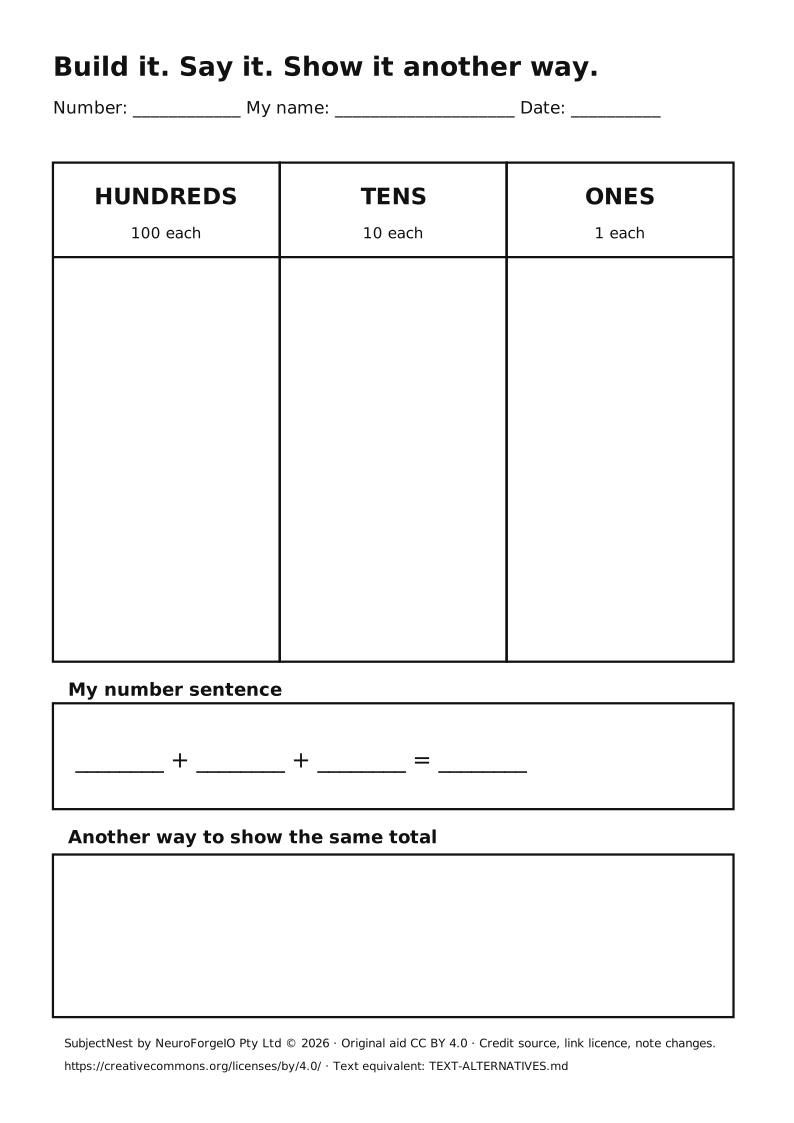
Use scrap paper for the place-value mat if a printer is unavailable. Label three columns hundreds / tens / ones; an empty column stays visible. A hundred-sheet can be a 10-by-10 dotted square, a ten-strip ten linked dots, and a one a single dot/counter. Tell learners the groups represent quantities; a drawn sheet is not literally 100 loose objects until the grouping is agreed. Create at least 3 sheets, 20 strips and 30 ones for demonstrations, or use flat paper marks and exchange cards to avoid a large loose collection. Do not use real money or classroom property without permission.
Teacher read-aloud contexts (original, fictional):
- Place-value library: “One full pack of 100 bookmarks, two packs of 10 and three loose bookmarks are ready. How many?” 123.
- Same structure, different life domain: “A garden has 13 strips of 10 plant labels and 4 loose labels. How many?” 134.
- Addition: “The class made 27 paper tags in the morning and 8 after lunch. How many tags altogether?” 35 tags.
- Subtraction choice A: “There are 32 cards. Nine are handed out. How many stay?” 23 cards.
- Addition choice B: “There are 18 seats. Seven more are placed. How many now?” 25 seats.
- Day 10 check: “A tray has 26 cards. Nine are taken to another table. How many stay?” 17 cards.
Routine that takes seconds, not a separate lesson: ask “What is the whole? What are the parts? What unit is the answer? How could we check?” Accept a valid different strategy. Separate a calculation slip from a story-model slip. When representing numbers, use H/T/O only after saying and showing the full labels; text and column position distinguish places, not colour.
Access: The plain-text mat can be spoken, enlarged or made with three tactile trays. If a learner has limited reach, they direct a partner/adult to place items; the learner still chooses quantity and grouping. For a learner needing smaller steps, stay in two-digit cases while modelling how a hundred extends the same idea. For a ready learner, ask for non-standard groupings and a second check rather than giving many more sums. The goal is flexible reasoning, not speed or motor fluency.
Rights: © NeuroForgeIO Pty Ltd 2026, SubjectNest, CC BY 4.0. Credit, link and note changes.