The Map A and place-exchange vectors have accessible titles/descriptions; the matching PDFs are A4. This text includes all information carried by these practice pictures. Colour is decorative. A teacher can copy the table, construct raised grids from string/paper squares, or read cells aloud. A learner can direct a partner to place markers; the partner should not silently correct their mathematics. The separate Map B text alternative stays with the Day 15 check.
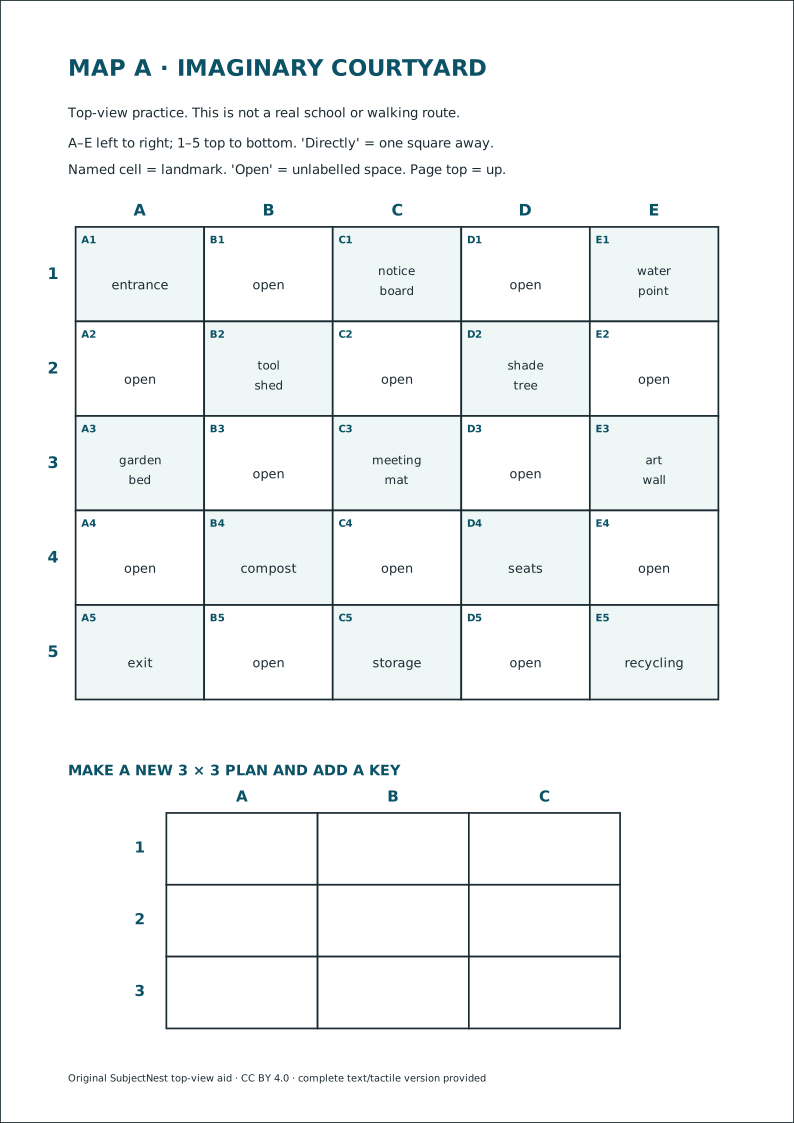
Map A · imaginary community courtyard
View from above. Page top is up, not necessarily compass north. Five columns A, B, C, D, E run left to right. Five rows 1, 2, 3, 4, 5 run top to bottom. Open is unlabelled space. A named cell is a landmark. “Directly” means one adjacent cell; “in the same row/column” can be farther away. This fictional map does not show exact distances, heights or safe real routes.
| Row | A | B | C | D | E |
|---|---|---|---|---|---|
| 1 | A1 entrance | B1 open | C1 notice board | D1 open | E1 water point |
| 2 | A2 open | B2 tool shed | C2 open | D2 shade tree | E2 open |
| 3 | A3 garden bed | B3 open | C3 meeting mat | D3 open | E3 art wall |
| 4 | A4 open | B4 compost | C4 open | D4 seats | E4 open |
| 5 | A5 exit | B5 open | C5 storage | D5 open | E5 recycling |
Below Map A is a blank 3 × 3 grid, columns A–C, rows 1–3, headed “Make a new 3 × 3 plan and add a key.” A tactile learner can use nine paper/cardboard squares, with column labels across the top and row labels at the side.
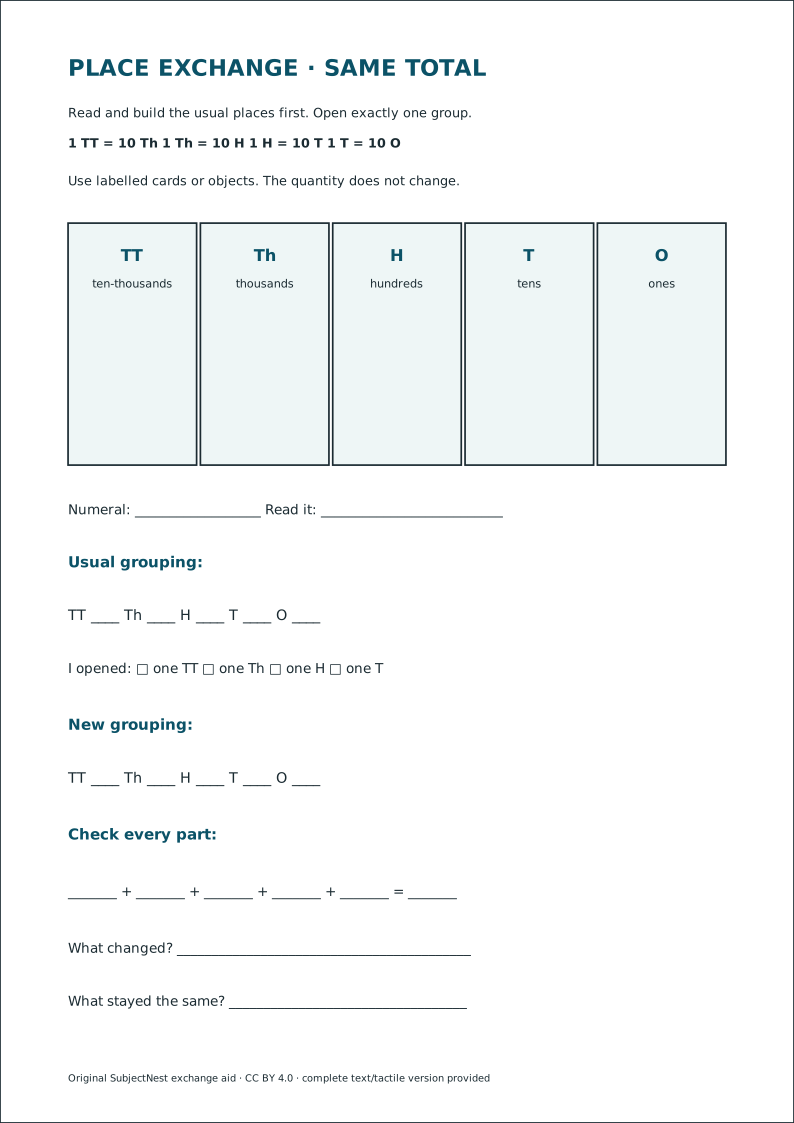
Five-place exchange mat
Title: “Place exchange · same total.” Five empty labelled boxes appear left to right: TT · ten-thousands, Th · thousands, H · hundreds, T · tens, O · ones. The direction reads: “Read and build the usual places first. Open exactly one group.” Exchange facts printed as text: 1 TT = 10 Th; 1 Th = 10 H; 1 H = 10 T; 1 T = 10 O. A labelled envelope/card represents larger groups; hundreds/tens/ones can use exchangeable paper/counters.
Below the boxes, the print prompts appear in order:
- Numeral: ; read it: .
- Usual grouping: TT , Th , H , T , O ___.
- I opened: one TT / one Th / one H / one T.
- New grouping: TT , Th , H , T , O ___.
- Check every part: ___ + ___ + ___ + ___ + ___ = ___.
- What changed? . What stayed the same? .
For a tactile alternative, use five clearly labelled pockets. When the learner requests an exchange, move exactly ten equivalent cards/pieces and recount the amount. A person may move them at the learner's direction; the mathematical choice remains the learner's.