The page that would not fit
Original fiction
Leila had drawn a comic about a tiny detective who could hear missing things. The detective heard a lost sock grumbling behind a cupboard and a missing key humming inside a shoe. Leila loved page four: a whole street of talking umbrellas.
At the lunch-table comic club, Max counted the pages. “Our folded booklet only has six,” he said. “Yours has eight.”
Leila pressed her palms against the table. The umbrellas needed their street. The key needed its song. If she removed the beginning, nobody would know why the detective listened.
“We could squeeze the words smaller,” Max suggested.
Leila looked at a speech bubble already crowded with letters. She imagined a reader holding the page right against their nose. “Or we could leave out something that does the same job twice.”
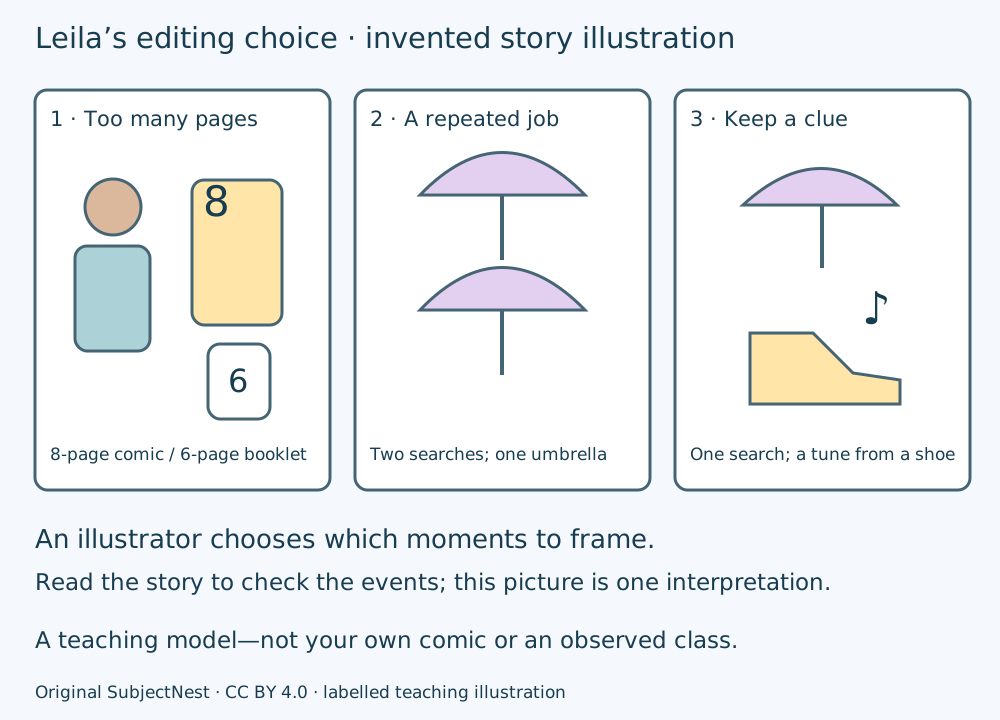
They read pages three and four. On both pages, the detective searched the wrong place and heard an umbrella complain. Leila kept one search instead of two, saving a page. The key’s discovery had a separate page too. She moved that moment into the final search panel, saving another page, and added a tiny tune from the shoe.
When Max read the six-page version, he paused before the last panel. “Is the key in there?”
Leila grinned. She had kept the surprise by giving him a clue. The umbrellas had lost a street, but the story had found a path.
Grown-up help
Invented children, club and events. The listening detective and talking objects are fantasy. The reader reaction belongs to this story, not an observed class.
These are shared texts, not controlled decodables. Use a separately matched school-selected passage for independent reading. All example people and clubs are invented except the explicitly cited general weather facts.
Open actual SVG: Leila’s editing choice · Full text and non-image alternatives