Five 35-minute sessions combining factors, practical modelling, source-aware writing and Year 5 HASS resource questions. The 36 books and box options are fictional. Do not imply a real school has these resources or ask learners to disclose family income or needs. This route addresses parts of AC9M5N02, AC9M5N09, AC9HS5K08, AC9HS5S01, AC9HS5S03, AC9HS5S05, AC9HS5S06, AC9E5LA02 and AC9E5LY06. See source and review notes.
Prepare: Text C, 36 counters or slips, six paper-box outlines, factor array and claim/evidence mat. Available six boxes each hold at most eight books; proposed four boxes of nine are not yet available; no costs are given. Learners can direct a helper, choose accessible digital numbers, or use the plain-text cards. There is no purchase or solicitation activity.
Day 1 — What kind of resource is it?
- Question · 3 min. Show Text C and ask, “What must a good box plan do?” Write proposed criteria without voting yet.
- Model · 5 min. Explain natural resource as material supplied by the environment, human resource as people's time/skills, capital resource as made equipment used to provide a service. In this scenario, trees/fibre are a possible source material, volunteer sorting is human work, and a reusable book trolley or sorting box can be capital equipment for the library service. A finished box is not a raw natural resource merely because its fibre came from a tree.
- Guided sort · 7 min. Sort
tree fibre / volunteer time / reusable trolley / donated books / cardboard box. Discuss that a good may have a different role depending on use; do not force “donated books” into a single category without explaining purpose. - Independent question · 12 min. Each learner writes one investigable question about the 36-book plan and two criteria (for example equal whole-book share, capacity, availability, transport, cost). They identify which criterion can be tested from Text C and which needs new information.
- Partner audit · 5 min. Partner points to evidence for a criterion or labels it “missing”.
- Exit · 3 min. Key: “Can we say five boxes are cheaper?” No; prices are missing. Learner explains rather than just saying no.
Day 2 — Equal shares and capacity
- Recall · 3 min. Read the actual constraints: 36 whole books, six available boxes, at most eight each.
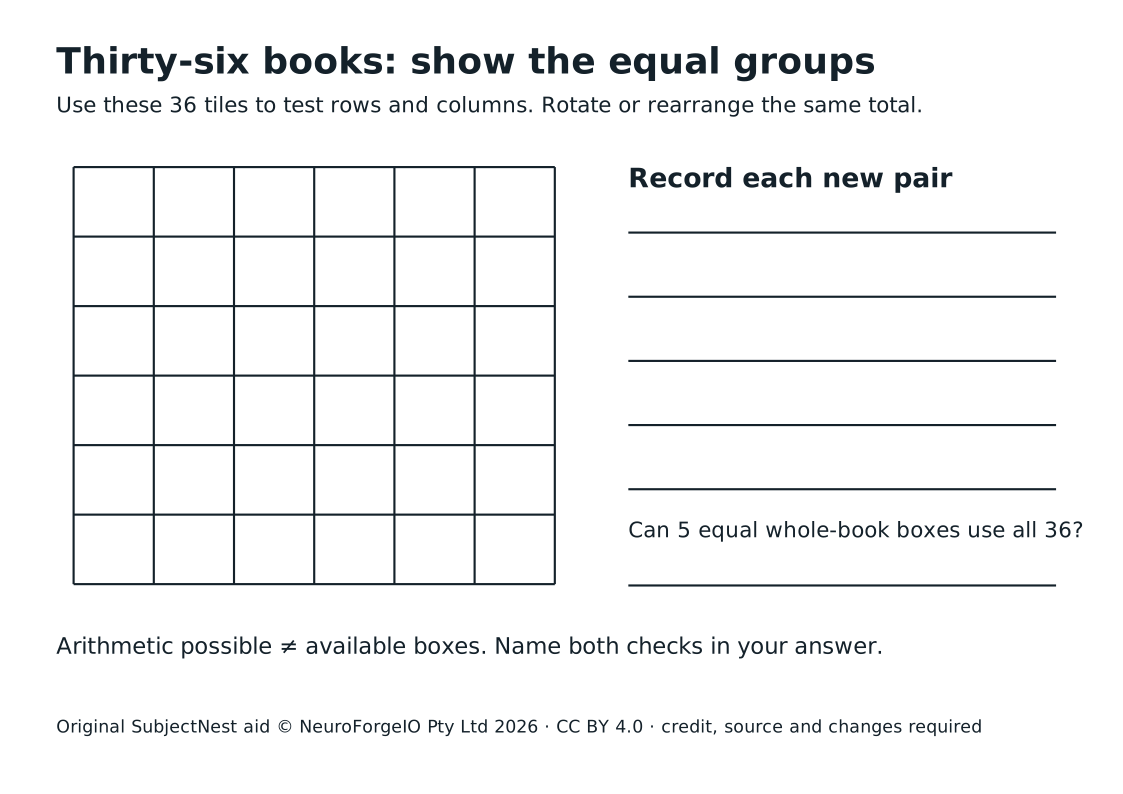
- Model · 5 min. Build six groups of six:
6×6=36, and six is no more than eight. - Guided factor pairs · 7 min. Use array mat to make
1×36,2×18,3×12,4×9,6×6. Ask which pair maps to six boxes. - Independent plan · 12 min. Learners complete a card: boxes used, books each, total, spare spaces per box and whether box availability is met. Key for six boxes: 6, 6, 36, 2, yes. They may make a tactile array or choose numerical form.
- Check the story · 5 min. A partner identifies a mathematically possible plan that still fails a practical constraint: four boxes of nine are not available and may exceed the known eight-book capacity of the available boxes.
- Exit · 3 min. “Does
4×9=36alone prove the four-box plan can happen now?” No; box availability/capacity differ.
Day 3 — Change one condition, see what changes
- Proposal · 3 min. Read the volunteer's five-box idea without judging the volunteer.
- Model · 5 min. Divide 36 into five groups: five sevens and one left. The equal whole-book requirement fails even if five boxes cost less.
- Guided variation · 7 min. Ask: “If the library permitted one partly filled box, would five boxes be possible?” Yes as a different requirement, e.g.
8+8+8+8+4=36, but the shares are not equal. Capacity eight per available box fits; verify whether only five of the six could be used. Mark the change explicitly. - Independent comparison · 12 min. Learners write two plans in a table: six equal boxes and five unequal boxes. Label which satisfies
equal,capacity,available. They may choose either if they state the governing criterion; no unstated “best” answer. - Counterclaim · 5 min. Partner says the strongest fair reason to consider fewer boxes and one reason to keep equal six. Discuss why cost cannot yet settle this.
- Exit · 3 min. “What changed between the two models?” The equality requirement, not the total 36.
Day 4 — Decide with a visible rule
- Criteria · 3 min. Learners choose a decision rule: e.g. “Use boxes already available, keep whole-book shares equal, stay within capacity.” Explain why those matter to the fictional service.
- Model matrix · 5 min. Draw columns
equal / capacity / available / price known. Six boxes of six: yes/yes/yes/no. Four of nine: yes/not for the available 8-capacity boxes/no/no. Five of seven plus one extra: no/yes/yes/no. - Guided source check · 7 min. Ask who supplied each fact. Text C gives counts and availability; the class's price guess supplies nothing. Mark unknowns with
?rather than zero. - Independent recommendation · 12 min. Learners choose a plan and justify against two criteria, acknowledge one alternative, and ask one information question. A learner may recommend not deciding yet because a safety or cost question matters.
- Peer challenge · 5 min. Listener asks, “What would make you switch?” Writer identifies a changed condition or new fact.
- Exit · 3 min. Teacher records whether the learner separates observed/given, calculated and unknown information. If not, return to colour-coded cards, not a repeated worksheet.
Day 5 — A proposal that another adult can use
- Audience · 3 min. The audience is a fictional librarian who can check resources; children do not promise a real decision.
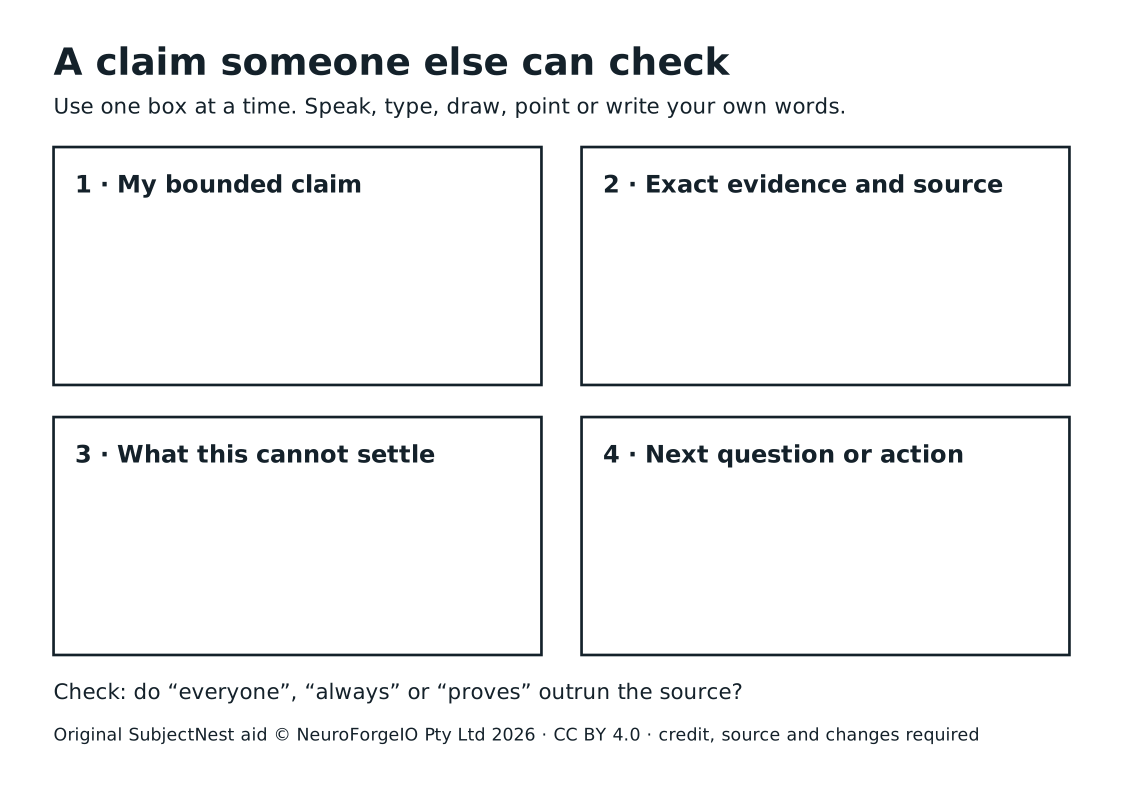
- Plan · 5 min. Set claim, factor fact, constraint, alternative and question in order.
- Rehearse · 7 min. Each learner tests a one-minute pitch with a partner. The partner paraphrases before raising a concern.
- Publish · 12 min. Create a one-page memo, accessible audio/AAC sequence or annotated array. Include a title, exact arithmetic, the given box conditions and what remains unknown. Do not invent prices. If real class work is photographed or recorded, use school permission rules and systems only.
- Rubric check · 5 min. Teacher marks
math correct / constraints visible / alternative fair / missing fact namedas secure, developing or not yet observed. Ask for one targeted edit. - Exit · 3 min. “Which sentence in your memo would a librarian be able to check immediately?” A good answer points to
6×6=36or another exact given/calculated fact, with a source.
Teacher moves: A child who calculates correctly but assumes a price needs a source check, not more multiplication. A child who offers a thoughtful resource criterion but cannot factor 36 needs a manipulatives/array reteach while preserving their HASS reasoning. When “fair” has different meanings, ask learners to state a criterion and its consequences rather than forcing one moral answer. Check physical accessibility of any box-handling task before class.
Rights: Original guide and fictional scenario © NeuroForgeIO Pty Ltd 2026, SubjectNest, CC BY 4.0. Credit, source, licence and changes. ACARA codes remain under ACARA's terms; ACARA does not endorse this resource. Local educator and access review pending.