Use the teacher examples and the rational benchmark strip. Six numbered steps total 25 minutes per lesson. Keep the written calculation, representation, context and checking method separate in the assessment record. Everyone attempts each brief exit; note a rotating 2–3 focus learners, then use later quiet checks if independent reasoning was obscured. Calculator use is for a post-solution check when noted, not a substitute for modelling. Codes mark partial Year 7 ACARA v9 work.
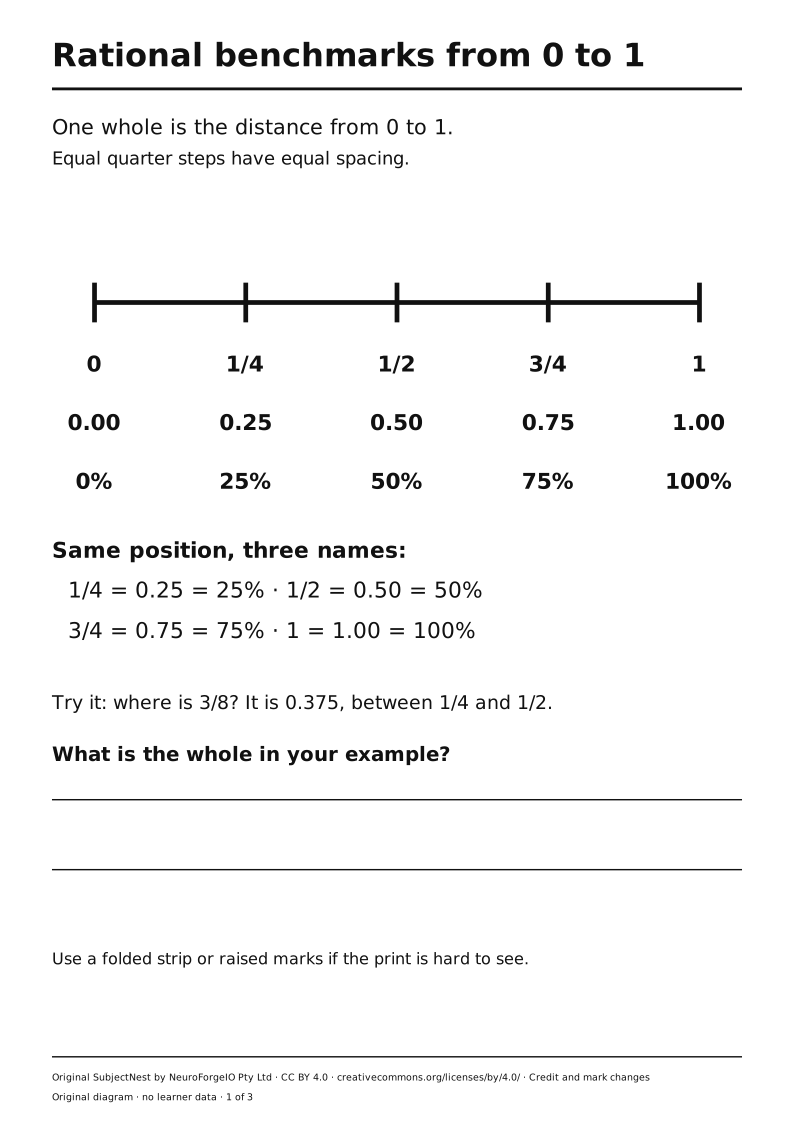
Day 1 — Three names for the same amount
Codes: AC9M7N04. Goal: connect a familiar fraction, decimal and percentage as equivalent rational quantities. Prepare: 100-square sketch or folded strip, 1/2, 0.5, 50% cards.
- Launch · 3 min. Say: “A battery icon at half, a race at 0.5 of its route, and 50% of a playlist may point to the same share. What does ‘same’ mean here?” These are invented contexts; compare the proportion, not units.
- Model · 4 min. Shade 50 of 100 equal cells. Say: “50/100 simplifies to 1/2; 50 hundredths is 0.50 or 0.5; per hundred is 50%.” Put all three labels at the halfway mark on 0–1.
- Guide · 6 min. Shade 25/100, rename
1/4 = 0.25 = 25%; then 75/100, rename3/4 = 0.75 = 75%. Ask why 0.25 and 25% are related but not written with the same symbol. - Choose and justify · 7 min. Pairs match nine shuffled cards for the three quantities. One explains using equal parts or hundredths; the other checks with the strip, then they swap. For a challenge, locate 10%=0.1=1/10.
- Use a domain · 3 min. “A fictional phone download is at 75%. Is it three quarters complete?” Yes, under the usual 0–100% indicator. Ask what the whole is (the download).
- Exit · 2 min. Everyone gives two other forms of
1/4. Listen to focus learners' explanation of the whole. If a child says 0.4, return to 25 of 100 cells.
Access: tactile 4-part strip, readable high-contrast labels, spoken or AAC matching; offer the same representations in text for screen readers.
Day 2 — A number line is a test of order
Codes: AC9M7N04. Goal: order rational values by common representation and position. Prepare: 0–1 strip, 3/8, 0.4, 1/2 cards.
- Start · 2 min. Ask: “Is 3/8 before or after 0.4 on a 0–1 line? A guess is fine; we will check.”
- Model · 5 min. Divide a strip into eighths.
3/8 = 0.375by 3 ÷ 8 or 375/1000. Mark it just left of 0.4. Explain that each tick represents equal numerical distance, not equal printed space between arbitrary labels. - Guide comparison · 6 min. Convert
1/2 = 0.5; order0.375 < 0.4 < 0.5. Use 0.4 = 2/5 as a second representation. Check that 0.4 is 4 tenths, not 4 hundredths. - Pairs place and defend · 7 min. Add
1/4,3/4and0.62. Pairs place cards approximately on the labelled strip and defend two neighbour relationships numerically. They may use a conversion or benchmark argument; line position without reason is incomplete. - Error talk · 3 min. Show a fictional placement of 0.62 to the left of 0.5. Ask: “Which benchmark tells us that cannot be right?” 0.62 is greater than 0.50.
- Exit · 2 min. Everyone orders
0.25,3/8,0.5→0.25 < 0.375 < 0.5. Sample focus reasoning; revisit thousandths if 0.375 is misread.
Access: large desk/floor line, tactile marked endpoints and quarters, worded comparison read aloud, AAC before/after choices. Record which conversion support was supplied.
Day 3 — Convert for a reason, not by a trick
Codes: AC9M7N04. Goal: explain 3/5 = 0.6 = 60% using equal parts. Prepare: 10-column strip or 100-grid.
- Question · 3 min. Say: “A game save meter shows three of five equal segments. What percentage is full?” Ask what one segment represents.
- Model · 4 min. Multiply numerator and denominator by 20:
3/5 = 60/100; then60/100 = 0.60 = 60%. Show six of ten columns shaded, so the representation can be checked visually. - Guided practice · 6 min. Convert
7/10to 0.7 and 70%. Convert1/8to 0.125 and 12.5% using 125 thousandths or a calculation, then ask whether 1/8 is smaller than 1/4. Note that not every fraction has a terminating decimal. - Meaningful choice · 7 min. Pairs choose a fuel gauge, art-project progress or sports possession fictional example and write three matching representations for either 3/5 or 7/10. Partner identifies the whole and explains a check. Extension: 2/3 is about 66.7%, not exactly 67%.
- Find a false match · 3 min. Display
3/5 = 0.35 = 35%. Ask students to show why 3 of 5 is more than one half, while 35% is less than one half. Repair the label. - Exit · 2 min. Everyone completes
7/10 = ___ = ___%→ 0.7, 70%. Focus learners justify via tenths/hundredths.
Access: manipulable ten strips, screen-reader text three fifths, quiet calculation route. Do not demand a particular digital tool for conversion.
Day 4 — Rounding means naming the accuracy
Codes: AC9M7N05. Goal: round decimals to a stated place and explain whether a context supports that precision. Prepare: place-value line and examples.
- Open · 2 min. Show
3.468 m. Ask: “If the measuring tape is reported to hundredths of a metre, what should we write?” - Model · 5 min. Mark hundredths in 3.468; the thousandths digit 8 rounds 6 hundredths up to 7. Write 3.47 m. Say the unrounded measurement would require an instrument that genuinely supports thousandths; our number is a practice example, not a measurement we took.
- Guided changes · 6 min. Round
18.374to one decimal → 18.4. Round0.946to two decimals → 0.95. Ask which place is kept and which next digit decides. - Context decisions · 7 min. Pairs get invented values: a relay time 14.387 s reported to hundredths → 14.39 s, and a jar mass 2.136 kg to tenths → 2.1 kg. Discuss why showing three decimal places from a rough estimate would imply false precision.
- Estimate check · 3 min. Ask whether 3.468 is closer to 3.46 or 3.47. It is 0.008 from 3.46 and 0.002 from 3.47, so the rounded result is sensible. Mark both hundredths on a line.
- Exit · 2 min. Everyone rounds
12.684to one decimal → 12.7 and names the hundredths digit 8 as the reason. Focus learners must state the requested place.
Access: enlarged place labels, tactile digit cards, spoken value plus accessible text. A learner may type the explanation; handwriting is not the rounding evidence.
Day 5 — Equivalent forms and sensible precision
Codes: AC9M7N04, AC9M7N05. Goal: sample Week 1 knowledge and choose next teaching. Prepare: Check A, benchmark strip, quiet station.
- Purpose · 2 min. Say: “Show how you know, then check if your answer makes sense on a 0–1 line.”
- Warm-up · 5 min. Together rename
1/2,0.5,50%and round4.238to a tenth (4.2). This is rehearsal, not scored evidence. - Equivalence task · 6 min. Everyone writes
2/5 = 0.4 = 40%and places it relative to 0.25 and 0.5. Observe planned focus learners privately while others check a partner's reason. - Precision task · 7 min. Round
12.684to tenths (12.7), then choose larger of0.65and3/4(0.75). Require a numeric reason; a correct guess alone leaves the strategy unobserved. - Feedback · 3 min. Name the precise work: “You made 2/5 into 4/10. Now let's connect four tenths to forty percent.” Let the learner repair one step, recording the prompt.
- Close · 2 min. Child names one helpful representation. Teacher selects the next model from the key, marking individual evidence
independent / prompted / not yet observed.
Access: verbal or tactile line, AAC/written equivalence, separate quiet interview later if the partner's answer concealed independence.
Day 6 — Fraction operations keep the whole in view
Codes: AC9M7N06. Goal: add/subtract positive fractions using equivalent denominators and check magnitude. Prepare: eighth strips and fraction cards.
- Launch · 2 min. Ask: “If half a page and a quarter page are filled, should the answer be less or more than one half?”
- Model · 5 min. Turn
1/2into2/4, then2/4 + 1/4 = 3/4. Mark both shares on the same whole strip. Explain why adding denominators to get 2/6 would change unit size and be wrong. - Guided subtraction · 6 min. Change
3/4to6/8;6/8 − 1/8 = 5/8. Ask which whole is represented and whether 5/8 is between 1/2 and 3/4. - Partner choices · 7 min. Choose
2/3 + 1/6 = 5/6or5/6 − 1/3 = 1/2. One partner builds equivalent parts, another checks with the strip or inverse. Swap. Offer like-denominator practice before unlike cases if prerequisite knowledge is insecure. - Domain link · 3 min. “A fictional mural uses 1/2 of a board for sketches and 1/4 for titles. What fraction is used?” 3/4, and 1/4 remains if the areas do not overlap.
- Exit · 2 min. Everyone solves
3/4 − 1/8 = 5/8with one clear conversion. Focus learners explain denominator choice.
Access: same-size physical fraction strips, raised partitions, written or spoken symbols; a partner may move pieces at the learner's direction.
Day 7 — Decimal arithmetic in a money context
Codes: AC9M7N06, AC9M7N05. Goal: add and subtract decimals while respecting place value and checking an estimate. Prepare: fictional receipt card in materials.
- Estimate · 2 min. “$12.75 and $8.60 should total around $13 + $9 = $22. What exact total?”
- Model · 5 min. Align decimal points and cents:
12.75 + 8.60 = 21.35. Say: “Five cents plus zero cents remains five; seven tenths plus six tenths makes thirteen tenths, so we exchange one unit.” Confirm total is close to $22. - Guided balance · 6 min. If a person had $25.00, subtract $21.35 → $3.65. Check
21.35 + 3.65 = 25.00. Explain cents are hundredths of a dollar, not free-floating digits. - Pair practice · 7 min. Solve
$42.30 − $17.85 = $24.45with a place-value sketch or written method, then verify by addition. A ready pair creates a different fictional receipt and checks it. A calculator may confirm after a shown method. - Context check · 3 min. Ask whether
$21.35or$213.50makes sense for two items near $13 and $9. Use estimate as an error alarm, not a replacement for exact work. - Exit · 2 min. Everyone gives
$25.00 − $21.35 = $3.65and one inverse check. Sample focus explanation.
Access: accessible monospaced decimal columns, tactile decimal marker, adult read-aloud of prices, AAC digits. Never require real spending or disclosure of family money.
Day 8 — A percentage is a part of a named whole
Codes: AC9M7N06, AC9M7N09. Goal: calculate simple percentages of a quantity using efficient decomposition and interpret the unit. Prepare: 100-grid/benchmark strip.
- Question · 2 min. “A fictional 80-minute playlist is 25% complete. How many minutes have played?” Ask what 100% represents.
- Model · 5 min.
25% = 1/4; one quarter of 80 is 20 minutes. Show 4 equal bars of 20 and check 4 × 20 = 80. - Guided second path · 6 min. Find 15% of 60: 10% is 6, 5% is 3, total 9. Say 15% means 15 per 100 of the whole, even though we calculate with useful parts.
- Choice practice · 7 min. Pairs choose 20% of 45 (9) for a fictional poster space, or 12.5% of 48 (6) for a fictional game progress bar. They state the whole, unit, method and reasonableness check. The context does not alter the arithmetic.
- Spot a mismatch · 3 min. Display
25% of 80 = 25. Ask why copying the percent number ignores the whole. Rebuild one quarter. - Exit · 2 min. Everyone finds 30% of 50 → 15, via 10% × 3 or 3/10. Focus learners explain the unit.
Access: tactile segmented bar, enlarged text, calculator after a model if individual plan allows; avoid speed-only judgement.
Day 9 — A model for a constrained decision
Codes: AC9M7N06, AC9M7N09, AC9M7N05. Goal: formulate and check a practical rational-number calculation. Prepare: fictional $120 event brief; no real purchase or club funds.
- Read · 2 min. “A fictional community event has $120 for two listed costs: $38.40 transport and $46.75 materials. How much remains?” Ask what quantities are known and unknown.
- Estimate · 5 min. Approximate
$120 − $40 − $47 ≈ $33; label estimate. Say exact remainder should be near this, not negative or above $120. - Model · 6 min. Add costs:
$38.40 + $46.75 = $85.15; subtract$120.00 − $85.15 = $34.85. Check$85.15 + $34.85 = $120.00. State $34.85 remains and that a budget does not tell us whether the event is worthwhile. - Partner alternative · 7 min. Pairs use a different valid strategy, e.g. subtract transport first:
$120 − $38.40 = $81.60; then$81.60 − $46.75 = $34.85. Ask which steps are easy to explain to a committee reader. A calculator can verify after the two methods are visible. - Interpret · 3 min. Ask: “Can we add another $40 item?” No, not within $34.85 remaining. Ask what else a real organiser would need to know; do not invent tax or prices.
- Exit · 2 min. Everyone gives remainder with unit and one check. Focus learners explain why the rounded estimate differs from the exact answer.
Access: read-aloud brief, line-by-line text, screen-reader-friendly amounts, paper tokens if helpful. No student or family financial data.
Day 10 — Show a representation, a calculation and a check
Codes: AC9M7N04, AC9M7N05, AC9M7N06, AC9M7N09. Goal: sample fortnight learning and set a specific next step. Prepare: Check B, number strip and private station.
- Set purpose · 2 min. Say: “You may change your answer if your model shows a better one. Tell me what convinced you.”
- Review · 5 min. Together match 1/2, 0.5 and 50%, then estimate
$20 + $35. These are familiar rehearsal values, not check answers. - Equivalent and precision prompts · 6 min. All show
3/5 = 0.6 = 60%, mark it on 0–1, and round7.486to hundredths → 7.49. Focus learners explain why 0.6 is to the right of one half. - New money problem · 7 min. Read: “A fictional project has $100.00. It spends $26.80 and $35.75. What remains?” Learners model, estimate and solve $37.45; check with the costs. Keep their work before class correction. This is arithmetic in an invented context, not a decision about actual funds.
- Feedback · 3 min. Use the actual error: “Your bar shows 3/5 correctly; let's connect six tenths to sixty hundredths.” Or “Your subtraction model is sound; let's align the cents.” Record prompt level.
- Close · 2 min. Learner chooses a representation worth keeping. Teacher records separate equivalence, rounding, modelling and calculation evidence, with a next teaching move from the key.
Feasible assessment: one teacher cannot interview a whole class individually in 25 minutes. Use 3–4 minute quiet conversations on Days 8–10 and later where needed; mark unseen independent work as not yet observed.
Rights: Original lessons and fictional contexts © NeuroForgeIO Pty Ltd 2026, SubjectNest, CC BY 4.0. Credit, link and indicate changes. ACARA codes retain separate terms.