Use the six clean original texts, three learner routes each day, optional extra/home menus, A4/text/tactile aids and separate teacher checks/worked key. Give Days 15/20 transfer passages as clean prompts on their day; because both prompts and key are public, a local replacement is needed when prior access matters. The model mathematics makes the text's meaning checkable; record English source interpretation separately from number fluency. Read-aloud gives listening-supported comprehension, not independent print decoding. AAC, writing, speech, tactile cards and a trusted scribe can carry the same analysis; capture the learner's own words and any prompt. No public performance, private home data, travel, purchase or fixed learning-style label is required. Rotate focus learners for exact evidence, then revisit a child whose first response was obscured by a pair.
Week 3 Day 11 Two expressions, one stated model
Codes: AC9E8LA08, AC9E8LY04, AC9E8LY05. Goal: explain what the two expressions mean in Text A, and distinguish equivalent model wording from a real-world fit claim. Prepare: Text A, blank equivalence and evidence mat.
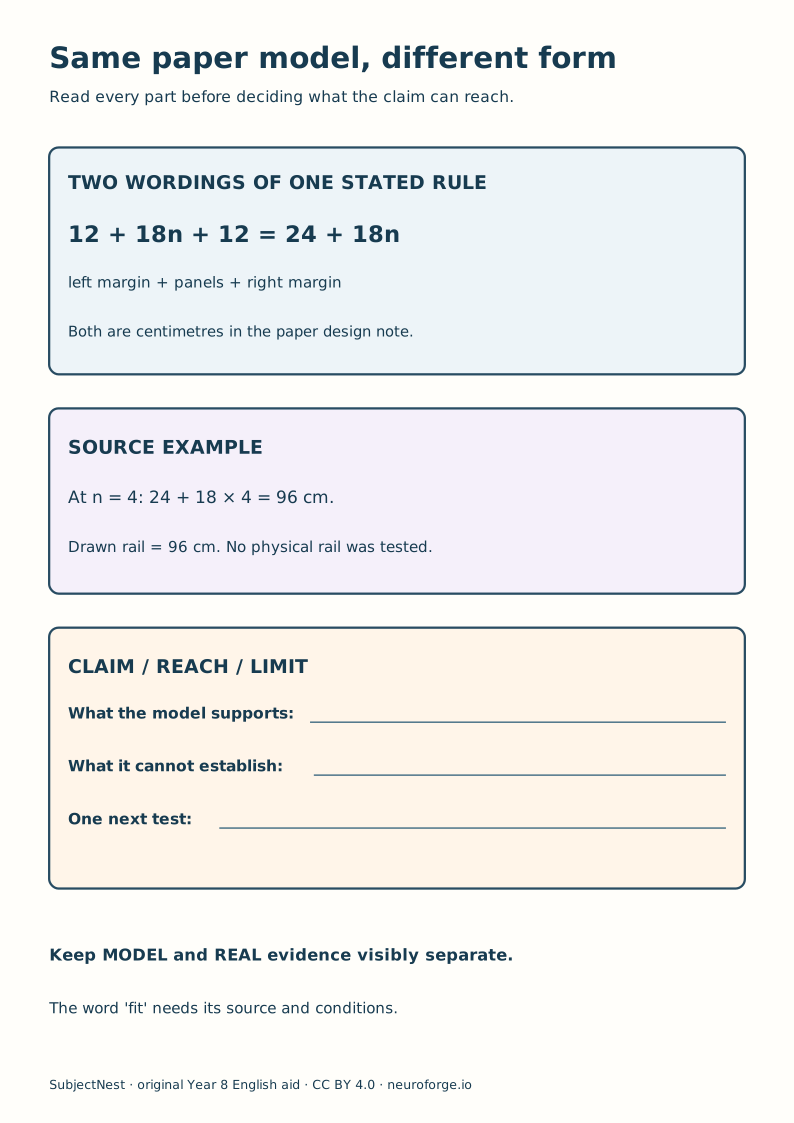
- Start · 2 min. Ask: “If two instructions look different, what would convince you they say the same thing?” Invite a check, not a guess about appearance.
- Read · 4 min. Students read the design note or hear an exact reading. Mark
n,L, the two 12 cm margins and the 96 cm drawn rail. State that no physical rail was tested. - Model · 5 min. Speak the first expression in ordinary language: left margin + all panel widths + right margin. Combine the two margins to read
24 + 18n. Check the table atn=2(60 cm); the same total follows both written forms. Explain that equivalent here concerns the stated rule. - Try · 7 min. Learners choose route A/B/C and give a word explanation tied to the source, plus one condition the paper model omits. If a calculation is wrong, check it with a calculator separately from the language claim.
- Probe · 4 min. Ask: “Four fit where?” Require in the drawn 96 cm model. Invite a learner to point to “clips, gaps, bent paper” before saying what a real display still needs.
- Exit · 3 min. Everyone explains why
12 + 18n + 12and24 + 18ndescribe the same model width, then names a limit. Staff next move.
Week 3 Day 12 The hybrid caption's two jobs
Codes: AC9E8LA03, AC9E8LY03. Goal: compare how a headline and a worked line position a reader in two captions. Prepare: Text B, hybrid source map.
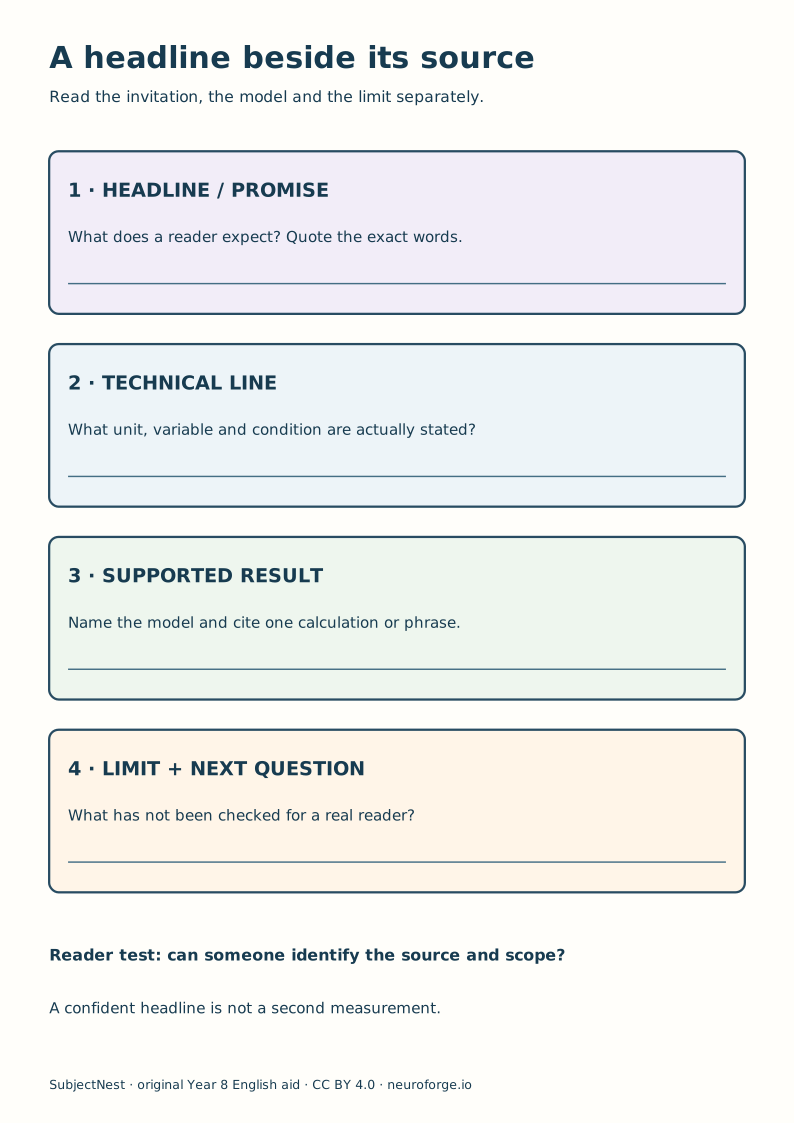
- Open · 2 min. Show only “Four panels fit perfectly.” Ask which word asks the reader to feel certain before seeing conditions.
- Read · 4 min. Give both complete captions. Students tag invitation/persuasion and calculation/explanation with words or tactile markers; no colour is needed.
- Model · 5 min. Read Caption 1's headline then small line. Point to the same source that Caption 2 uses. Explain the hybrid structure: promotional opening joined to a technical statement. Quote “every exhibition” and ask whether one paper rule reaches that far.
- Compare · 7 min. Choose a learner route. Name one feature and its effect on a visitor, plus one way the alternative caption handles scope. A shorter or longer caption can be defended if the evidence and limits remain.
- Reader test · 4 min. A peer/teacher asks “What was actually modelled?” and “What would still need testing?” The author repairs a misleading certainty word without erasing the invitation entirely.
- Exit · 3 min. “This caption first ___ to make a reader ; the source line , but ___.” Record actual text feature/effect, not just “persuasive”.
Week 3 Day 13 Make the paragraph earn its claim
Codes: AC9E8LA04, AC9E8LA05, AC9E8LY04, AC9E8LY06. Goal: build a paragraph with source, worked example, embedded qualification and an honest limit. Prepare: Texts A/B, equivalence and evidence mat, clause strips.
- Question · 2 min. “What does ‘four fit’ need beside it before we can trust that sentence?” Seek the rail and panel dimensions.
- Show · 4 min. Re-read the table row at
n=4and Caption 1. Identify the note as the source rather than the headline as independent evidence. - Model · 5 min. Build: “The four-panel design, which includes two 12 cm margins, uses 96 cm in the supplied paper model.” Show that the embedded clause adds a condition inside the sentence. Follow with a second sentence about untested gaps, rather than hiding the limit in a decorative aside.
- Compose · 7 min. The three routes all require claim, sourced numeric detail and a qualification for a reader deciding what to test next. Learners write, direct or dictate a short paragraph; a partner may operate a tool but not supply reasoning.
- Audit · 4 min. Remove the embedded clause. Ask what source condition vanished. Check whether the following sentence gives a real limit rather than repeating “it fits”. Revise one passage.
- Exit · 3 min. Submit first and revised versions; point to the source detail and the words that stop the claim exceeding the model.
Week 3 Day 14 A margin can mean more than a measurement
Codes: AC9E8LA02, AC9E8LE03, AC9E8LE05, AC9E8LY05. Goal: explain how viewpoint, a simile and a layered image shape the final meaning of “margin”. Prepare: Text C, blank line and meaning aid.
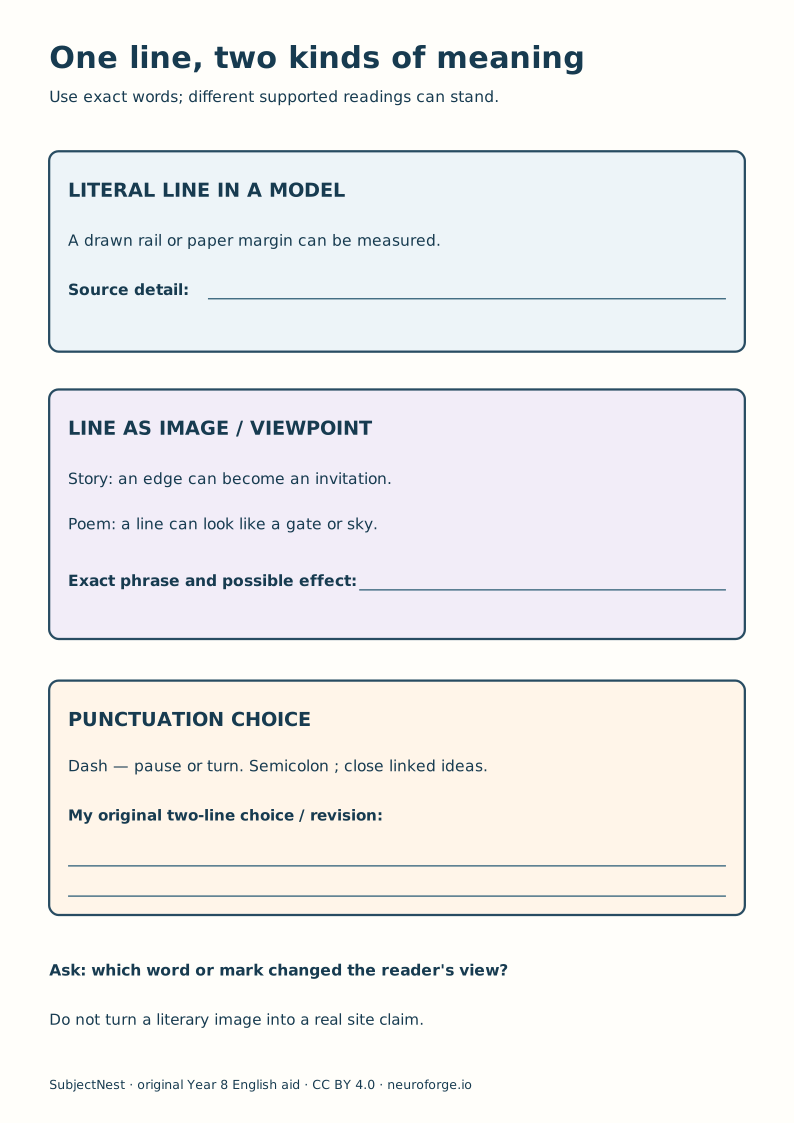
- Predict · 2 min. “What might the title The space at the edge mean in a design note? Could it mean something else in a story?” Keep first guesses provisional.
- Read · 4 min. Read the vignette quietly or exactly aloud. Pause when Theo taps the equal signs; ask what he assumes those signs settle. Continue to Ren's question from the next table.
- Model · 5 min. Place the literal 12 cm margin beside Maja's “somewhere to arrive.” Quote “less like emptiness and more like a frame” as a simile and “invitation” as a possible metaphor for a welcoming page. Explain that Theo's title and crowded captions position a visitor differently from Maja's calmer page; these are story details, not measured calm.
- Interpret · 7 min. Pick route A/B/C: close reading, scene map or two-viewpoint explanation. Each names a character's change, a specific phrase and both a literal and layered reading of the edge.
- Discuss · 4 min. Invite a supported alternative: did Theo change because of the arithmetic, Ren's question, or trying the visitor's view? Separate what the text says from what the reader infers.
- Exit · 3 min. “The margin is ___ in the model; in the story it may also , because the text says .” Do not score a single emotional reaction.
Week 3 Day 15 Fresh hybrid explanation check
Codes: AC9E8LA04, AC9E8LY03, AC9E8LY06. Goal: independently analyse a new paper-model source and write a bounded caption for a reader. Prepare: fresh Check A and public teacher worked key; no advance practice with its exact values or wording.
- Frame · 2 min. Tell students the source is new. Ask them to show what the model establishes, what a caption overstates, and one next check. Give access supports without hinting at an answer.
- Read · 4 min. Present the fresh source exactly; record independent print or exact adult reading. Do not explain the arithmetic unless access to the task requires a separate calculator check.
- First response · 5 min. Learners mark the source condition, one valid result and one unsupported phrase. Record first work before prompting.
- Write/compose · 7 min. Three learner routes allow a paragraph, source–claim board or oral/AAC text with local transcript. Each produces an overview, evidence, limit and next test in the learner's words.
- Self-audit · 4 min. Students point to a number or phrase supporting their claim and circle the word that limits it. Keep later edits beside the first response.
- Collect · 3 min. Store locally. Use criterion-level next moves, not a whole-curriculum grade.
Week 4 Day 16 “At most” is not “everyone”
Codes: AC9E8LA03, AC9E8LA08, AC9E8LY03. Goal: read the technical condition and evaluate the headline's reach in a new hybrid notice. Prepare: Text D, hybrid source map.
- Contrast · 2 min. Read “Everyone gets a turn!” and “at most three complete demonstrations fit this model session.” Ask if they promise the same thing.
- Read · 4 min. Show the full notice. Identify
d, the 5-minute setup, 15 minutes per complete demonstration and the 50-minute total. At most is a mathematical condition, not a promise about people. - Model · 5 min. Point to
5 + 15d ≤ 50and the suppliedd=3/d=4examples. Explain the layout's promotional first line and technical second block. State that “three complete demonstrations fit” says nothing about how many readers participate. - Try · 7 min. Choose route A/B/C and repair the headline for a fictional reader while keeping the useful timing fact. A child may check arithmetic; assess wording and source reach separately.
- Probe · 4 min. Ask which unmeasured parts (questions, changeover, access adjustments) could alter a real schedule. Do not ask students to identify a peer's access need.
- Exit · 3 min. “The model allows ___ complete demonstrations if ; it cannot promise .” Look for a named condition and audience effect.
Week 4 Day 17 Who is hidden by “allocation”?
Codes: AC9E8LA06, AC9E8LA04, AC9E8LY03, AC9E8LY06. Goal: evaluate source quotation and nominalisation, then revise responsibility without inventing an actor. Prepare: Text E, Text D and equivalence and evidence mat.
- Hear · 2 min. Say “Allocation will occur.” Ask: “Who does it, and how do we know?”
- Read · 4 min. Learners read the coordinator and Kit notes. Mark what the coordinator plans, what Kit expects, and what neither source verifies. Names and observations are fictional.
- Model · 5 min. Point to allocation, a noun standing for the action allocate. The source does not say who will do it. A repair can say, “The fictional coordinator's note promises allocation but does not name the allocator”; claiming that Kit or the teacher will allocate would invent evidence.
- Revise · 7 min. Choose a learner route. Make a short notice/reply paragraph quoting or accurately paraphrasing one note, clarifying actor uncertainty and preserving the true timing result.
- Audit · 4 min. A partner/teacher matches each quotation to the original and asks whether “will be completed” describes a finished action. Correct any invented actor or changed tense.
- Exit · 3 min. “The word allocation hides ; the source actually says ; a reader still needs to know ___.”
Week 4 Day 18 A line and a voice
Codes: AC9E8LA02, AC9E8LA09, AC9E8LE02, AC9E8LE03, AC9E8LE05, AC9E8LE06, AC9E8LY05. Goal: interpret Text F's personification, line image, dash and semicolon, then make and revise a small original literary response. Prepare: Text F, line and meaning aid; offer quiet non-audio reading.
- Notice · 2 min. Show “the ink knew where to stop.” Ask whether ink can literally know; invite a prediction about why a poet might write it.
- Read · 4 min. Read the poem once silently or aloud. Let learners mark two lines that shift from measurement to viewpoint. Reread only if needed, without announcing the “correct” feeling.
- Model · 5 min. The dash after “page” suspends the thought; the semicolon in “I moved the line; I kept the page” holds two complete ideas close together. Quote “closing gate” and “sky” as opposed metaphorical images that may position readers differently. Keep the analysis tied to words; the poem does not assert a literal gate or sky on the page.
- Respond/create · 7 min. Choose route A/B/C. Give a supported opinion about effect and write two original lines using one deliberate image or punctuation choice. Revise one word or mark and state how the effect changes. A quiet private display counts as sharing the draft, not spoken performance.
- Compare · 4 min. Invite two defensible readings of “choice unmade”. Ask which line supports each; do not ask a pupil to recount a personal barrier or copy a cultural poem.
- Exit · 3 min. Name one literary choice, its effect and a phrase that supports the reading; submit first and revised two lines.
Week 4 Day 19 Challenge a promise fairly
Codes: AC9E8LY02, AC9E8LY06, AC9E8LY07. Goal: plan and deliver a concise source-bound challenge to the fictional team, adapting evidence, pace and mode to an agreed audience. Prepare: Texts D/E; a 45–60 second private slot with teacher or consenting partner; written/typed/AAC alternative if oral performance is unsuitable.
- Audience · 2 min. “The fictional team can still change its poster. What should they keep, and what must they stop promising?”
- Model · 4 min. Give a 20-second response: “Your model fits three complete demonstrations in fifty minutes. The headline promises a turn for everyone, which the model does not show. Who will allocate slots, and what time is needed for questions?” Keep source fact, limit and request distinct.
- Plan · 5 min. Learners choose a route and order acknowledgement, evidence, qualification and question. A spoken route plans volume, pace and emphasis; an AAC/text route plans equivalent emphasis and order without pretending to evidence vocal control.
- Rehearse/deliver · 7 min. Present privately or to a consenting partner. Listener paraphrases before asking one question. A quiet written response remains a valid English composition route; record it as such, not as a speech sample.
- Revise · 4 min. The presenter uses the listener's question to move a source line earlier, replace “everyone” or clarify the actor. Record the change, not confidence or accent.
- Exit · 3 min. “I kept ___ because the source supports it; I challenged ___ because ___.” Capture actual delivery mode and independent wording.
Week 4 Day 20 Fresh rule and audience check
Codes: AC9E8LA06, AC9E8LY03, AC9E8LY06. Goal: analyse a fresh notice's source, hidden actor and overclaim, then write for an unfamiliar reader. Prepare: fresh Check B and public teacher key; do not preview its values, phrase or actor issue earlier.
- Frame · 2 min. State the audience and allowed response modes. The source is new; the task is to retain a valid model statement and repair its unsupported promise.
- Read · 4 min. Give the fresh passage exactly. Record independent print or exact adult reading; do not point to the error.
- Analyse · 5 min. Students identify one valid result, one overclaim, one word that hides an actor, and a source detail for each. Keep first response visible.
- Create · 7 min. Learners choose a route and make a three- or four-sentence note to the fictional audience with model, limit and next check. If arithmetic is supported by a calculator, note the support separately.
- Self-check · 4 min. Ask students to point to the source phrase behind their timing claim and the phrase that narrows their conclusion; revise one overstatement if found.
- Collect · 3 min. Use the separate criterion key for the next lesson. This check alone cannot decide a Year 8 English standard or a real scheduling decision.
Original resource rights: © NeuroForgeIO Pty Ltd 2026, SubjectNest, CC BY 4.0. Credit, licence, source and changes. ACARA content-description wording is separately attributed in the crosswalk.