All passages and cards here are original to this draft. Teacher-only oral texts are not student decoding material. The teacher may read them live or make a local recording from these exact scripts. If sharing a recording, add its voice/asset rights and transcript to the pack record before publication. Use a natural pace and allow a pause or replay.
Oral text A — The Kite at the Door (Day 1; optional later re-read)
On a windy morning, a red paper kite slipped from the classroom shelf. It skated across the floor and stopped beside a puddle at the open door. Asha reached for it, but the kite was too far away. Bo brought a long ruler. Together they pulled the kite back without stepping into the puddle. The paper felt damp. They laid it flat to dry. After lunch, Asha drew a yellow sun on it. “Now it has a weather story,” Bo said.
Teacher meaning notes: skated here means moved smoothly across the floor; damp means a little wet. Do not show the passage for independent reading. Story map: kite moves near puddle → Asha and Bo reach it with a ruler → they dry and change it. Ask “What did the story say?” before inviting predictions or personal connections.
Three-picture sequence, made in class: On three blank cards draw (1) a kite beside a puddle, (2) two hands holding a ruler toward the kite, (3) a dry kite with a sun. These are original sketch directions; no external picture is required. For a tactile version use a folded paper kite, a short ruler and a paper sun.
Oral rhyme B — Boots by the Door (Day 2)
Red boots by the door.
Blue boots on the floor.
One boot hides a sock.
One boot rests on a rock.
Teacher note: Read aloud. Have learners listen to door/floor and sock/rock. These printed words are not student decoding cards. If a local accent changes how a pair is heard, replace it with a clear locally rhyming pair and record the change; rhyme recognition is about the sound, not the printed ending.
Decoding cards (student-facing only from the stated day)
Cut apart or display one at a time. Print in a plain, large sans-serif typeface; keep a text version for screen readers. Do not use a picture to cue a word before the learner has attempted the grapheme–phoneme blend.
| First use | Student cards | Taught sounds present | Teacher note |
|---|---|---|---|
| Day 3 | m | /m/ | Letter, not a word. |
| Day 4 | a, am | /æ/, /m/ | am is modelled first. |
| Day 5 | s, S, Sam | /s/, /æ/, /m/ | Capital S begins the fictional name. |
| Day 6 | t, T, at, mat, sat, Sam sat. | /t/ plus prior sounds | Capital letter and full stop are print conventions. |
| Day 7 | p, P, pat, tap, map, Pat sat. | /p/ plus prior sounds | Pat is a fictional name; pat is also a regular word. |
| Day 8 | i, sit, sip, tip, Tim sat. | /ɪ/ plus prior sounds | T was introduced on Day 6. |
| Day 9 | n, in, pin, pan, nap | /n/ plus prior sounds | The four-sound words below are an optional stretch. |
Do not put moon, apple, sock, insect, ruler, kite or other oral exemplars on student decoding cards during this launch sequence. Learners may encounter them in the adult-read story or the environment, but they are not expected to sound them out from these seven letters.
Mini-text C — Three Small Actions (Day 9)
This is the first connected student-facing decodable text. It uses only m, a, s, t, p, i, n in their taught common sounds, with capital forms S, T, P already introduced. All words are regular for the taught correspondences. The words naps and taps have four phonemes and are an extension after the teacher models a fourth sound box.
Sam sat.
Tim naps.
Pat taps.
Meaning prompt: “Which person is resting? Which person makes a tapping sound?” A learner may read only Sam sat. independently while the teacher reads the remaining two sentences for meaning. Record exactly which words the learner decoded without help.
Low-ink visual strip: Draw three plain stick figures on blank cards. Show one seated, one with closed eyes resting, one with a hand tapping a table. Keep the pictures covered until after an attempted blend so they support comprehension without replacing decoding. The text is also usable with no pictures.
Oral text D — The Missing Seed (Day 10 assessment)
Leah took a packet of seeds to the garden table. She tipped out three seeds, but one rolled away. She and Arun looked under the tray. The seed was not there. Arun saw it beside the watering can. Leah picked it up and planted it. They put the packet away so no more seeds could spill.
Read aloud twice without showing print. Questions in ASSESSMENT.md ask about people, the problem and the solution. A student can answer with speech, AAC, pointing to the teacher's three sketched event cards, or acting. This checks story meaning; it is not a decoding assessment.
Reusable teacher-made response templates
Three-event story strip
Print or draw three large empty boxes in a row. Label the boxes First, Then, Last for the adult. The adult reads the labels; the learner may draw, place an object, point or dictate. Leave the label text out of a student decoding check.
| First | Then | Last |
|---|---|---|
| |
|
|
Sound boxes
Give one box per phoneme, not one per syllable. Put a counter in each box for a spoken word, then replace counters with taught letters. The print cards include empty three- and four-box versions.
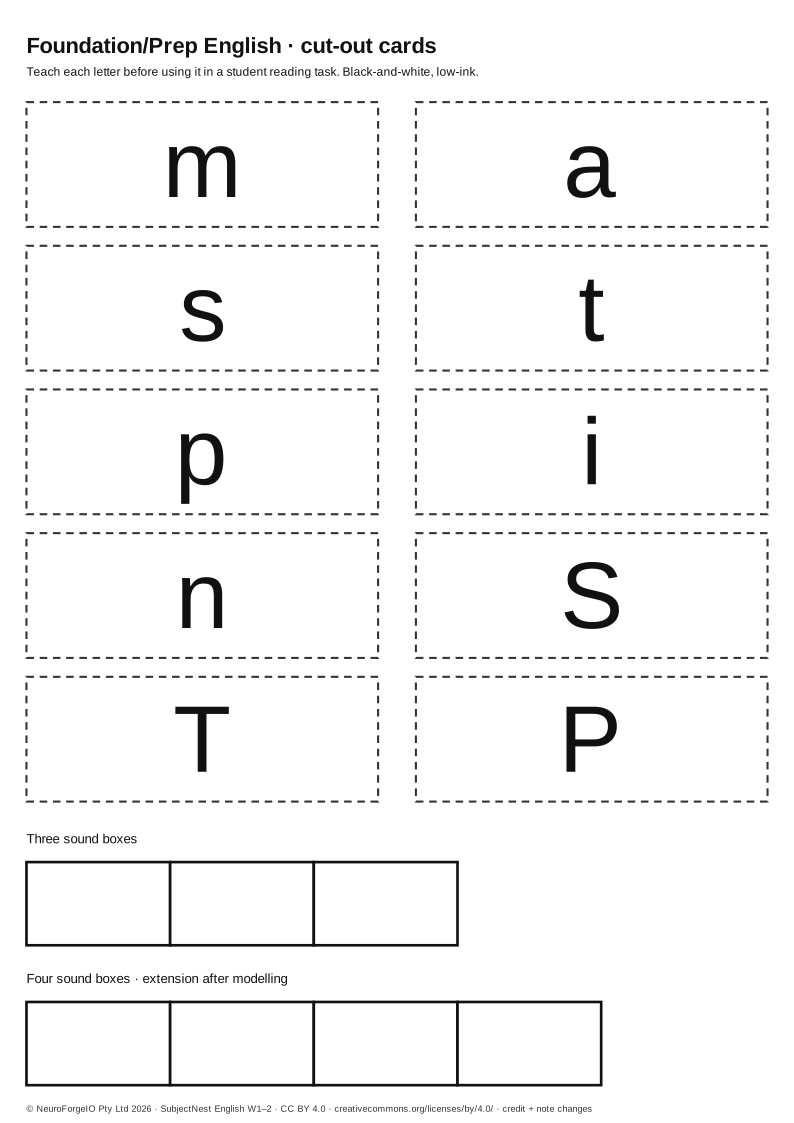
| 1 | 2 | 3 | optional 4 |
|---|---|---|---|
Simple evidence note
Date / learner code / lesson / item / response / independent or prompt used / route (speech, AAC, tiles, writing, pointing) / next teaching move. Keep any identifiable classroom record in the teacher's approved local system, not in a shared public copy or SubjectNest prototype storage.