Status: original teaching draft; curriculum alignment, classroom suitability, accessibility and language review pending human review.
Scope: ten 25-minute launch lessons plus an end-of-fortnight evidence check. This is a starting sequence, not a complete English program or a judgment against the end-of-Foundation achievement standard.
Year label: Australian Curriculum Foundation Year. Prep is the Queensland label for this school year. It is not intended to describe a pre-Prep kindergarten program. Check the local jurisdiction and school sequence before teaching.
What a teacher can run from this pack
- Ten daily lesson plans, each with a goal, explicit teacher words, timed steps, access choices and a quick formative check.
- Original teaching materials: two teacher-read oral texts, a rhyme, word and sentence cards, student response templates and a controlled decodable mini-text.
- Two-week assessment: exact prompts, a recording sheet, analytic rubric and next-teaching decisions.
- Print-ready sound and sound-box cards, with the same content available as text below and in
MATERIALS.md. - Machine-readable source and rights record.
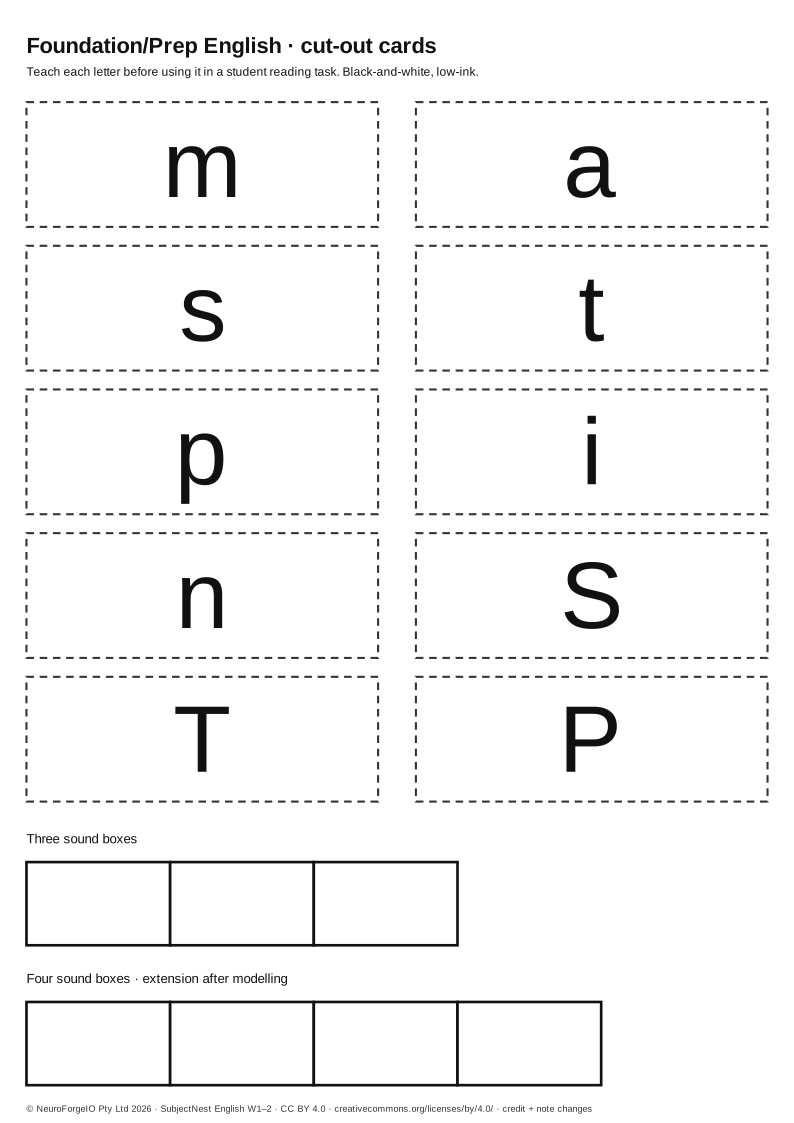
Use ordinary pencils, seven letter cards, counters, paper and optional large-print or tactile copies. The teacher reads all directions, oral texts and prompts aloud. Student-facing printed words are introduced only after their grapheme–phoneme correspondences have been taught. A listening story is not a decoding task.
Teaching sequence and decoding boundary
| Day | Main move | New correspondence | Student reading boundary |
|---|---|---|---|
| 1 | Listen, retell, count words in a spoken sentence | none | Teacher reads all print. |
| 2 | Hear and make rhymes; count syllables | none | Teacher reads all print. |
| 3 | Hear initial /m/; connect it to m | m → /m/ | Individual letter only. |
| 4 | Hear /æ/; connect it to a | a → /æ/ as in apple | am only, with teacher modelling. |
| 5 | Hear /s/; connect it to s, then S | s/S → /s/ | Sam as a name; no independent sentence yet. |
| 6 | Hear /t/; connect it to t, then T | t/T → /t/ | at, mat, sat; Sam sat. |
| 7 | Hear /p/; connect it to p, then P | p/P → /p/ | Add pat, tap, map; Pat sat. |
| 8 | Hear /ɪ/; connect it to i | i → /ɪ/ as in in | Add sit, sip, tip; Tim sat. Teacher explains T starts Tim. |
| 9 | Hear /n/; connect it to n | n → /n/ | Add in, pin, pan, nap and the three-sentence mini-text. |
| 10 | Show what has stuck and choose the next step | none | Only the seven taught correspondences in the decoding check. |
This is an instructional sequence chosen for this pack, not a claim that ACARA prescribes this sound order. In Australian English, the short sound represented here by a is /æ/ and by i is /ɪ/. Say stop sounds cleanly (/t/, /p/) rather than adding “uh”. Teach names of the letters alongside their common sounds, but assess the sound connection separately. Adopt the school's approved handwriting formation model; this pack does not invent one.
Curriculum and teaching evidence
The lesson headers give the exact Australian Curriculum v9 Foundation English codes they provisionally address. They are not official alignment approval. The source is the ACARA v9 curriculum workbook, downloaded 29 September 2026 and stored with SHA-256 db446882d2c00cf7c085a03e250e2442fda6c44011fc114680c46c1dc7a822c3 in the repository. ACARA's English learning-area page explains the Language, Literature and Literacy strands and the role of phonic knowledge. Check version history before publishing or using the pack with a later cohort.
The short, explicit model–guided practice–independent check pattern is informed by the Australian Education Research Organisation's Teach explicitly, Early literacy and Monitor progress guides. These sources support instructional choices; they do not certify this pack or predict an outcome for an individual child.
Access and use
Offer the same goal through real response routes: spoken or AAC answers, pointing to two or three choices, movable letter tiles, large print, tactile letter cards, a quiet listening spot, a transcript read by an adult, or a pencil response. Do not require eye contact, speed, public speaking or a particular body position. Record what the learner demonstrated and how, including any prompt or support. A picture choice can show story comprehension; it cannot, by itself, prove independent phoneme production. For a learner who cannot access the English sound task through hearing, plan an individual equivalent with the learner, family and relevant specialist rather than inferring a reading difficulty from this check.
Reuse this pack: © NeuroForgeIO Pty Ltd 2026, “SubjectNest Foundation English, Term 1 Weeks 1–2”, version 0.1.0-draft. Original lesson text, stories, assessment and print cards are licensed under CC BY 4.0. Copy, adapt and use them commercially with credit to SubjectNest by NeuroForgeIO Pty Ltd, a link to this pack and the licence, and a note of any changes. No third-party story, image, voice or classroom worksheet is included. ACARA curriculum wording retains its own rights under ACARA copyright and terms; it is not part of our licence grant. SubjectNest is not affiliated with or endorsed by ACARA.