Keep this sheet teacher-facing. Cut or copy only the stated child lines onto learner cards. Show print before a picture when checking decoding. A spoken explanation can use richer vocabulary than the child's print. Large print, tactile letters, a screen reader with headings, or a child-directed tile placement can be equivalent access; log what the child controlled.
Adult oral fiction A · The cup that changed its mind
On the first paper ramp, a large empty cup tipped and slid sideways. Nia predicted that the same cup would roll farther if the teacher changed the ramp's surface. The teacher kept the cup, the start line and the slope in the same places. They changed only the paper surface from smooth to ridged. In their first two tries the cup stopped near the start; in their next two it went farther. Nia said, “I predicted farther. That happened in these tries, but I want to try again before I say it always happens.”
This is an invented story about an unusual cup; it does not report a law of motion or a real class result. “Changed its mind” is a playful title, not a claim that cups think. Ask what stayed the same, what changed, what was actually seen and what is still uncertain. In a real test, surface texture is one of several influences; the story's four tries cannot establish a universal rule. A teacher uses their actual observations, including an unchanged or mixed outcome.
Adult oral information B · A result is one piece of news
A test begins with a question that can be tried safely. People say what they think may happen. They choose one thing to change and try to hold other important things steady. They make a record of what they notice, even if it surprises them. When they tell someone else, they say what happened in this test. They can ask what else to try. A drawing, photo or mark on a chart helps people inspect a result, but it must match what was actually observed.
This original explanation is a classroom model, not a prescribed scientific method for every investigation. A test can be inconclusive. Do not substitute the invented fiction result for the real class record.
Child print, presented as separate cards
All cards use earlier taught single-letter correspondences, selected ll, sh, ee, ay, and bounded high-frequency A/a, I, is, It from earlier packs. Check the actual child's taught sequence. No picture is a cue for the first read. Adult may define meaning after the attempt.
| Day | Child-facing line or words | Teacher boundary |
|---|---|---|
| 91 | red, cup, mat, see | Shuffle; ask for sounds, blend and meaning separately. see has one /iː/ in ee. |
| 92 | A red cup is on a mat. | Six words; adult story A is longer and is read aloud only. |
| 93 | It can roll. It can stop. | Two sentences, each with an ending dot. A real object may slide instead. |
| 94 | I can see a red cup. | First-person I is /aɪ/ as a word. The sentence describes the paper scene only if the cup is visible. |
| 95 | A cup is on a mat. | The line states a position, not what a real test showed. |
| 96 | ten, mat, play, see | Mixed review of previously taught links; no speed score. |
| 97 | I can see ten. | A child needs an actual ten-object display to assert this as an observation. |
| 98 | May I see a map? | A question asks; it does not grant permission. |
| 99 | A red cup is on a mat. | Child may change a word only if the new line matches a self-made or supplied drawing. |
| 100 | Held-out items in ASSESSMENT.md only | Do not rehearse transfer items. |
Card master and exact text alternative
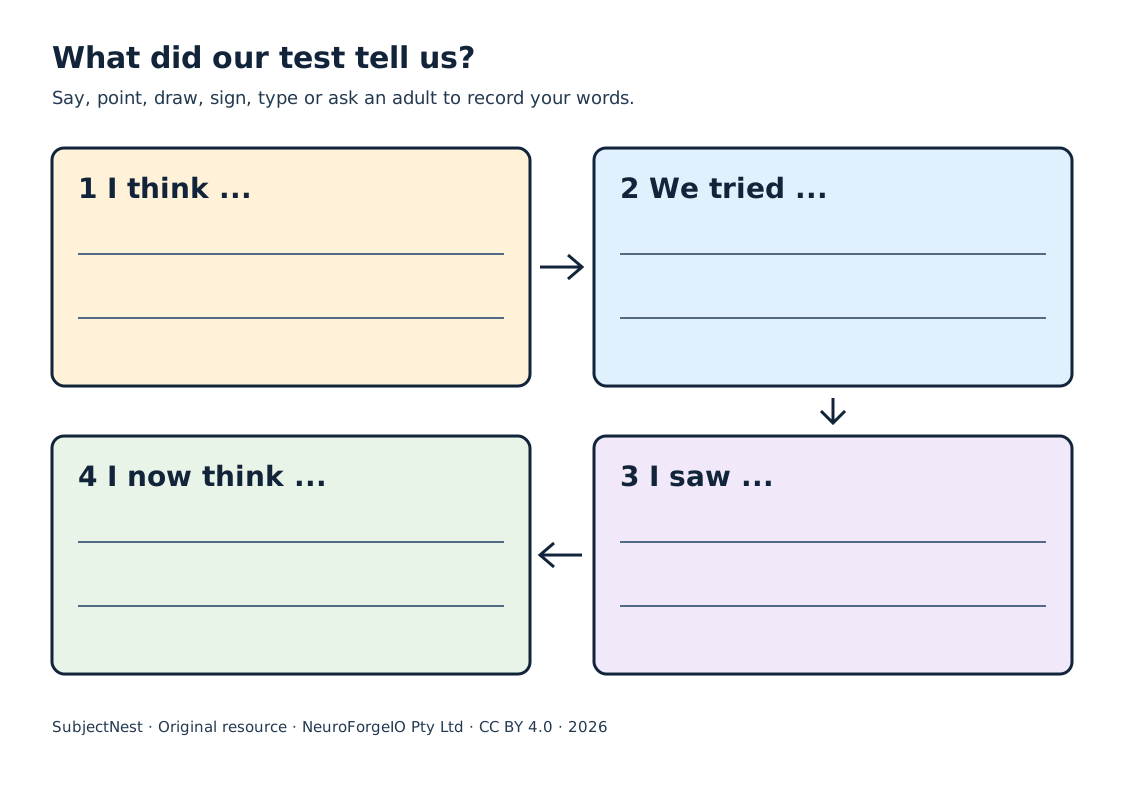
Print four cards in a large, plain font: I think ... (prediction); We tried ... (action); I saw ... (observation); I now think ... (revision). These are adult-read prompts, not child-decoding lines. The sequence mat has boxes 1–2 on the top row and 3–4 on the bottom row, with arrows tracing a clockwise route. The boxes are pale cream, blue, lilac and green with dark text; meaning also comes from the words and numerals, not colour. A nonvisual route is four tactile or spoken numbered cards in the same order. A child may select a box, sign, speak, AAC-compose or direct a scribe; write down the child's actual idea, not an adult-completed response.
Family / educator mini-use
With safe household objects, ask “What do you think will happen if we put this paper on a smooth table?” Invite a prediction, try once, and describe only what happened there. Adults control any object selection and supervision. No slope, small rolling object, water, loose cord, height or unknown material is required. A child can instead order four pictureless spoken cards and tell a made-up test story. This is an optional conversation, not homework or evidence of parental participation.