Original SubjectNest draft · educator and accessibility review pending. © NeuroForgeIO Pty Ltd 2026, CC BY 4.0. This is a Week 10 review point; align it with the school's actual term calendar. It samples Foundation content and chooses next teaching. It is not a standardised test, diagnosis, report grade or proof of a full achievement standard. Exact ACARA source and separate rights are in README.md.
Plan the observation roster before Day 41
Make a private list of learners and allocate three focus slots each day across Days 41–50. Ten days give 30 short slots, enough for a typical class to receive at least one close observation while other children work at familiar stations. Adjust the roster to the actual class size and any additional support; if a child is absent or an opportunity is inaccessible, mark NA and schedule a follow-up. Do not try to observe every child in every activity or hold every portfolio conversation on Day 50. Keep exact work and notes in the school's approved private system, without public pupil uploads or required photographs.
The child may show understanding with objects, pointing, sign, AAC, drawing, a verified home-language response, or an adult moving pieces precisely as directed. Record the format and cue. An inaccessible visual subitising task is not scored zero; use a suitable quantity task and retain the distinction. A supported response guides instruction but does not become an independent observation.
Fresh mini-investigation for AC9MFST01
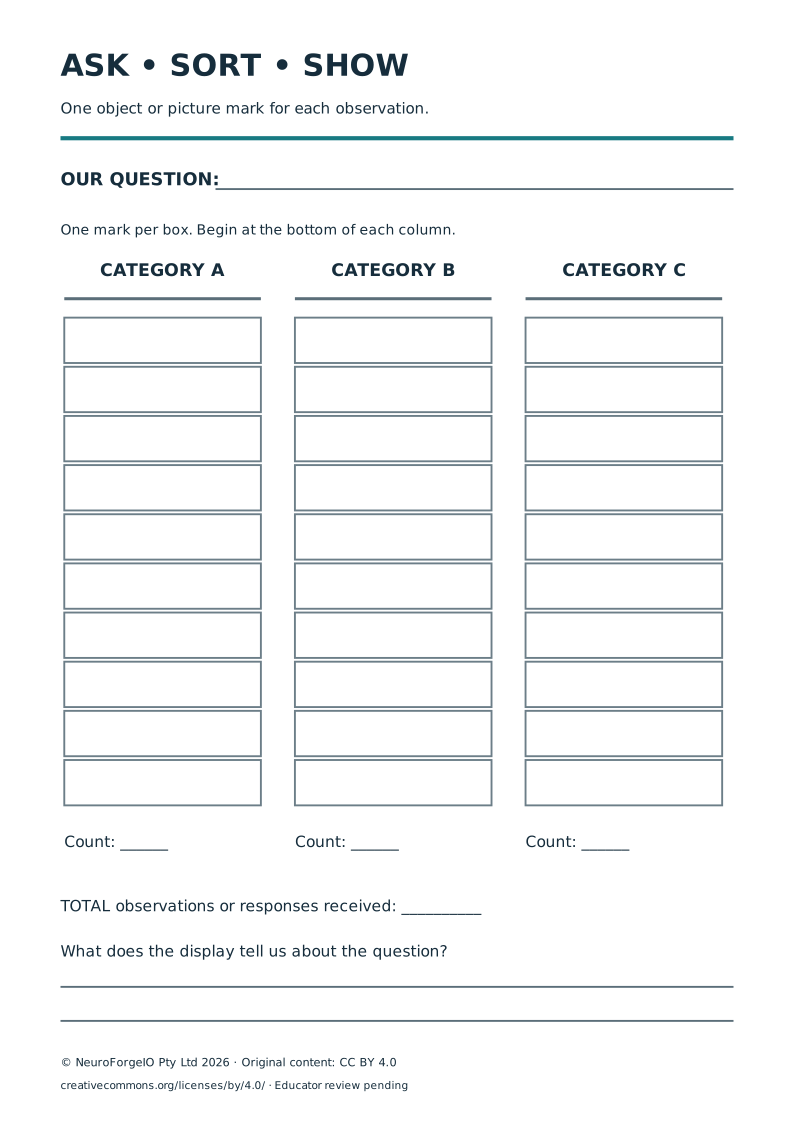
Use a fresh copy of D10, mixed and collected one at a time: 4 CUP, 3 SPOON, 5 PLATE word-and-shape cards. Give the question: “Which shared-table label appears most in this card set?” Supply three labelled mats and the low-ink data page. The child collects, sorts, displays and answers. If card pictures are inaccessible, provide tangible or enlarged category markers; keep the same one-item-one-observation rule.
| Check | Independent point | Evidence to write down |
|---|---|---|
| Collects the mixed set one card at a time without counting a card twice | 1 | How cards were handled or directed |
| Places every card in its one stated category | 1 | Any category confusion and resolution |
| Transfers one object/card to one picture mark, or constructs an equivalent accessible object display | 1 | Exact display format and whether the mapping stayed one-to-one |
| Gets all three category counts and the total | 1 | CUP 4, SPOON 3, PLATE 5; total 12 |
| Answers the given “most” question with a count or pairing reason | 1 | PLATE 5 most; compare with CUP 4 and SPOON 3 |
Maximum: 5 independently observed points. There is no validated pass mark. A missed item tells the teacher what to teach; it does not certify the child against AC9MFST01. Record earned / assessed, with NA for an item that could not be observed. For a learner still consolidating sorting, begin with a six-card version (three plate, two cup, one spoon) and record the smaller sample and key explicitly: plate 3 most, total 6. Do not silently convert its score into a 12-card score.
Portfolio evidence matrix
Use work from Weeks 1–2, Weeks 3–4, Weeks 5–6, Weeks 7–8 and current lessons, plus a fresh check where necessary. The earlier assessment items are sources of observations, not a set of scores to add together. Mark each row I = independent in a fresh context, S = shown with support, NA = not yet observed in an accessible way. Write one example and its date. A single I is a useful sample, not broad mastery.
| Code and question | Useful evidence | Next check if unclear |
|---|---|---|
| AC9MFN01: Can the child name/show/order 0–20? | 0, teen numeral and 20 linked to actual sets and order, not card appearance alone. |
New numeral between 11–20 with loose objects. |
| AC9MFN02: Can the child recognise a 1–5 group without one-by-one visual counting where accessible? | Fresh 4/5 layouts plus what grouping was seen; note visual versus tactile/described route. | New accessible small-group card. |
| AC9MFN03: Can the child count/compare sets to 20 and show why? | New spread versus bunched pair with count/pairing reason. | Fresh 16/18 and equal pair. |
| AC9MFN04: Can the child split/combine up to ten? | Two valid disjoint parts, every object used once, same whole after recombining. | Eight as 5/3, then 4/4. |
| AC9MFN05: Can the child act out an add or remove story? | Start/action/named result for one addition and one subtraction; distinguish moved versus remaining. | Fresh 6+2 and 9−4 scenes. |
| AC9MFA01: Can the child recognise/copy/continue repeating patterns in more than one form? | AB and a three-position unit, copied and continued; note tactile, visual or symbolic route. | Fresh AAB and translation to another form. |
| AC9MFST01: Can the child collect/sort/compare data for a familiar given question? | D10 mini-investigation and at least one earlier object/image example. | New small three-category deck with a stated question. |
Copyable private record
Learner code: ____  Dates: ____  Access format/language: _____________
D10 data check earned / assessed: ____ / ____   NA items: _________
AC9MFN01 I / S / NA  Example/date: _____________________________
AC9MFN02 I / S / NA  Example/date: _____________________________
AC9MFN03 I / S / NA  Example/date: _____________________________
AC9MFN04 I / S / NA  Example/date: _____________________________
AC9MFN05 I / S / NA  Example/date: _____________________________
AC9MFA01 I / S / NA  Example/date: _____________________________
AC9MFST01 I / S / NA Example/date: _____________________________
Child's chosen example or question: ______________________________
Specific next teaching move: ______________  Recheck date: _____
Choose the next teaching move
| What the evidence shows | Next move | Fresh recheck |
|---|---|---|
| Same card sorted twice or image display has extra marks | Move one card at a time from an unsorted pile to one category and one mark; pair originals with marks. | Six-card fresh deck, then twelve-card D10. |
| Correct three counts but “most” comes from physical picture size | Align marks from the same baseline, count or pair; connect the answer to the given question. | New three-category deck with unequal sizes of drawn icons. |
| Zero or tie category ignored | Keep all three labelled mats visible, including the empty one; compare counted categories. | Fresh 4/4/0 deck. |
| Numeral/frame work correct but loose count slips | Move loose objects to a second mat once each; ask for final total. | Fresh 14, then 18 loose. |
| Part-whole groups counted as additional objects | Empty the whole space into two bounded parts, recombine the same objects. | Five split two ways, then ten. |
| Always adds, even when a story removes objects | Act out the named location and move removed objects outside its boundary; ask what remains there. | New 7−2 story before mixed stories. |
| Copies a pattern but cannot continue it | Bracket two complete repeating units; begin a third with objects rather than verbal guessing. | New AB or AAB pattern with three-place continuation. |
| Evidence is secure across fresh settings | Keep retrieval in routines; follow the next planned Foundation sequence rather than repeating the same worksheet. | Return after several days with a different context or accessible virtual representation. |
Record one smallest useful next step and a recheck date, not a permanent label. AERO monitoring guidance informs this use of evidence; the local rubric itself has not been classroom validated.