Print the week and day-parts aid and duration comparison aid at A4, or use the text/tactile equivalents below. Large plain cards, removable markers and paper strips suffice. No app, timer, special purchase or personal calendar is required. The learner cards contain no keys; keep assessment out of view until Days 115 and 120.
Week 23 practice sets
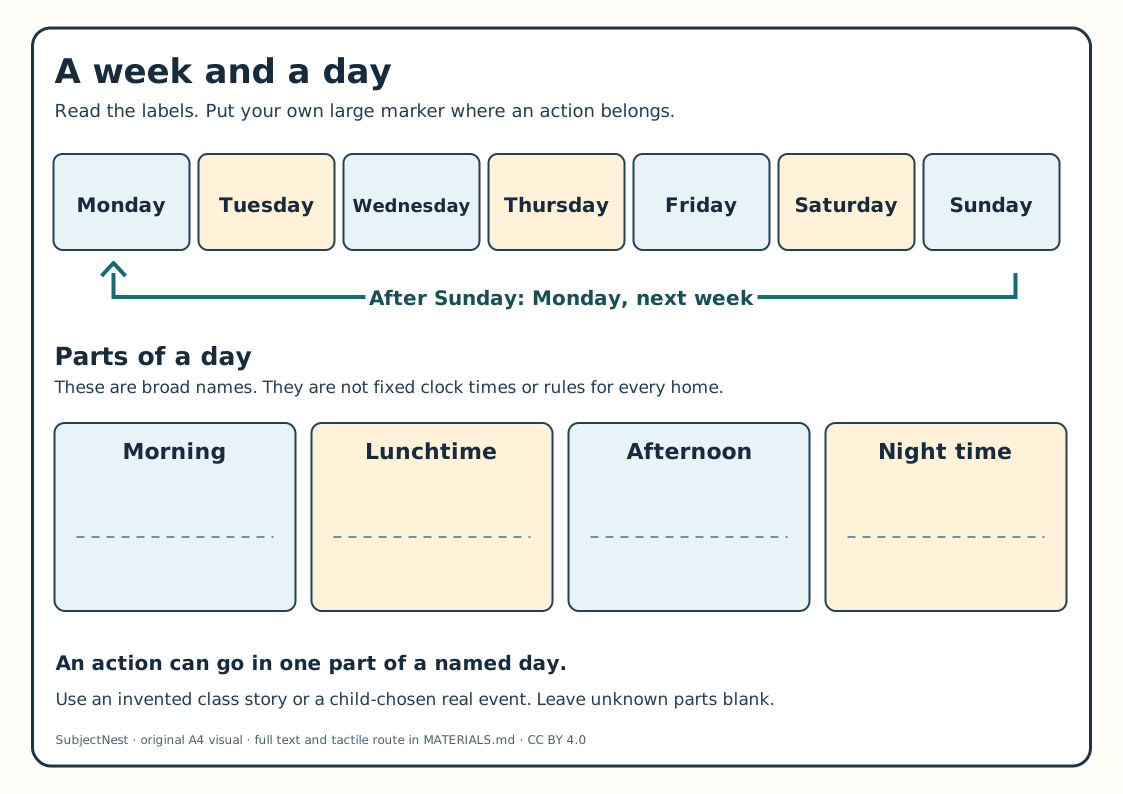
Set A · seven-card order. Make seven large day cards, one each: Monday, Tuesday, Wednesday, Thursday, Friday, Saturday, Sunday. This is the conventional sequence taught for this national code; a week's displayed first day may vary by calendar. Always say which card is the chosen start, then continue cyclically. For initial teaching place Monday at the left, Sunday at the right. Shuffle before the child attempt. Key from Monday: Monday → Tuesday → Wednesday → Thursday → Friday → Saturday → Sunday; the day after Sunday is Monday of the next week. A named day alone tells us no individual person's activity.
Set B · invented class Book Day. Teacher says: “On Monday morning our imagined class draws covers. On Thursday morning it shares books. At Thursday lunchtime it visits a book table. On Thursday afternoon it puts books away.” Use this to connect day and part of day; these are fictional story facts, not claims about children's own calendars. Another invented example is a garden-paper display: Tuesday afternoon make labels; Friday morning put them beside drawings. A third is a puzzle-project finish: Wednesday lunchtime see the completed puzzle; Wednesday afternoon put pieces in a box. A quieter fourth is a book sign: Sunday night an imaginary character draws one at home, without asking a learner to do so.
Set C · four broad day-parts. Make separate word cards morning, lunchtime, afternoon, night time. On a fictional school day, order morning → lunchtime → afternoon → night time. They are broad labels, not exact clocks. If a familiar action differs by child, accept and describe the child's stated context without “correcting” family routines. For a fictional paper scene, one possible action each is: morning open a classroom book; lunchtime put an imaginary paper lunch picture on a tray; afternoon tidy paper; night time see a star picture. Do not teach night time as necessarily sleep.
Set D · changing reference day. Show Thursday. Ask which named day comes immediately before (Wednesday) and immediately after (Friday). Then show Sunday and ask what comes next (Monday of the following week). Children may move tactile cards rather than read their day labels independently; the teacher reads labels as needed. Day naming is mathematics here, not a reading fluency test.
Week 24 direct-duration setup
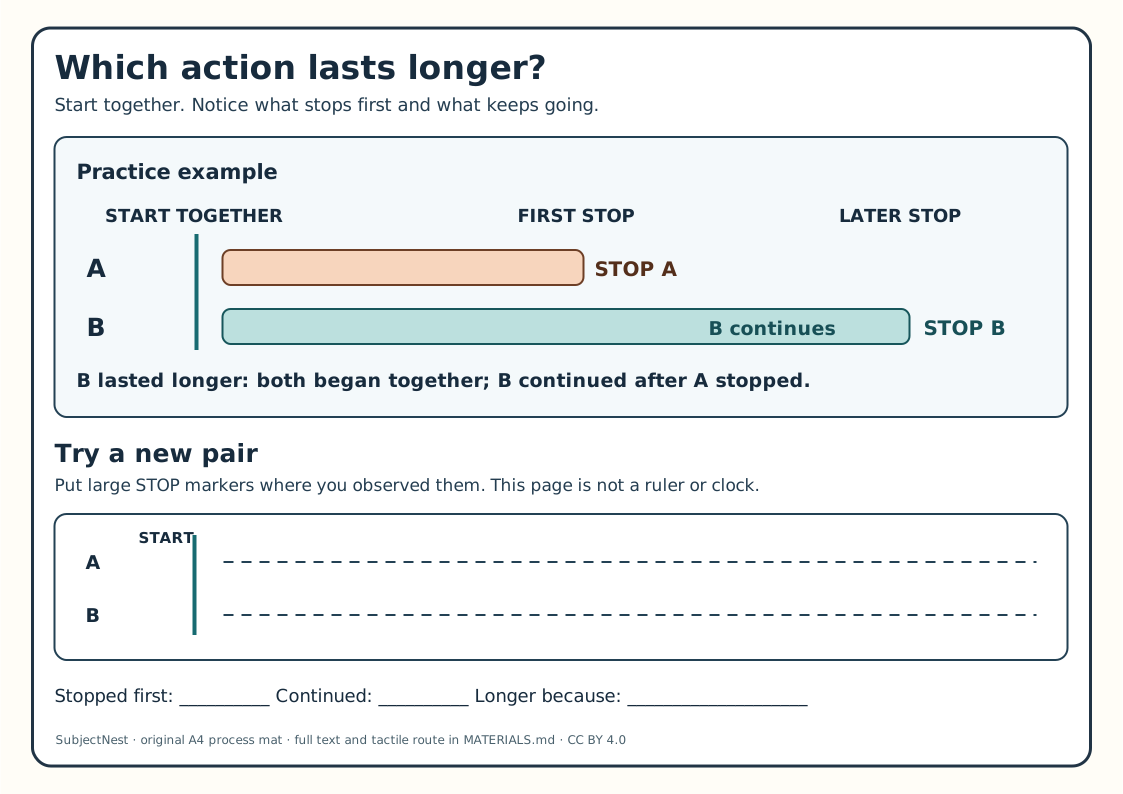
Comparison rule: two actions begin at the same signal. If A stops while B continues, B lasts longer. The child must identify what they observed and name the compared events. No stopwatch or exact seconds are necessary. Do not use two actions started at different times and then call later finishing “longer.” All practise cases are intentionally safe, quiet and paper based.
Set E · two paper strips (Days 116–117). Adult and child, or two adults, start sliding two paper markers together along separate broad lanes. One adult gives a clear STOP A signal while B visibly/tactilely continues, then STOP B. First run: A = blue marker, B = circle marker, so B lasted longer. Reverse the stopping order on the second run, so A lasted longer. The distance each marker travelled is irrelevant. A learner can control the START/STOP cards, watch, feel a marker pause on a tactile lane, or listen to two distinct soft sounds that stop in order. Avoid relying only on colour.
Set F · story and drawing (Day 118). Two adults begin an adult-read picture story and a quiet drawing action together at START; the drawing stops first while the story continues. The story lasts longer. The fact that one has more words or marks is not the proof. Repeat with a puzzle-card sorting action and a book-cover drawing action; choose and announce which stops first, then let the child reason from the observed order.
Set G · equal length and fair test (Day 119). Two visible marker actions begin on the same signal and end on the same signal: they last the same length of time as observed at this level. On a second run start the markers at different times; ask why stop order alone now cannot settle duration. To compare fairly, restart together or use another shared observable interval. Do not present the second run as a valid direct comparison.
Safety and accessibility: use large paper pieces, not small counters where mouthing is a concern; no blindfolds or sudden loud sounds. Ask a learner what sensory channel works for them. Use a repeated accessible start/stop cue, but log repetitions. The attribute is elapsed duration, not a child's speed, movement capacity or enjoyment.
Exact SVG text equivalents
Week and day-parts sheet: A4 landscape. The top row has seven equal boxes in order: Monday, Tuesday, Wednesday, Thursday, Friday, Saturday, Sunday. A curved arrow after Sunday points back to Monday with the words “next week.” The lower row has four blank, equally sized boxes with large labels: Morning, Lunchtime, Afternoon, Night time. Underneath is a blank line “I can place an action in a part of a day.” There are no pictured family customs or fixed times. For a tactile equivalent, make seven raised day cards and four raised day-part cards, read their labels aloud and allow the child to place a large moveable token.
Duration sheet: A4 landscape. At the top: “Start together. Watch what stops first.” Two broad horizontal lanes labelled A and B begin at one vertical START line. In the practice illustration, a labelled STOP A marker comes before STOP B while the B lane continues; text below reads “When A stops and B continues, B lasts longer.” At the bottom are two blank lanes and spaces for “stopped first,” “continued,” and “reason.” This is a process diagram, not a ruler or number line. For a tactile equivalent, give two raised parallel strips and chunky removable STOP markers; say the stop signals aloud.
Record during instruction
Use a private record with day, code/target, setup, learner's exact first placement or words, mode, adult cues, reason, and next move. For a duration claim, keep the actual start and stop sequence. For a day-part claim, distinguish “can order these labels” from “connects an action to one broad part in a stated context.” A child's home routine remains their own and is never a deficit diagnosis.