Adult decision gate for actual material observation
The paper sources below make a complete lesson route. An optional real Science inspection uses three broad, clean, intact, school-approved sample surfaces: A plain paper-based card, B woven fabric, and C craft corrugated paper-based card with broad ridges. The teacher may also preassemble one large sign with a visible card backing and a firmly secured fabric patch. Confirm exact material identities from the teacher's own preparation and reliable product/source information; if a component is uncertain, write MATERIAL UNKNOWN, even if it looks familiar. Check local allergies, fibre shedding, adhesives, edges, visual/tactile access, infection-control rules and cleanup. No child cuts, tears, rubs dusty fibres, tastes, smells, wets, heat-tests, bends to breaking, or must touch a sample. Avoid small detached swatches, loose clips and personal possessions. Adults handle the sign; samples remain broad and secured. If the setup is unavailable or unsafe, do not improvise: write REAL OBSERVATION NOT AVAILABLE and use the FICTIONAL MODEL only.
For each actual source, record local date, teacher approval/pretest, exact object/sample identity, how each material label was verified, view/access, what the child directly noticed (for example visible ribs or a smooth appearance), any optional safe directly felt feature, the exact neutral ADULT REPORT if the child did not directly access a feature, and unknown parts such as covered glue. A teacher's maker statement can identify prepared components when provenance is sound; it does not become the child's direct sensory observation. A printed drawing can depict stripes, not prove the pictured object's real material or tactile texture. A change of touch mode or a missed view is recorded, not silently filled. In this pack, observed surface appearance and reported/verified material identity occupy separate fields.
If the integrated Week 27 block already produced an approved, dated Science observation with this exact source/provenance/access record, use that genuine record rather than handling materials again to fill a timetable. Do not backfill a missing field from memory or from L's fictional model; mark it unknown and plan a new safe view only when needed.
Use one stated sorting rule at a time, such as visibly ribbed / not visibly ribbed in this view. An item may share a visible property with a different material. Keep the counterexample rather than forcing a universal rule. This is not a water test, strength test, proof of hygiene, or claim that every fabric/card object has one texture. Earlier Foundation Science packs sample other material properties; this fortnight focuses on visible components and one-property classification with source labels.
Complete original FICTIONAL MODEL sources
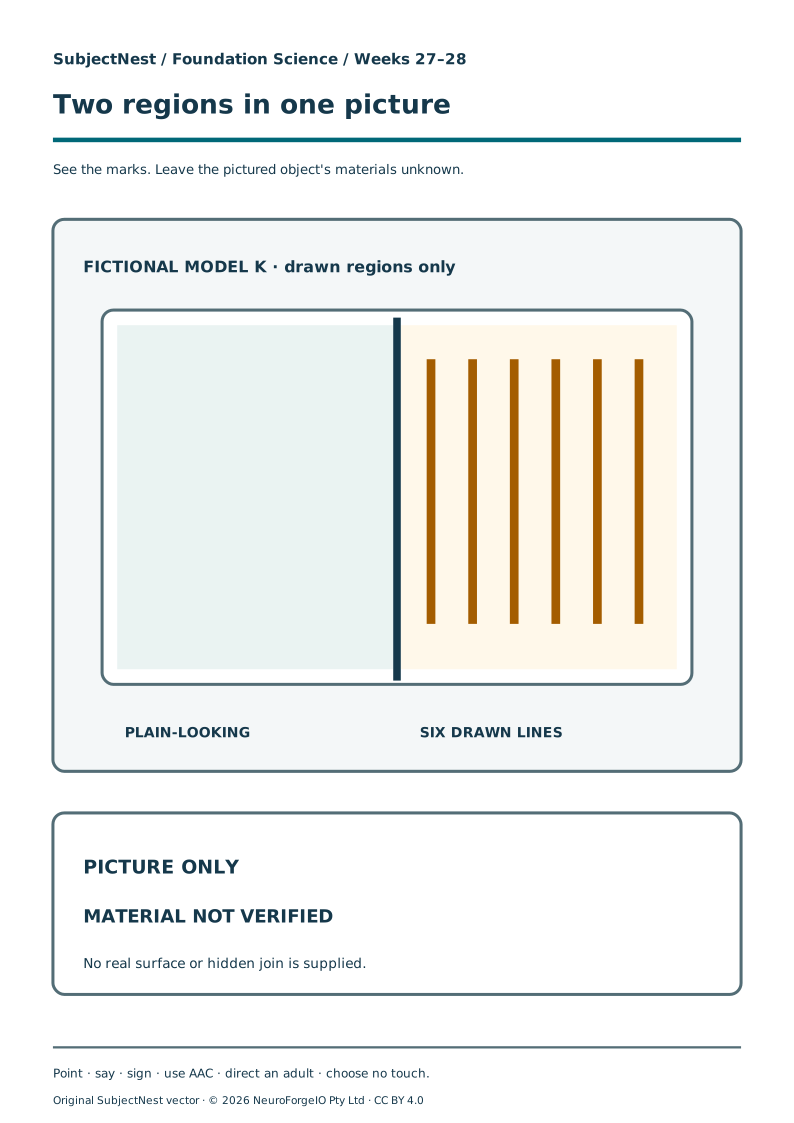
Model K · split-colour picture. A paper drawing shows one large rectangle. Its left half is blank and smooth-looking; its right half has six wide parallel drawn lines. There is a heavy dividing line, but no back view, real object, maker, verified material, date or touch. A text caption says, “The left looks plain. The right shows six drawn lines.” That much can be said about the picture. It cannot establish fabric, card, glue, hidden components or actual texture. The drawing says PICTURE ONLY in large text and is not a sample.
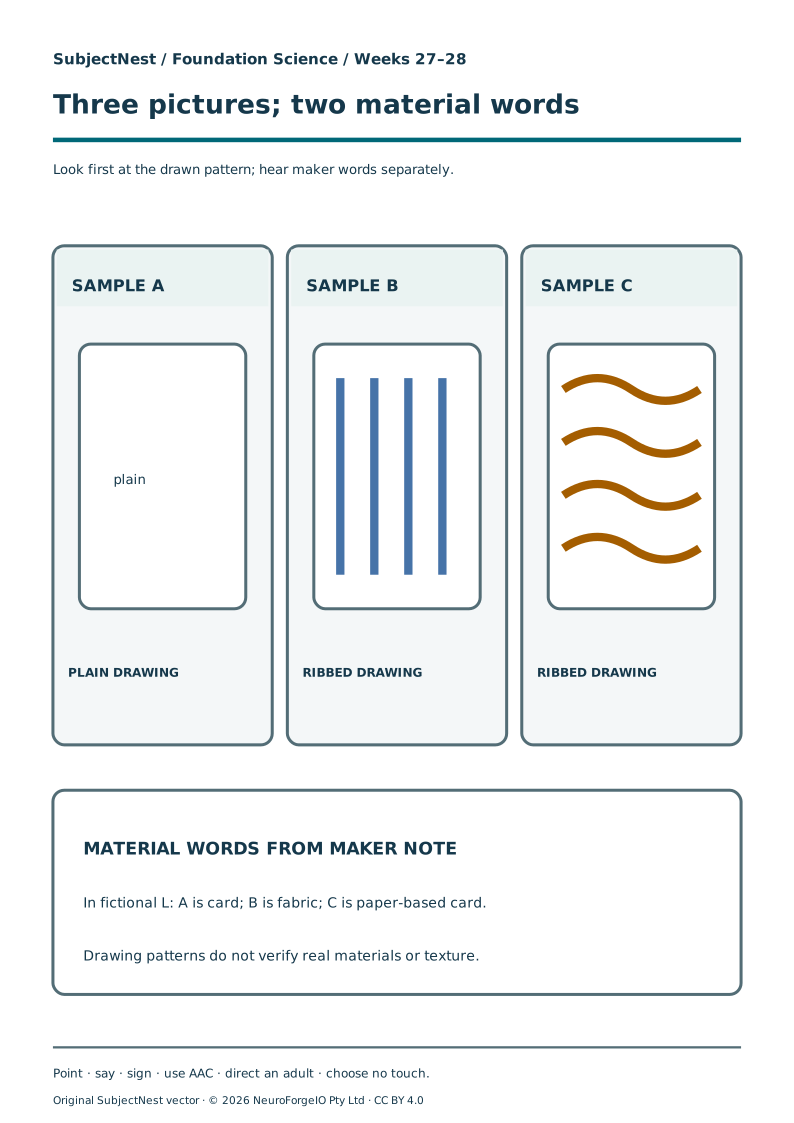
Model L · invented maker's three-sample note. This paper note is FICTIONAL MODEL, not a local observation. An imaginary adult writes: “I prepared sample A from a large plain uncoated card sheet; it looked smooth to me. I prepared sample B from a large woven fabric sheet; I could see broad ribs. I prepared sample C from a large craft corrugated paper-based card sheet; it also showed broad ribs. I attached B as a broad patch to A for an invented sign; I did not record the hidden joining material.” In this invented source, A and B have different reported materials; B and C share the reported visible ribs despite different reported materials. One can say “The fictional maker's note lists card and fabric as visible sign components, and lists two ribbed samples.” One cannot say that a real school sign has those materials or that ribbing always means fabric. C is a counterexample to the false rule. The three pictorial swatches show a plain panel and two different patterns, but their material words come from the invented note, not the drawing itself.
Model M · unsupported display captions. One imaginary poster says, “Anything with visible ribs is fabric.” A second says, “Every sign with two coloured regions is made of two materials.” L contradicts the first within its invented record because C is paper-based card with reported ribs. K alone cannot support the second because drawn colour/line regions are not material identification. A sound correction is “This source shows lines here; material identity needs a verified source.” The correction does not deny that a real verified composite object may have different materials.
Model N · invented question to a maker. A fictional learner asks an imaginary maker, “What did you put on this sign, and how do you know?” The imaginary maker replies, “In this story I used the plain card from sample A and the fabric from sample B. The hidden join was not recorded.” This is an attributed fictional answer; it can practise respectful questioning and exact reporting. It is not a real interview, material inspection or child's direct observation. A real teacher-maker can answer a neutral material question if willing and locally approved, but record actual words, provenance and any “I don't know.” No personal or family question is needed.
Six original A4 aids · exact linear, auditory and tactile equivalents
Each aid has an SVG and selectable-text PDF linked from the pack index. Large-print, braille, AAC and broad secured tactile adaptations can follow these exact ordered descriptions. No loose small counters. Declining touch is a full access choice. A tactile paper diagram still does not establish the material of a real object.
- Split sign picture: one large rectangle, left region plain, right region six wide parallel lines, strong vertical divider; labels PLAIN-LOOKING / SIX DRAWN LINES / PICTURE ONLY / MATERIAL NOT VERIFIED. Read from left to right then the two source cautions. Tactile: one broad fixed rectangle with a divider and six secured raised lines on the right; it remains a model.
- Three pictorial swatches: three broad bordered squares A, B, C from left to right. A has an empty field; B has thick parallel vertical strokes; C has thick parallel horizontal wavy ridges. Labels A PLAIN DRAWING / B RIBBED DRAWING / C RIBBED DRAWING / MATERIAL WORDS FROM MAKER NOTE. Read drawings first, then L's fictional maker words separately. Tactile: three broad fixed panels with two distinct raised-line orientations; do not pretend paper line texture is actual fabric/card feel.
- Safe source gate: a large sample-table outline with three secured swatch shapes, a no-touch choice and a source tag. Six ordered fields APPROVAL + LOCAL DATE; KNOWN LARGE MATERIALS; ADULT PRETEST + HANDLING; CHILD ACCESS CHOICE; MATERIAL SOURCE OR UNKNOWN; ACTUAL FEATURE OR NOT OBSERVED. Read exactly; no actual outcome is prefilled.
- Two-source record: two blank pictorial observation/source panels for SAMPLE A and SAMPLE B, each with a large blank surface field and DIRECT FEATURE / ADULT REPORT / MODEL. Lower fields MATERIAL LABEL + HOW VERIFIED; LOCAL DATE; HIDDEN JOIN UNKNOWN. No rib/texture answer is prefilled. Read A fully before B.
- One-property sort: SOURCE + DATE / FICTIONAL MODEL line, then two large empty bins VISIBLE RIBS IN THIS VIEW / NO VISIBLE RIBS IN THIS VIEW, a separate UNSORTED tray with three empty square markers, an UNCLEAR / NOT VIEWED waiting space and a distinct COUNTEREXAMPLE / OTHER MATERIAL box. No sample is pre-sorted. Read source, rule, bins, unsorted tray, waiting space, counterexample in that order.
- Ask, source, explain: a question bubble and a source bubble joined to a bounded claim strip. Fields MY NEUTRAL MATERIAL QUESTION; DIRECTLY NOTICED FEATURE; MAKER/PRODUCT SOURCE + EXACT WORDS; MATERIAL IDENTITY OR UNKNOWN; COUNTEREXAMPLE; PRIVATE LISTENER RESPONSE OR NONE. A source answer is attributed; no real listener response is supplied. Read in order and offer child-directed adult scribing.
Original fictional sources, protocols and aid descriptions © 2026 NeuroForgeIO Pty Ltd, SubjectNest, CC BY 4.0. ACARA/QCAA wording and linked resources retain their own rights.