Five 35-minute integrated blocks, Foundation / Queensland Prep · teacher draft. Pair with English Days 101–105 and mathematics Days 101–105. This guide brings Visual Arts making and response into the week; keep the separate English print and mathematics shape evidence. It is not a claim to cover a whole Arts standard.
Question: How can shapes in an original picture help someone understand or feel welcome in a shared space? The teacher makes a fictional paper community-room collage before class: a round paper window, two triangular bunting pieces, a square table top and an oblong shelf. Label this as an educator-made example, not an account of any real community or cultural design. Children may choose different shapes and meanings. Do not treat one person's response as what “everyone” thinks. A learner need not discuss their own home or family space.
Prepare and protect: use large pre-cut paper shapes, glue sticks where allowed, a tray or digital equivalents; school-approved scissors only under local rules. No small pieces for children who mouth objects. Have a no-glue movable-paper route. Give the shape aid after first hands-on noticing if you want an independent description. Read its text equivalent or provide tactile outlines. Ask before displaying a child's work, and honour a private response. Do not photograph or upload identified children/work without school consent.
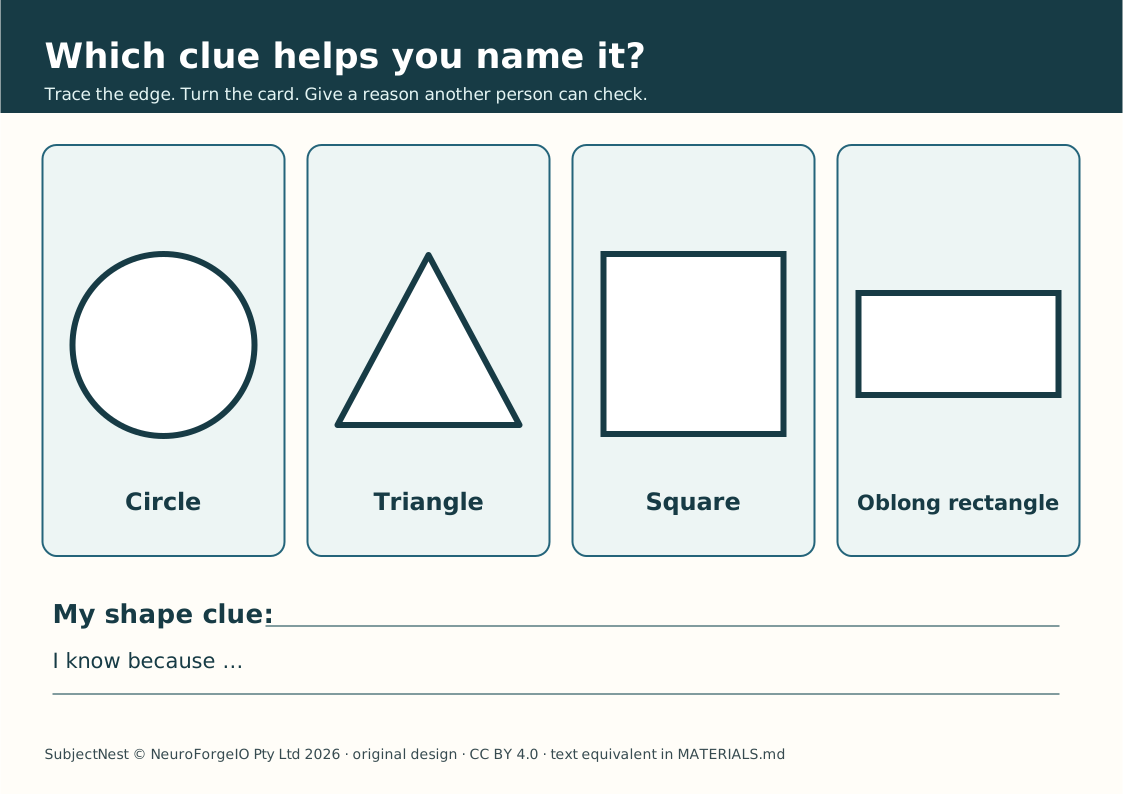
Schedule: run this guide's Day 105 after the separate English and mathematics Day 105 first checks if an independent first response is the aim. The collaborative art activity is practice and response, not a second fresh check.
| Day | Thirty-five-minute route | Evidence and teaching response |
|---|---|---|
| 101 · Notice and ask | 5 min show the original room collage; 7 min children trace or describe two visible shapes; 8 min ask which part of the picture each shape suggests; 10 min children choose one part and make a first “I notice … because …” response by speech, AAC, mark or drawing; 5 min gather one question about who might use such a picture. | Keep the child's exact shape clue and question. If a child names by colour, invite an edge/corner clue; if the picture's meaning differs for the child, ask for their reason rather than enforcing the maker's intent. |
| 102 · Make a new idea | 5 min revisit question; 7 min compare circle/triangle edges; 8 min plan a fictional shared place on paper with at least two child-chosen shapes; 10 min create or direct placement safely; 5 min explain what one shape does in their picture. | Keep first arrangement and child-owned meaning. A child may use a blank paper “room” or a wholly different imaginary scene. Score maths shape property separately from art choice. |
| 103 · Let a viewer try | 5 min child chooses a willing familiar viewer or adult; 7 min describes one shape without pointing; 8 min viewer points to the understood part; 10 min child asks “What did my picture help you notice?” and listens; 5 min records one useful response. | Do not require public speech or eye contact. If viewer selects a different shape, ask which descriptive clue could be clearer. Record maker's intent and viewer's report as distinct sources. |
| 104 · Why might it matter? | 5 min revisit the teacher collage; 7 min teacher says it was made to give people a way to talk about an imagined shared room, not to represent a real community; 8 min children discuss whether art could help someone notice, imagine, remember or ask a question; 10 min child creates a one-sentence reason about this work and may ask a willing class adult what it helped them notice; 5 min compare the two views without “everyone” claims. | Keep a child's reason and any willing viewer's actual words. If no viewer is available, keep a hypothetical question rather than inventing testimony. This is a partial AC9AVAFE01 opportunity, not proof of community impact. |
| 105 · Revise or keep | 5 min show first work; 7 min revisit one exact viewer response; 8 min child decides to change a shape, label, position or keep it with a reason; 10 min make/recheck the version; 5 min choose private, small or consented display and record what changed. | Keep before/after and the child's reason. A learner may decline display and still complete the response. Do not use the art task as the fresh maths/English check; those use separate held-out cards. |
Proposed national links: AC9MFSP01 for child reasoning about shapes; AC9AVAFD01 for discovering ideas, AC9AVAFC01 for communicating an idea, AC9AVAFP01 for sharing with a chosen audience, and AC9AVAFE01 for exploring a reason art can matter to people in the supplied context. Exact codes and Foundation year checked in the official ACARA v9 workbook, retrieved 29 September 2026; pinned SHA-256 db446882d2c00cf7c085a03e250e2442fda6c44011fc114680c46c1dc7a822c3. These links are partial; local adoption, cultural authority and professional judgment remain necessary. No First Nations visual motif, language, community art practice or generic cultural meaning is invented. Seek appropriate local knowledge holders if adding such content.
Access: spoken/tactile description of the collage, large high-contrast shapes, child-directed adult placement, digital moveable shapes, no-glue route, quiet/private viewer and AAC/sign/gesture/drawing explanation. Ask the child which route works; do not assign a fixed “visual” or “kinaesthetic” label. Preserve the child's exact idea and adult assistance. Identifiable records stay in school-approved storage.
Original guide, fictional collage concept and prompts © 2026 NeuroForgeIO Pty Ltd, SubjectNest, CC BY 4.0. Credit, link and indicate changes. ACARA material retains its own terms. Human educator, access, local syllabus and classroom review pending.