Each block is 25 minutes. Use learner cards and the teacher material setups and text alternatives. Keep fresh checks unseen until Days 105 and 110. Record the child's first independent sort, placement or reason, exact prompt and access route. A shape name without a checked clue and a route copied after adult modelling are different evidence from independently explained thinking.
Week 21 · Day 101 — Curved or straight?
Goal: sort familiar large paper shapes by an observable edge and explain one choice. Proposed code: AC9MFSP01. Prepare: practice shape collection; neutral colours; Card 101.
- Notice · 3 min. Show a circle and triangle of the same colour. Ask what could be checked about their edges, without asking for names first.
- Model · 4 min. Trace circle's continuous curved boundary and a triangle's straight side; place each in a labelled group.
- Guide · 5 min. Children trace a square and oblong card and add them to the straight-edge group. Check by touching or following a high-contrast outline.
- Independent sort · 7 min. Give a new-sized circle, triangle, square and oblong. Child sorts and explains one choice by edge, not colour or size. Preserve first placement.
- Challenge · 4 min. Ask if turning the triangle changes whether its sides are straight. Child tests by rotating the same card.
- Exit · 2 min. Ask for a reason a circle is in the curved group. If only the name is given, model tracing and recheck a new outline tomorrow.
Week 21 · Day 102 — A triangle stays a triangle
Goal: name and create a triangle with three straight sides and corners across size and orientation. Proposed code: AC9MFSP01. Prepare: two dissimilar triangle cards, three large strips, Card 102.
- Retrieve · 3 min. Child finds one straight-edge card and gives a visible reason.
- Model · 4 min. Count a triangle's three straight sides and three meeting corners, then turn it without adding a side.
- Guide · 5 min. Compare a small rotated triangle and large upright triangle; children trace and count each, not the space it occupies.
- Independent make · 7 min. Child connects three large strips end-to-end to make a closed triangle or directs a digital/adult placement; explain why an open three-strip path is not yet the outline.
- Test · 4 min. Rotate the made triangle and compare with a four-sided card. Ask which exact feature separates them.
- Exit · 2 min. “How many straight sides did you check?” Expect three; reteach closed shape versus open path if needed.
Week 21 · Day 103 — Four sides are not the whole story
Goal: describe a square and an oblong rectangle using side/corner clues without enforcing false exclusive categories. Proposed code: AC9MFSP01. Prepare: same-colour square and oblong, equal-length paper strips, Card 103.
- Retrieve · 3 min. Child checks one triangle and one four-sided card by tracing, not size.
- Model · 4 min. Count four straight sides and corners on both cards. Match strips along adjacent sides of the square; all four match on this card.
- Guide · 5 min. Compare the oblong; its long and short adjacent sides differ. Say this is one rectangle example and that a square also has rectangle properties.
- Independent compare · 7 min. Give a rotated square and oblong. Child names or selects both and gives one shared feature plus one useful distinguishing clue.
- Check · 4 min. Ask whether turning the square made a new shape. Have child match sides again rather than rely on orientation.
- Exit · 2 min. Expect “both four straight sides; square has four equal sides on this card.” If only “one is bigger,” revisit strips tomorrow.
Week 21 · Day 104 — A shape within an object
Goal: recognise a familiar 2D outline within an original pictured object and justify where it is. Proposed code: AC9MFSP01. Prepare: educator-made paper room picture: round clock face, triangular bunting, square tile, oblong table top; Card 104.
- Retrieve · 3 min. Briefly trace circle, triangle, square and oblong practice outlines with a child-selected route.
- Model · 4 min. Point only to the clock face in the drawing: it looks circle-like because its visible outline curves around. The whole clock may have depth.
- Guide · 5 min. Children find bunting's triangular face and count three edges/corners on the drawing. Ask if the hanging string is part of that triangle.
- Independent locate · 7 min. Child chooses a different pictured object part, traces its boundary and names a familiar shape with a reason. Record exactly which part was chosen.
- Transfer · 4 min. Show an angled view of the table top and ask whether one picture alone proves every real table has that shape. Expect a bounded claim about this drawing.
- Exit · 2 min. “What part did you look at, and what shape clue did you check?” Reteach part-versus-whole if blurred.
Week 21 · Day 105 — Fresh shape sort and make
Goal: independently sort new outlines, make one and give a reason. Proposed code: AC9MFSP01. Prepare: unseen assessment set, Card 105 warm-up only.
- Welcome · 3 min. Say the new pieces help the teacher choose the next shape activity; no timed race.
- Warm-up · 4 min. Allow child to make any familiar closed paper shape; ask them to show one side or edge they checked.
- Fresh sort · 5 min. Present held-out rotated/sized outlines without names; ask for a group rule. Do not hint at orientation.
- Independent make · 7 min. Child uses large strips or child-directed placement to make a matching shape and explains why it belongs in the chosen group.
- Check · 4 min. Teacher asks for a counterexample from the set; record first and revised reasons separately.
- Exit · 2 min. Choose an exact next move: edge tracing, closed-shape making, rotation recheck or environmental-shape reasoning. One sort does not prove the whole content description.
Week 22 · Day 106 — Position needs a reference
Goal: describe cup picture position relative to a named mat, then retest after moving it. Proposed code: AC9MFSP02. Prepare: large paper mat and cup, Card 106.
- Notice · 3 min. Put cup on mat and ask “Where is the cup relative to the mat?”
- Model · 4 min. Say “The cup is on the mat,” move it beside and say “The cup is beside the mat.” Name the reference in both.
- Guide · 5 min. Child places cup under the mat on a flat paper model or directs placement; check the relation from the agreed viewing position.
- Independent placement · 7 min. Give a fresh starting layout, then an adult-read relation. Child moves/directs the cup and states where it ended relative to the mat; record first placement.
- Check · 4 min. Move the mat but leave cup fixed; ask if the earlier statement remains true. Let child revise with a visible reason.
- Exit · 2 min. “Beside what?” Expect the mat. Tomorrow use a three-object reference if only isolated vocabulary appeared.
Week 22 · Day 107 — Between two named objects
Goal: show and describe between using two reference objects; recognise how moving one can change the claim. Proposed code: AC9MFSP02. Prepare: paper star, book, cup, Card 107 and practice map.
- Retrieve · 3 min. Ask child to show cup beside mat and name the mat as reference.
- Model · 4 min. Arrange star–book–cup across paper. Say “The book is between the star and cup.” Point to both references.
- Guide · 5 min. Children place a different large marker between two named paper symbols, checking its position with a finger path.
- Independent try · 7 min. Child arranges three shuffled objects, gives a true between sentence and directs another person to locate the middle item.
- Change · 4 min. Move the cup to the left of star; ask whether the original between sentence remains true. Child checks, rather than guesses from the word alone.
- Exit · 2 min. Expect a sentence naming both objects around the middle. Use a tactile line with three large positions if needed.
Week 22 · Day 108 — Two legs on a paper map
Goal: describe and follow start, first stop and next stop relative to map symbols. Proposed code: AC9MFSP02. Prepare: practice paper map or tactile equivalent, Card 108, marker.
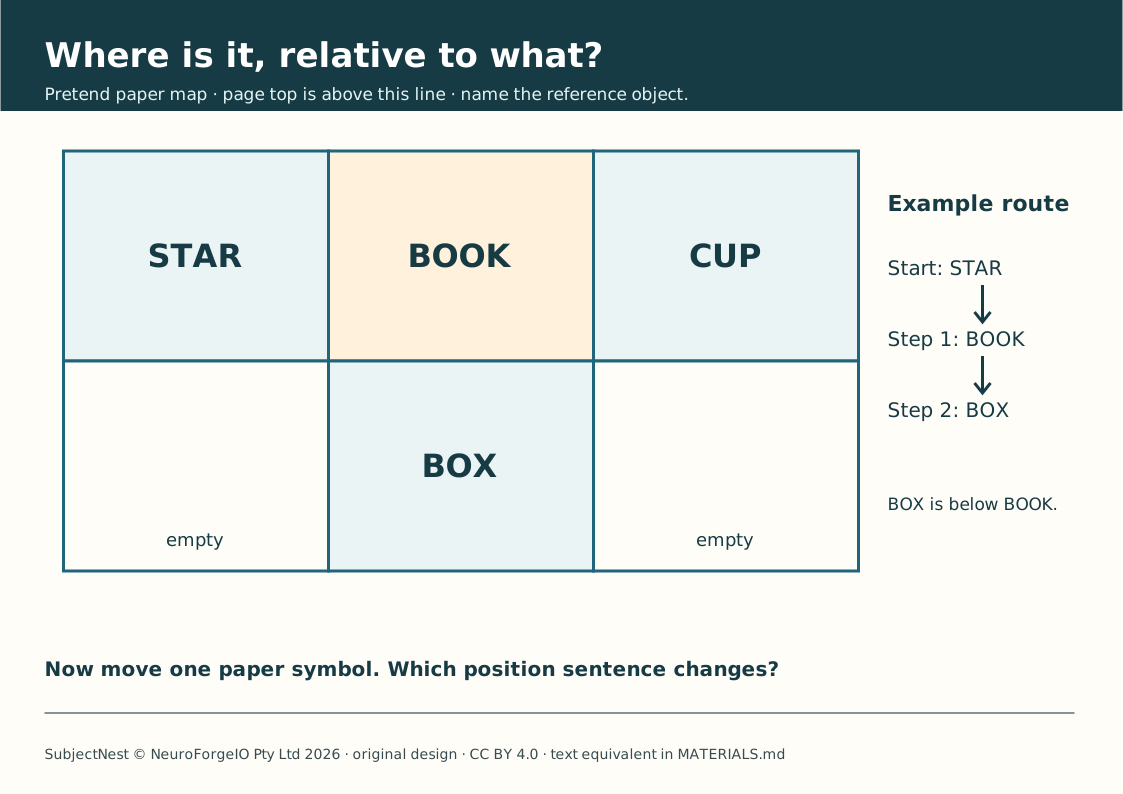
- Orient · 3 min. Name this as a paper model; place the visitor on star and say where the page top is.
- Model · 4 min. Move star → book, pause, then book → box. Name book as both first stop and second start.
- Guide · 5 min. Child points to cup relative to book, then box relative to book. Check right and below from the stated page orientation.
- Independent route · 7 min. Child gives or follows a new two-leg route using the same map, stopping after each leg. Record the actual endpoint and wording.
- Check · 4 min. Partner/adult follows only the spoken, signed or AAC instruction. Child revises a missing reference or ambiguous step.
- Exit · 2 min. Ask “Where is box relative to book?” Expect below on this map; if answer is just “there,” add named-reference practice.
Week 22 · Day 109 — When the map changes
Goal: update a position description after one symbol moves and test a revised route. Proposed code: AC9MFSP02. Prepare: loose paper map symbols, Card 109, marker.
- Retrieve · 3 min. Child points to start, first and next on yesterday's practice map.
- Model · 4 min. Move the box from below book to beside cup; explain why “box below book” is no longer true.
- Guide · 5 min. Rehearse a new two-step path to the moved box, naming each object and pausing between moves.
- Independent design · 7 min. Child changes one different symbol, describes where it now is relative to another, and gives a two-leg route. Listener follows without adult correction first.
- Audit · 4 min. Compare intended and actual endpoints. Child revises the map or words, saying which changed; save both versions.
- Exit · 2 min. “Which symbol moved, and which relation changed?” If child only recounts the old route, use one step with two symbols tomorrow before the fresh check.
Week 22 · Day 110 — Fresh position check
Goal: follow an unseen two-step paper route and justify one relative location with a named reference. Proposed code: AC9MFSP02. Prepare: fresh assessment map, large/tactile symbols and a private record.
- Welcome · 3 min. Explain the new map is a way to find the next teaching step, not a speed test or a real room direction.
- Orient · 4 min. Give the map orientation and symbol names without tracing the route; child identifies the stated start.
- Listen · 5 min. Read the two connected directions once, repeat by the agreed route if needed and log the repeat.
- Independent route · 7 min. Child moves/directs visitor one leg at a time, names final object and states where it is relative to the supplied reference.
- Check · 4 min. Ask how the child knows; only then show the key and invite a revision. Preserve first and revised route separately.
- Close · 2 min. Choose a next move: name the reference, one-leg practice, linked-leg practice, page orientation or transfer to a different safe familiar space. Inaccessible evidence is not observed.
The English lesson also uses route language; keep the two subject records separate and do not double-count a coached group demonstration as an independent check.