Five 35-minute integrated blocks, Foundation / Queensland Prep · teacher draft. Use with English Days 106–110 and mathematics Days 106–110. The main model is an invented six-space paper map with a complete text/tactile alternative. These are routes for a paper visitor, not directions for a child to leave a supervised area, use public roads or replace an evacuation procedure.
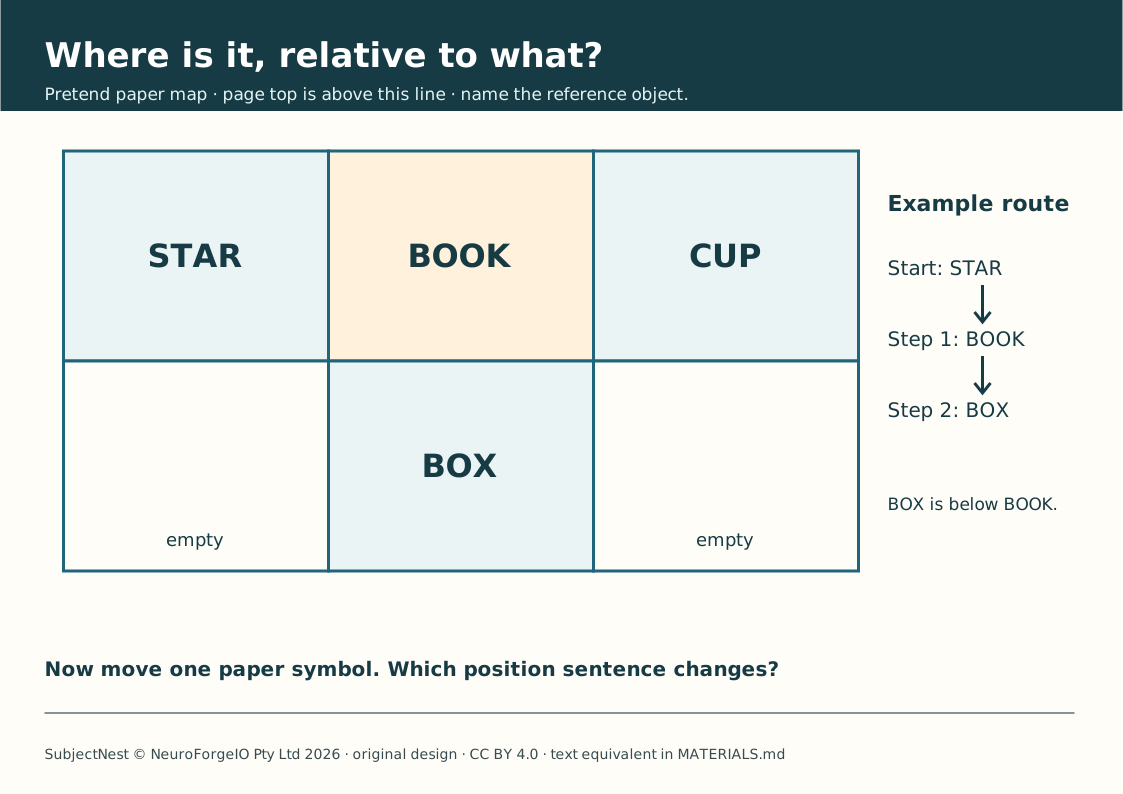
Prepare: large star/book/cup/box symbols and a moveable visitor, Start/First/Next cards, a mat that states page orientation and a second blank grid. If a familiar real classroom route is locally approved, pre-walk it with the supervising adult, keep all children in a safe bounded area and allow a seated paper route instead. Never publish a precise school or child location. A direction works only relative to a named reference and agreed viewpoint; a changed map calls for a changed direction.
Schedule: run the Day 110 group rehearsal after the separate English and mathematics held-out checks so the first responses remain interpretable. Those checks use different maps from this guide.
| Day | Thirty-five-minute route | Evidence and teaching response |
|---|---|---|
| 106 · Start and stop | 5 min agree that the paper map is imaginary; 7 min read/star/book/cup/box positions aloud or tactilely; 8 min teacher models star → book → cup with a pause; 10 min each child moves or directs a visitor and says first/next stops; 5 min ask what needs naming before “go there.” | Record first and next separately. If child jumps to the final object, model only the first leg, then use a different destination. English listening and maths location records remain distinct. |
| 107 · Beside, below, between | 5 min place book between star and cup; 7 min child says what the book is between, naming both; 8 min show box below book on the page; 10 min move one symbol and ask which relation remains true; 5 min child makes a new reference-rich sentence. | “Below” without “the book” is incomplete for the target. Use a tactile line or vertically aligned large cards. Do not claim left/right is universal when the viewer turns the page. |
| 108 · Give a usable route | 5 min revisit Start/First/Next; 7 min teacher models a star → book → box route with two distinct legs; 8 min child plans a different two-leg route on paper; 10 min a willing partner/adult follows exactly what was said, signed or selected; 5 min child adds a missing reference if endpoint differs. | Preserve the first instruction and revision, not a polished adult script alone. A child who directs another person's hand still controls the route. |
| 109 · Map change and safety | 5 min teacher moves the cup picture; 7 min children compare before/after map; 8 min discuss why an old route can become unclear and why real safety routes need adult-approved current information; 10 min child revises a paper route and tests it; 5 min name the changed relation. | Keep original and changed paper layouts. If a real class-room exploration is approved, teacher supervises and records only a general relation, not a shareable plan of entrances or addresses. |
| 110 · Tell someone how to check | 5 min use a new practice blank grid, separate from the held-out subject assessments; 7 min child chooses three symbols and labels start/first/next; 8 min child gives a two-leg route; 10 min listener follows and reports endpoint; 5 min child revises or explains why no revision is needed. | This group rehearsal is not the fresh English or maths Day 110 check; those have different hidden maps. Keep one child-controlled instruction and listener result to guide later integrated work. |
Proposed national links: AC9MFSP02 for position/location relative to named people/objects in a familiar space, AC9EFLY02 and AC9EFLY07 for listening, interaction and a short communicated route, and AC9HPFM02 only if locally approved safe movement is taught and observed. The paper-only option supports the other goals but does not evidence the physical movement code. Exact Foundation code/year checked in the official ACARA v9 workbook, retrieved 29 September 2026; pinned SHA-256 db446882d2c00cf7c085a03e250e2442fda6c44011fc114680c46c1dc7a822c3. These are partial teaching links, not endorsement or a local syllabus decision.
Access and dignity: paper, tactile, spoken, signed, AAC, enlarged or digital map; quiet adult partner; child-directed placement; movement-free route. Repeat a direction when needed and log the repeat. Check hearing/vision/motor access with learner and relevant specialist before interpreting an error. No learner needs to disclose a home address, personal travel pattern or safety event. Store child evidence privately under school policy.
Original map activity and guide © 2026 NeuroForgeIO Pty Ltd, SubjectNest, CC BY 4.0. Credit, link and indicate changes. ACARA material retains its own terms. Human educator, safety, access and local syllabus review pending.