A label knows one thing. A person’s account knows another. Which clue helps your question?
Paper, telling/signing/AAC, private work, rest or finish are all okay. A helper can read the source or do the moving you choose.
Pick a way
(a) Source ticket desk: Give each chosen answer a source-type ticket: catalogue, attributed account or actual observation.
(b) Question pocket: Make a paper pocket for one supported answer and one unanswered follow-up; no cutting is necessary.
(c) Two voices rehearsal: Have a willing helper read O5 as written; child tells which speaker/source supports the detail and labels the reading as rehearsal.
Complete selected sources
O5 — A catalogue and an account
Original fiction. A catalogue note written 2025 says the invented Maple Drawer holds one paper spotting game with four illustrated cards; it labels its making period “about 1992”. An attributed fictional recollection from Vera, recorded 2026, says: “In 1994 I played a paper spotting game with my sister. We took turns finding the pictured leaf.” The catalogue does not identify who used its particular game. Vera's recollection does not say her game is the catalogue's game. Neither names the paper maker or proves every family had it. Asking about Vera's playing companion can use the recollection; asking how the catalogue describes its cards can use the catalogue. Exact identification linking the two objects stays unknown.
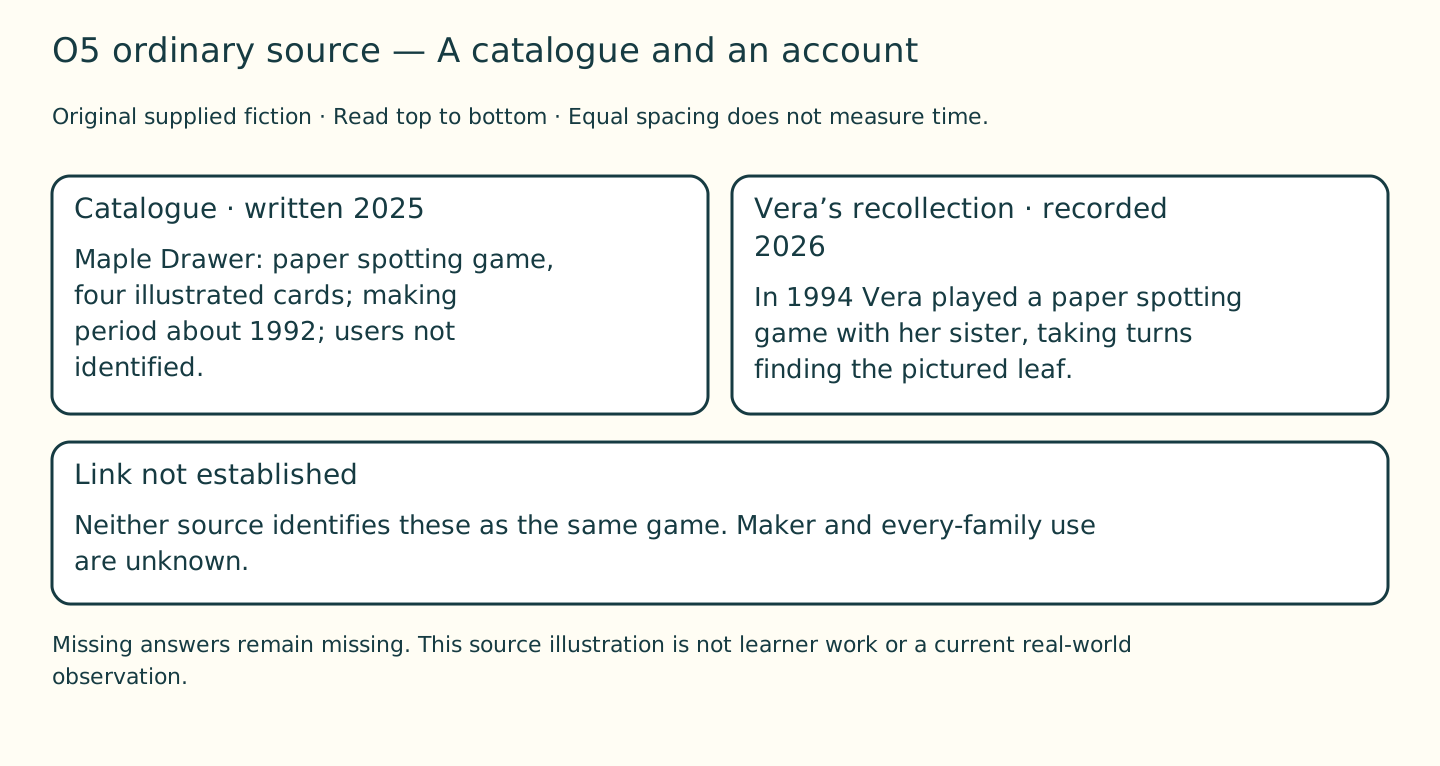
Whole drawing and complete text alternative.
Grown-up help
Offer one wanted route, not all three. Read the source neutrally, or support sign/AAC, dictation, broad marks and child-directed operation. Keep adult work separate. Rest, private work, pass or finish are valid options. [Full teacher plan](../teacher/day-36.html) · [Blank making mats](../aids/OWN.html).Sources and reuse · Original educational work © NeuroForgeIO Pty Ltd 2026, CC BY 4.0. Linked authority/provider exceptions and learner ownership stay separate.