Checked 29 September 2026. This is an authored and mechanically checked fortnight, not a classroom trial, independent expert review, national approval or state syllabus sign-off. It reaches 120 in selected tasks but cannot by itself establish full Year 1 attainment.
| Primary source | Checked use | Limit |
|---|---|---|
ACARA Australian Curriculum v9 official download, retrieved 29 September 2026; pinned original workbook SHA-256 db446882d2c00cf7c085a03e250e2442fda6c44011fc114680c46c1dc7a822c3 |
Local content-description import confirms AC9M1N01: recognise, represent and order numbers to at least 120 with materials, numerals, number lines and charts. It confirms AC9M1N02: partition one- and two-digit numbers in different ways, including tens and ones. Both records are Year 1. |
Week 5–6 three-digit models sample N01; they do not extend N02 to three-digit partition or complete either code. A child needs repeated independent evidence in the school's sequence. |
| ACARA Year 1 number charts and puzzles work-sample page | Independent public check that the Year 1 achievement statement includes number names, numerals, quantities and order to at least 120. | Its example tasks and learner work are not copied or treated as evidence that SubjectNest's tasks work. |
| ACARA copyright and terms | Separate authority over exact curriculum wording, exclusions and attribution. | No ACARA diagram, work sample, logo or worksheet is embedded; no endorsement. |
| AERO explicit instruction guide | Informs short model, guided attempt, independent response and feedback/next teaching structure. | AERO has not tried or rated these exact lessons. |
| QCAA ACiQ v9 | Queensland local adoption entry point. | The national pack is not verified against current Queensland, NSW or any other state/territory scope and sequence. |
Recomputed facts and held-out checks
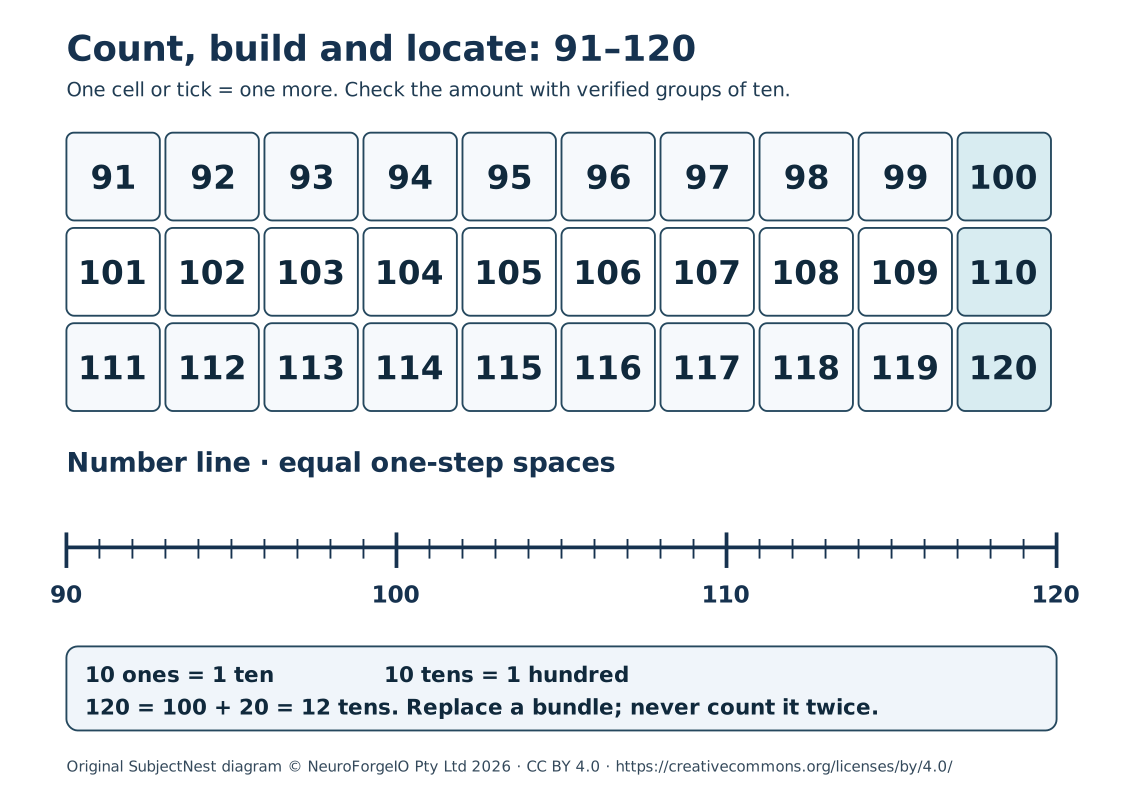
- Thirty original context-card totals were recomputed from 9, 10, 11 or 12 verified strips plus named singles. The teacher key lists every value/action. At 99 + 1, ten ones become one ten and ten tens become one hundred; at 109 + 1 and 119 + 1, ten ones become one further ten. In all three trades, the amount is unchanged.
- A hundred square is an alternative representation of ten full strips. The centre zero in 103 means zero separate tens in the standard hundred-plus-ones model; 103 still contains groups of ten. The key addresses that wording to avoid a false place-value explanation.
- The chart and one-step line show every integer 91–120 and equal ticks 90–120; text and tactile directions give the same information. The line from 103 to 113 has ten steps and nine interior whole-number positions. The generator uses no third-party visual and the printable aid contains its licence.
- Day 25 and Day 30 checks are withheld from prior modelling as situations and task combinations; some number values recur across instruction because the concept requires transfer with familiar values. The learner check page has no answer table. A copied group model, chart guess or adult-completed trade is recorded with its support, not silently marked independent.
Use walk-through
Teacher: I can prepare ten audited strips, a hundred bundle and singles, then run each 25-minute block from its timed script. Day 27 needs twelve strips if I choose the no-hundred alternative; I can instead use a tactile ten-bundle plus two strips. Each day has three different interest contexts and a specific misconception response. I hold Check 1/2 away from learners, observe first representations, use the key to distinguish an access adjustment from a maths prompt, and choose an unused recheck. This is a 25-minute maths component, not a whole-day program.
Learner: I can choose drawn books, music, game, map, art or other invented marks without revealing my own address, money or preferences. I can build, touch, point, select, sign, speak or direct an adult, and I can look at the line when locating is the target. Nothing is timed for speed. If the pieces are too small, I can use large or tactile substitutes. I can challenge an incorrect model by finding the duplicated strips instead of being told only “wrong.”
School/funder reviewer: The release unit has ten 25-minute scripts, thirty fictional card choices, two fresh formative sheets, an explicit key and next moves, one original A4 SVG with full text alternative, exact pinned code/year checks and file hashes. These are inspectable inputs and desk checks, not evidence of learning gain, teacher workload reduction or classroom adoption. Year 1 still needs Weeks 7–40, other subjects, a locally approved Languages pathway, local/state overlay, accessibility/user review and classroom feedback.
Reuse and pending decisions
Original prose, number examples and vector aid © NeuroForgeIO Pty Ltd 2026, CC BY 4.0. Credit SubjectNest by NeuroForgeIO Pty Ltd, link the source and licence, and note changes. The optional generator/verifier code is Apache-2.0. ACARA material keeps its own terms. No child data, bought kit, stock art, recorded narration or translation is embedded. A translation needs a named locale and qualified human review; a First Nations language edition needs language-owner authority and a community-led process.
An experienced teacher, disability/access reviewer, local curriculum lead and learners should test the actual card size, language load, 25-minute timing, place-value misconceptions and real usability. A desk run-through does not replace them. Revisions should preserve earlier first-response evidence rather than pretending every child mastered the number range after one day.