Five 35-minute Science, mathematics and English sessions. Partial Year 10 ACARA v9 links: Science AC9S10U05, AC9S10I01, AC9S10I04, AC9S10I05, AC9S10I06, AC9S10I07, AC9S10I08; mathematics AC9M10ST01, AC9M10ST03; English AC9E10LA02, AC9E10LY06. The cart readings are authored simulations for a 0.50 kg cart; they were never measured. The supplied numbers cannot establish a wheel-finish effect. This is a safe paper/model route into Newton's laws and evidence quality, not full experimental coverage or a claim that eight points validate a law.
Prepare: eight-row table, scatterplot frame, paper arrows and a ruler. Screen optional only for local enlargement/plotting. No physical cart is needed. If a school adds a real cart, an approved science educator must plan apparatus, force measurement, surface, risk assessment, accessibility and repeatability; do not substitute this fictional table for actual readings. No images, recordings or names of children are collected.
Day 1 — Name the system before using a formula
Question: What does F_net = ma mean for the specified cart? Evidence: force/mass/acceleration diagram and unit sentence.
- Start · 3 min. Say: “A media claim uses a number. We first ask what quantity was changed and what was measured.” Display the three column names and 0.50 kg mass.
- Model · 5 min. On paper draw a cart box and an arrow labelled net force. Explain that net force means the combined force after opposing effects, not merely a person's push. State
F_net = mafor the simple model. - Calculate · 8 min. At 1 N and 0.50 kg, ideal acceleration is
1/0.50 = 2 m/s²; at 2 N it is4 m/s². Name each unit and what is held fixed. - Compare · 10 min. Pairs compute ideal values at 3 and 4 N (6, 8 m/s²) and compare with the two simulated readings at each force. They label “ideal prediction” separately from “authored reading”.
- Explain · 6 min. Ask why 1.8 and 2.1 can sit near 2 without being equal. In a real investigation, measurement/method variation may matter; here the discrepancy was authored. Do not invent a specific error source as a fact.
- Exit · 3 min. Everyone states: “For fixed 0.50 kg, doubling net force from 1 to 2 N doubles ideal acceleration from 2 to 4 m/s².” Teacher samples focus reasoning.
Access: tactile arrow, spoken units, large table or screen-reader text; student directs a partner's diagram if needed.
Day 2 — Represent eight readings without losing repeats
Question: How does a representation reveal pattern and variation? Evidence: table-to-plot or exact text-coordinate map.
- Retrieve · 3 min. Ask which variable belongs on each axis and why the table has two readings per force.
- Model · 5 min. Place
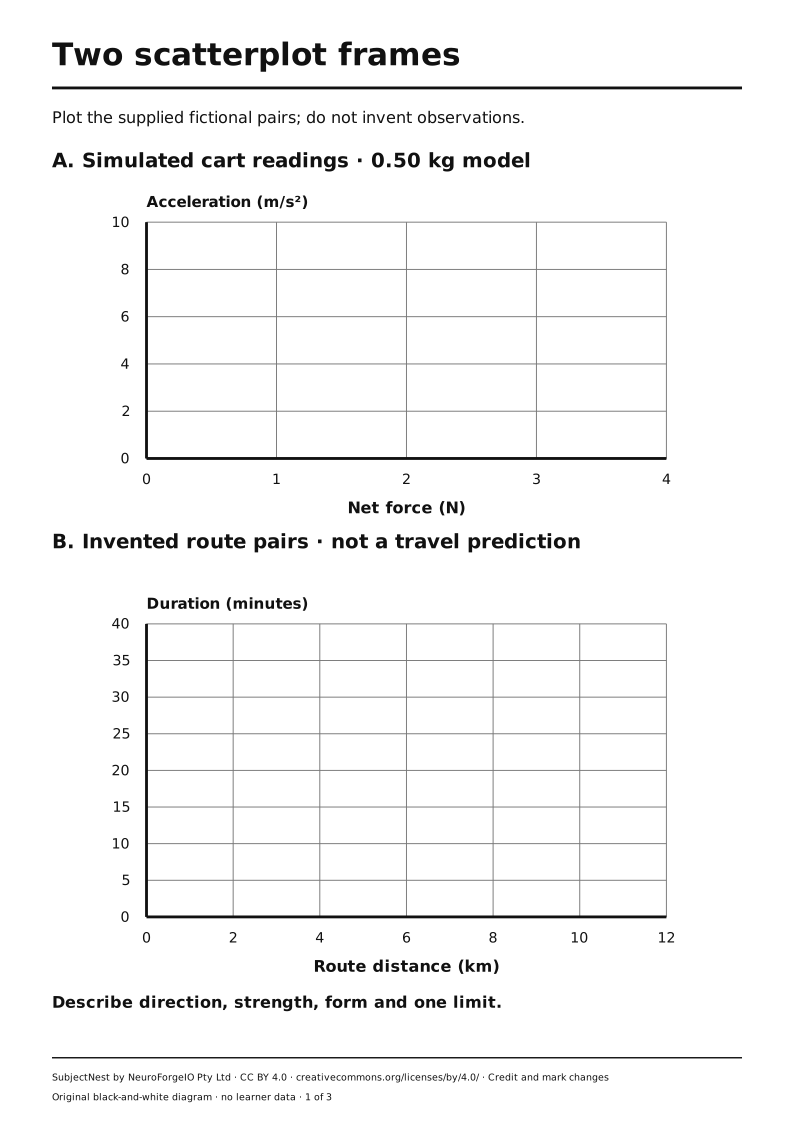
(1,1.8)and(1,2.1)on the graph. Do not merge them into one point; repeated x does not mean error. - Construct · 8 min. Pairs place the remaining six points, read them back from Table A, and label N and m/s².
- Analyse · 10 min. Describe rising, near-linear pattern; compute paired means 1.95, 4.00, 6.05, 7.95. Compare to ideal 2,4,6,8 while keeping “simulated” visible.
- Check · 6 min. Deliberately show a wrong graph with one 4 N point at 1.8. Students locate the transposition by checking the source row, not visual intuition alone.
- Exit · 3 min. Everyone reports one coordinate and one pattern statement with fictional scope.
Access: text ordered pairs and tactile axes are equivalent representations for the scientific inference. Note if number transposition rather than scientific reasoning caused an error.
Day 3 — An association is not the proposed cause
Question: Does Table A test a silver wheel finish? Evidence: claim–evidence–missing-comparison note.
- Read · 3 min. Display Text B's headline. Ask what change it claims caused what outcome.
- Model · 5 min. Point to 8.1 at 4 N and 1.8 at 1 N. Both force and acceleration differ; the table has no wheel-finish column. It cannot isolate a finish effect.
- Question · 8 min. Pairs form an investigable question: “At the same cart mass and applied push, do otherwise comparable finish conditions give different acceleration readings?” Label the finish as the proposed factor, acceleration as outcome. A finish could change resistance and therefore net force; do not pretend that holding net force fixed would test that route.
- Plan on paper · 10 min. Sketch comparable trials: same cart mass, same applied-force method, same track/measurement method, repeated readings for each finish. This is a design critique, not an invitation to conduct an unapproved experiment. Measuring applied force, resistance and acceleration would each need a valid method; this classroom sheet supplies none of those measurements.
- Challenge · 6 min. Ask whether comparing only the highest silver trial with the lowest other trial would be fair. No: select like conditions and consider all repeated readings.
- Exit · 3 min. Everyone writes the missing comparison and one reason a single extreme is weak evidence.
Access: three-column factor/outcome/held-comparable board, oral/AAC route, quiet written option.
Day 4 — Make a caption that can survive scrutiny
Question: How do we communicate a result without a result we never obtained? Evidence: peer-audited caption with limit.
- Set purpose · 3 min. “A corridor reader may see the headline before the table. What must the first line say honestly?”
- Model · 5 min. Contrast “Silver finish quadruples speed” with “In simulated data, acceleration rose with net force for a fixed-mass model cart.” Mark quantity, conditions and scope.
- Draft · 8 min. Students make a 50–70 word caption, print or accessible text, citing two points or means and a limit. No real photo or child voice is needed.
- Peer audit · 10 min. Partner checks source, units, no speed/acceleration swap, no finish claim, and readable limit. Author revises; criticism targets the claim, not the person.
- Discuss · 6 min. Ask what extra valid evidence would be needed before a finish claim. A planned comparison is not evidence of an outcome; a reader should know the difference.
- Exit · 3 min. Everyone submits the corrected title plus one uncertainty sentence. Teacher observes planned focus learners.
Access: caption in large print or text; dictation/AAC with a local transcript; assess scientific reasoning separately from decorative skill.
Day 5 — Check a new ideal model and the old claim
Question: Can a learner use the law and still reject an unsupported claim? Evidence: individual calculation and evaluation.
- Orient · 3 min. Say: “The next values are an ideal calculation, not another measured trial.”
- Retrieve · 5 min. Revisit
F_net=ma, units and why Table A did not test finish. Teacher gives no new-check answer. - Independent item · 8 min. Give the learner Week 1 check. New model: 1.0 kg cart, 3 N net force. Calculate ideal acceleration and compare with a 0.50 kg cart at the same 3 N. Then answer whether the finish headline is proved.
- Explain · 10 min. In pairs, learners read each other's reasoning and ask one specific question; original learner answers or revises. Teacher samples 2–3 focus learners, documenting any prompt.
- Feedback · 6 min. If mass/force are swapped, return to units and inverse relation. If the learner treats a paper plan as completed evidence, ask what was actually observed. Keep a later independent recheck.
- Exit · 3 min. Everyone submits calculation and one supported caption sentence.
Key: 3 N / 1.0 kg = 3 m/s² ideal; at 0.50 kg and 3 N, 6 m/s² ideal. Same net force with double mass gives half the ideal acceleration in this model. Table A still has no finish comparison, so cannot establish the headline. Later independent recheck: at 2 N, a 0.25 kg ideal cart has a=8 m/s²; a 0.50 kg cart has 4 m/s². Ask the learner to label ideal, not observed, and explain the mass comparison. A correct number without the model/units needs an interpretation prompt.
Teacher record: day | local learner code | exact calculation/claim | independent/prompted/not yet observed | access | next teaching | recheck. Keep at school; SubjectNest does not collect child data.