Teacher master: includes interpretations and data answers. Give learners the separate student reading set. These texts, characters, posts, prices and data are fictional and original to SubjectNest. The mathematics teacher sheet holds the exact simulated numbers. Provide selectable text, large print or an exact adult reading. No paid text, account, video, child recording or translation is required. This opening set samples analysis and composition; it does not replace the Australian, First Nations Australian and world literature a school must select and review for the full course.
Text A — The number below the headline (short narrative)
The media club had one afternoon to make a display about the model cart trials. On the sheet, eight acceleration readings sat beside four different net forces. The numbers rose from 1.8 to 8.1. Arin drew a line through the dots and wrote the headline in capitals: SILVER FINISH MAKES CART FOUR TIMES FASTER.
“It is a strong line,” Leena said. She did not mean the graph. The words would stop people in the corridor. The club had spent a week making posters no one had looked at.
Arin tapped the first and last rows. “The numbers are there.”
Leena read the column headings aloud: net force, acceleration. “The first trial used one newton. The last used four. And acceleration isn't speed.” She turned the sheet so both of them could see the labels.
For a moment Arin imagined the blank space where the headline would have been. Then he wrote a smaller line beneath it: Simulated cart data; no wheel-finish comparison. The big words still sat above it, claiming more than the table could show.
“That note won't catch someone's eye first,” Leena said.
They tried again: MORE NET FORCE, MORE ACCELERATION IN OUR MODEL DATA. Under it they wrote what they had not tested. The second headline looked less like a victory. It gave a reader somewhere to start asking questions.
Reading possibilities
- Third-person narration offers a close view of both students without turning either into a villain. Arin values attention to the display; Leena values scope and precision. The ethical tension is whether a dramatic message justifies an unsupported claim.
- “It is a strong line” briefly carries two meanings: visual trend and persuasive sentence. The final “somewhere to start asking questions” suggests a purpose for honest communication. A different reading is welcome if grounded in text.
- The piece is fictional literature, not an actual lab report. It illustrates one way voice and sentence choice can affect response; it is not a substitute for the diverse literary study across Year 10.
Text A2 — Margin notes (original short poem)
I draw a hill from dot to dot,
a line so neat it seems to know.
The ruler tells me where it goes;
it cannot tell me why it grew.
I turn the paper toward the light.
The numbers do not change their place.
I ask who chose the first two dots,
and which ones never reached the page.
The speaker uses first person and a questioning, reflective voice. The “hill” is an image of a rising graph, not a claim about a real landscape. The final two lines shift attention from an attractive pattern to selection and missing evidence. Invite a different interpretation when it is supported by the poem's words.
Text B — A fictional media post to audit
SILVER FINISH MAKES CART FOUR TIMES FASTER! Our highest reading was 8.1 and our lowest was 1.8. That's proof that the silver finish works. Anyone who questions the result is ignoring the numbers. Get the new finish for your project.
This is an invented, deliberately flawed post, not an advert or scientific result. The source sheet records 8.1 m/s² at 4 N and 1.8 m/s² at 1 N, both for a 0.50 kg cart in fictional simulated trials. It records acceleration, not speed, and no comparison of wheel finishes. The ratio 8.1 ÷ 1.8 = 4.5 does not isolate any finish effect. “Anyone who questions…” excludes legitimate scrutiny. The invented imperative “Get…” implies a purchase decision without evidence.
Text C — A careful display caption (informative)
What the model data show. In eight fictional simulated trials with a 0.50 kg model cart, higher listed net forces correspond with higher acceleration readings. Two readings were supplied at each force from 1 to 4 N. The association is strong, positive and approximately linear within this constructed set. An ideal F_net = ma model predicts 2, 4, 6 and 8 m/s² for these forces and mass; the authored readings sit near those values.
What the model data do not show. No wheel-finish variable was recorded, so this set cannot test whether a finish changes acceleration. It also cannot establish how a real cart behaves without a reproducible investigation, instrument information and uncertainty analysis. A reader should not treat simulated numbers as measured results.
Compare B and C
B uses a shouty headline, selective extremes, certainty words and an excluding sentence to drive action. C leads with method and scope, separates observation from inference and gives a limit before recommendation. Neither text is a real source. Evaluation should name the exact words and data, not merely call one “good” and one “bad”.
Day 4 four-strip task key
Give learners the deliberately scrambled route strips from STUDENT-TASKS.md. A clear order is: source (“The six route pairs in this classroom sheet were invented”); pattern (“The listed duration generally increases as route distance increases”); support (the 2 km/7 minute and 12 km/35 minute pair); limit (traffic and stops were not recorded). Pattern and support may swap if the reader can still find the source and limit. Ask the learner to justify prominence rather than rewarding only one order.
Fictional adult device-hire decision (shared with Week 2)
An adult fictional household needs a device for study and creative work for an uncertain duration. For this exercise only, both month-to-month plans are assumed to meet the same access, safety and service minimums and to have no exit fee. Plan A: $240 setup plus $80 per complete month. Plan B: $480 setup plus $50 per complete month. The household has a $1,000 practice cap for 10 months. Real contract terms, performance, repair support, consumer rights and the household's circumstances are not supplied. Do not use this brief for an actual purchase.
Text D — A short-horizon argument (fictional adviser note)
If the device is needed for only four months, I would choose Plan A on stated price. Its modelled total is $560, compared with $680 for B. The lower setup charge matters when the arrangement ends early. But the phrase “only four months” is doing important work: the need might extend, and our sheet says nothing about actual service quality. I would verify the duration and full terms before anyone committed. At ten months, my price argument no longer wins.
Text E — A ten-month argument (fictional adviser note)
At a ten-month horizon, Plan B has the lower stated total: $980 rather than A's $1,040. It also fits the fictional $1,000 cap, while A exceeds it by $40. I would recommend B only within this simplified model, after checking that both plans really offer equivalent access, repairs and exit terms. The larger setup cost could be a barrier if the household cannot pay it at the start, even when the ten-month total is lower. A one-number “cheapest plan” slogan would hide that timing issue.
Teacher reading moves and word bank
- D and E can both be sound within different horizons. The writer's values appear in emphasis: immediate affordability in D, total ten-month cost in E. Neither knows the real household's priorities. Ask which noun or qualifier changes the claim's scope.
- The phrase “on stated price” signals a narrow criterion. Modelled means calculated from the invented rule; it does not mean observed market price. Net force is the combined force that changes motion; acceleration is change in velocity per time, not speed itself. Association describes a data pattern; it is not by itself proof of a cause.
- For respectful discussion, replace “Anyone who questions…” with “A reader may ask what other factors changed.” Analyse the exclusionary effect without asking students to disclose identity or personal finances.
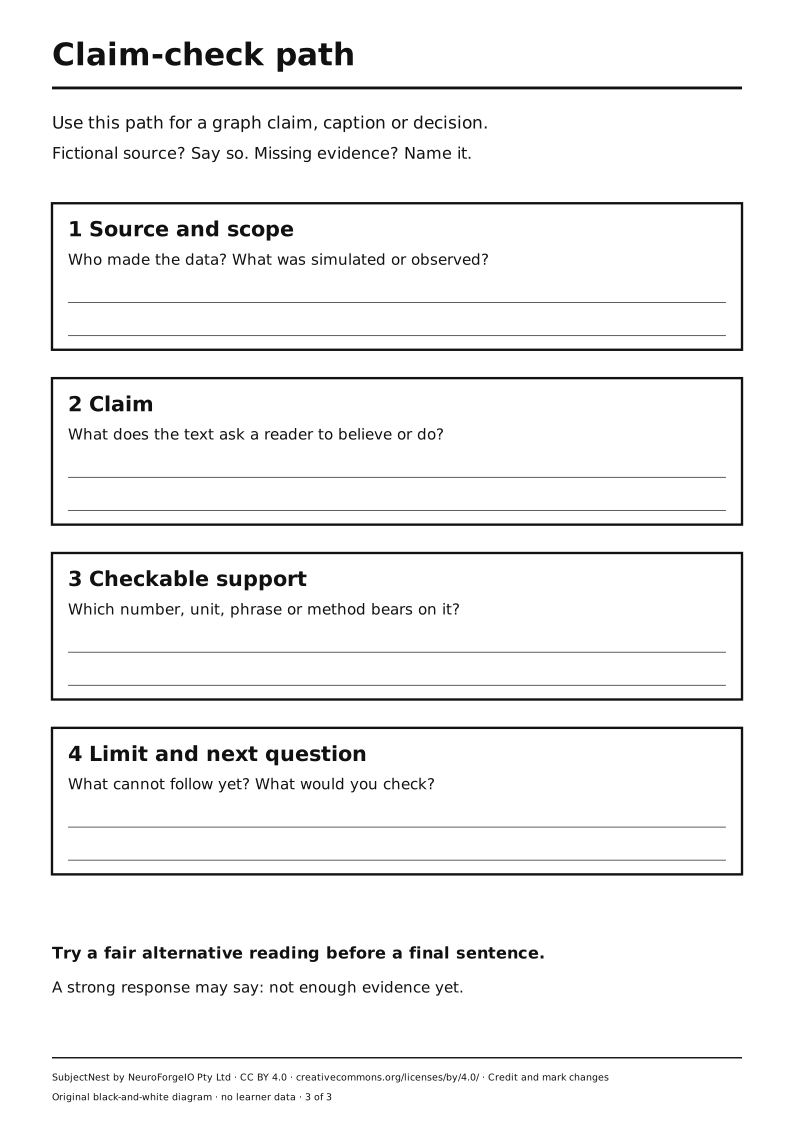
- A line of reasoning needs claim → selected data → explanation of relevance → boundary/uncertainty. The decision/evidence aid provides this sequence in text and print.
Reuse: Original SubjectNest prose, characters and fictional data © NeuroForgeIO Pty Ltd 2026, CC BY 4.0. Credit source/licence and mark changes. ACARA descriptions remain under separate terms.