Give learners the original reading set and dated task cards. Keep the teacher reading master and keyed checks with the educator. The claim-check aid is learner-ready. Each lesson has six timed phases totalling 25 minutes. Learners may read silently, hear an exact adult reading, use selectable text, speak, type, write or use AAC for the same reasoning goal. A code marks partial Year 10 Australian Curriculum v9 work. Rotate close observations across 2–3 focus learners a day; a whole-class exit is not 30 individual interviews.
Day 1 — Two values inside one narrative
Codes: AC9E10LE04, AC9E10LY05. Goal: analyse an ethical position in Text A with precise evidence. Prepare: Text A and two-column “choice / possible value” notes.
- Invite · 2 min. Say: “A headline attracts attention but may say more than the data. What would you protect first?” Give private think time; no personal disclosure needed.
- Read · 5 min. Read Text A aloud or allow silent reading. Pause after Leena reads the column headings; ask what Arin's original headline leaves out.
- Model · 5 min. Quote “That note won't catch someone's eye first.” Explain that Leena is considering placement as well as truth; the text positions accurate scope as an obligation to readers.
- Partner inquiry · 7 min. Choose Arin or Leena. Name one action, the value it may reveal and a quoted phrase. Partner offers a fair alternative interpretation, not a personality label.
- Discussion · 4 min. Ask whether the corrected headline loses all impact. Use its actual wording. Distinguish a reader's supported ethical judgement from the author's single fixed answer.
- Exit · 2 min. Everyone completes: “The narrative invites us to question ; the phrase ___ supports this because .” Teacher samples focus explanations.
Access: exact text, line markers, adult reading, typed or dictated evidence. Do not score willingness to speak publicly.
Day 2 — Voice changes the question
Codes: AC9E10LE06, AC9E10LE04, AC9E10LA05. Goal: compare how narrative and poem voice shape response. Prepare: Text A and A2.
- Listen · 2 min. Read the eight poem lines once, then ask learners to choose a line that lingers.
- Model · 5 min. Contrast Text A's third-person scene and dialogue with the poem's first-person “I”. The speaker turns a line into a “hill”, then asks who selected dots.
- Reread · 6 min. Pairs annotate where the poem's focus shifts from shape to evidence and where the narrative shifts from catchy wording to checking labels.
- Compare · 7 min. Students write or speak two sentences: one effect of each voice on the reader. Require exact words from both texts; “poem feels better” alone is not analysis.
- Experiment · 3 min. Rewrite “I ask who chose the first two dots” as an impersonal report sentence. Ask what sense of a human question is reduced or gained.
- Exit · 2 min. Everyone names one voice choice and its likely audience effect, with an example phrase.
Access: poem in selectable text; no demand for expressive reading. A learner may choose to hear lines twice or mark them tactilely.
Day 3 — Words can include or shut out a reader
Codes: AC9E10LA01, AC9E10LA02, AC9E10LY03. Goal: identify the social effect and implied values of an invented media post. Prepare: Text B and the source data.
- Read · 2 min. Read Text B exactly. Ask learners to underline one command or certainty phrase.
- Model · 5 min. Focus on “Anyone who questions the result is ignoring the numbers.” Explain that it frames scrutiny as disloyalty, which may discourage legitimate questions. The phrase reveals a value placed on quick agreement.
- Source check · 6 min. Locate 8.1 and 1.8 in Table A. Students note that net force differs (4 N vs 1 N) and no finish comparison exists.
- Repair choices · 7 min. Learners rewrite the excluding sentence in an invitation to check evidence, then rewrite “proof” with a scoped claim. A partner reads the new wording as a sceptical reader.
- Discuss · 3 min. Ask: “Would ‘some readers may ask’ change the data?” No, but it changes whose questions the text welcomes. Do not target any real student's identity or language.
- Exit · 2 min. Everyone pairs one exact phrase with its implied value/effect and one more precise alternative.
Access: highlight, copy/paste, large print, speech/AAC selection. The evaluation is of fictional wording, not a learner's manner of speaking.
Day 4 — Structure makes a claim navigable
Codes: AC9E10LA03, AC9E10LA04, AC9E10LY04. Goal: compare the organisation of Texts B and C for purpose. Prepare: both texts, claim-check aid and the four learner strips.
- Question · 2 min. “Which text asks for action first? Which makes its limit visible?”
- Model · 5 min. Map B: headline → selected extremes → certainty → command. Map C: scope → pattern → theoretical comparison → explicit limit. Say the sequence is part of the message.
- Guided annotation · 6 min. Students label C's two paragraphs and note how the repeated “model data” phrase keeps readers in scope.
- Rebuild · 7 min. In pairs, reorder the four exact invented-route strips from the learner task card into a trustworthy mini-caption: source, pattern, support, limit. Then compare with B's order.
- Evaluate · 3 min. Ask whether a limit at the very bottom of an unreadable page would work as well. Discuss reader navigation and prominence without inventing viewing statistics.
- Exit · 2 min. Everyone explains one structural choice and its effect on what a reader notices first.
Access: movable paper strips or text headings, screen-reader-friendly labelled paragraphs, partner reading on request.
Day 5 — Check A: a caption worth trusting
Codes: AC9E10LA08, AC9E10LY06, AC9E10LY05. Goal: create an accurate compact caption using technical words and a limit. Prepare: learner Check A, teacher key, and learner Table A.
- Purpose · 2 min. “A reader who has not seen the table should know what was simulated and what was not tested.”
- Model term · 5 min. Contrast acceleration with speed and net force with wheel finish. Write one precise sentence: “Higher listed net force accompanies higher simulated acceleration in this set.”
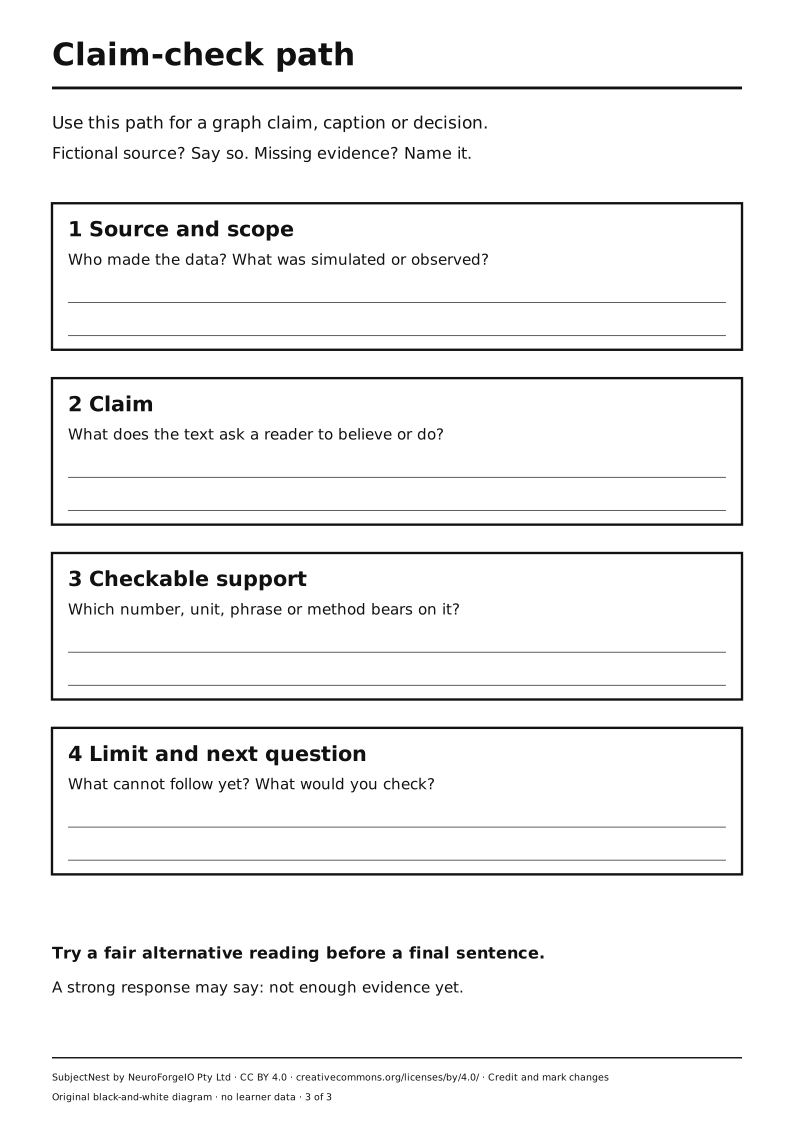
- Plan · 6 min. Learners use the claim-check aid: source, pattern, data example, limit. Point out a number must have unit and comparison conditions.
- Independent writing · 7 min. Write 3–4 sentences or an accessible equivalent with transcript. They may use Table A but not copy Text C whole.
- Self-edit · 3 min. Circle any “proves,” “always” or speed/acceleration confusion; repair at least one if present. Teacher samples 2–3 focus learners.
- Exit · 2 min. Everyone submits the caption. Use the key to choose next text or word move.
Access: sentence labels but no supplied conclusion; speech/AAC/typing; a locally recorded response needs a transcript and school data handling, not publication.
Day 6 — Two sound arguments with different horizons
Codes: AC9E10LA02, AC9E10LY03, AC9E10LY05. Goal: identify how assumptions and values shape Texts D/E. Prepare: fictional device brief and two notes.
- Orient · 2 min. “Both writers use the invented numbers. They answer different time questions.”
- Read · 5 min. Read D and E; mark “four months” and “ten-month horizon”. Clarify that the household is fictional and no personal budgets are requested.
- Model · 5 min. Check D: A(4)=$560, B(4)=$680. Explain why “on stated price” narrows the conclusion and hints at the author's value of lower initial commitment.
- Compare · 7 min. Pairs check E: B(10)=$980, A(10)=$1,040. Each selects one qualification and explains how it changes the apparent certainty. Swap texts.
- Question · 4 min. “Can one writer be right at four months and the other at ten?” Yes. Ask what a reader must know before adopting either: likely duration and real terms.
- Exit · 2 min. Everyone completes: “Text __ is persuasive for __ months because ; its limit is .”
Access: cost table, adult reading, private answer, calculator after model where approved. No family finance disclosure.
Day 7 — A sentence can hold a condition in view
Codes: AC9E10LA05, AC9E10LA08, AC9E10LY06. Goal: craft precise conditional and contrast sentences. Prepare: D/E and cost board.
- Hear · 2 min. Compare “B is cheaper” with “At ten months, B has the lower modelled total.” Ask which is safer for an unfamiliar reader.
- Model · 5 min. Write “Although B has a higher setup cost, its ten-month modelled total is $60 lower.” Identify the concession, main claim and exact horizon; check $1,040−$980=$60.
- Guided repair · 6 min. Repair “Since A starts cheaper, it always costs less.” Use equality at month 8 and a conditional clause naming duration.
- Independent choice · 7 min. Students write two linked sentences for a fictional arts studio, home device or community organisation reader using the same plan data: one condition and one fair counterpoint. The audience can change; figures cannot.
- Test aloud · 3 min. Partner reads the sentence without context. Author adds a unit or horizon if missing.
- Exit · 2 min. Everyone submits one sentence whose truth depends on a named condition.
Access: clause strips, dictation, keyboard or AAC; judge meaning before handwriting or pronunciation.
Day 8 — Punctuation and questions can make limits visible
Codes: AC9E10LA09, AC9E10LA01, AC9E10LY03. Goal: use punctuation and inclusive wording to clarify a claim's conditions. Prepare: Texts B/E and claim-check aid.
- Prompt · 2 min. “What would a reader need to ask before spending?” Keep the exercise fictional and non-advisory.
- Model · 5 min. Write “Check two conditions: the full terms and the device's accessibility.” The colon introduces a list. Then “Plan B is lower at ten months (in this simplified model).” Brackets mark a qualification without hiding it.
- Source critique · 6 min. Revisit B's “Anyone who questions...” and E's condition checks. Students explain why an invitation to ask is more useful than labelling a doubter.
- Edit choices · 7 min. Choose a cart or hire claim. Write a short headline plus one sentence with a colon or brackets and an explicit limit. Make the limit readable, not tiny or buried.
- Peer test · 3 min. Partner identifies exactly what the punctuation introduces and whose question the new wording permits. Fix any colon that introduces no explanation.
- Exit · 2 min. Everyone states the punctuation's job and reads the resulting claim's scope.
Access: punctuation cards, plain-text version of the claim, spoken draft; do not rely on colour or type size alone.
Day 9 — Recommend without overselling
Codes: AC9E10LA04, AC9E10LY06, AC9E10LY03. Goal: draft a two-paragraph recommendation that names data, assumptions and an alternative. Prepare: device brief, D/E, claim-check aid.
- Audience · 2 min. “A fictional adult reader wants a 10-month decision within $1,000. We can report the model; we cannot certify a real contract.”
- Model plan · 5 min. Fill source = invented plan rules; claim = B fits $1,000 at 10 months; calculation = $980 versus $1,040; limit = actual terms and access remain unverified.
- Plan · 6 min. Learners decide how to present A fairly for a shorter horizon and what would change the recommendation. They may argue for no commitment yet while awaiting information if they explain why.
- Draft · 7 min. Write two short paragraphs or an equivalent accessible presentation with transcript: recommendation/figures, then alternative/limits/next check. No real purchase or sending to others.
- Edit · 3 min. Partner checks that all dollar amounts and durations match the brief and that no “always” claim escapes the stated horizon.
- Exit · 2 min. Everyone submits a revised claim and one explicit uncertainty.
Access: paragraph headings, typing/speech/AAC, private peer or teacher review. A writing support should preserve the learner's own choice and reason.
Day 10 — Check B: read a fresh claim, then revise it
Codes: AC9E10LA02, AC9E10LY04, AC9E10LY06. Goal: independently diagnose a new overstated claim and produce a scoped response. Prepare: the fresh learner Check B, teacher key and plan data; give Check B only on Day 10.
- Orient · 2 min. “Name the assumption under the statement. You may disagree with its conclusion if you show why.”
- Read · 5 min. Supply the exact fresh statement in print or adult reading, without hinting at the error.
- Analyse · 6 min. Students identify claim, one valid figure, one missing condition or overgeneralisation and the implied priority.
- Revise · 7 min. Write 3–4 accurate sentences for the fictional reader; use an alternative duration or plan and one verification question. Collect before answer discussion.
- Self-check · 3 min. Underline source data and bracket a qualification; repair one overstatement. Teacher observes focus learners and notes prompts.
- Close · 2 min. Everyone submits the response. Use the key to plan an independent later recheck where needed.
Access: selectable text, large print, exact adult reading, quiet response, typed/AAC or spoken answer with local transcript. No child recording or data is published.
Reuse: Original SubjectNest lesson prose © NeuroForgeIO Pty Ltd 2026, CC BY 4.0. Credit source/licence and mark changes. ACARA codes retain separate terms.