Use: Two short inquiries: how a communication tool worked, then how maps can show nested place scales. Each block is notice 2 + try 7 + show 3 minutes. Use learner cards and source notes, the original source-to-scale mat or text equivalent, and teacher checks. The National Museum of Australia typewriter account supports the brief factual museum note, paraphrased and credited on learner Card 1; no image/video is copied. All named people and invented map places below are fictional. No child has to describe home technology, family history, a personal route or why a real place matters.
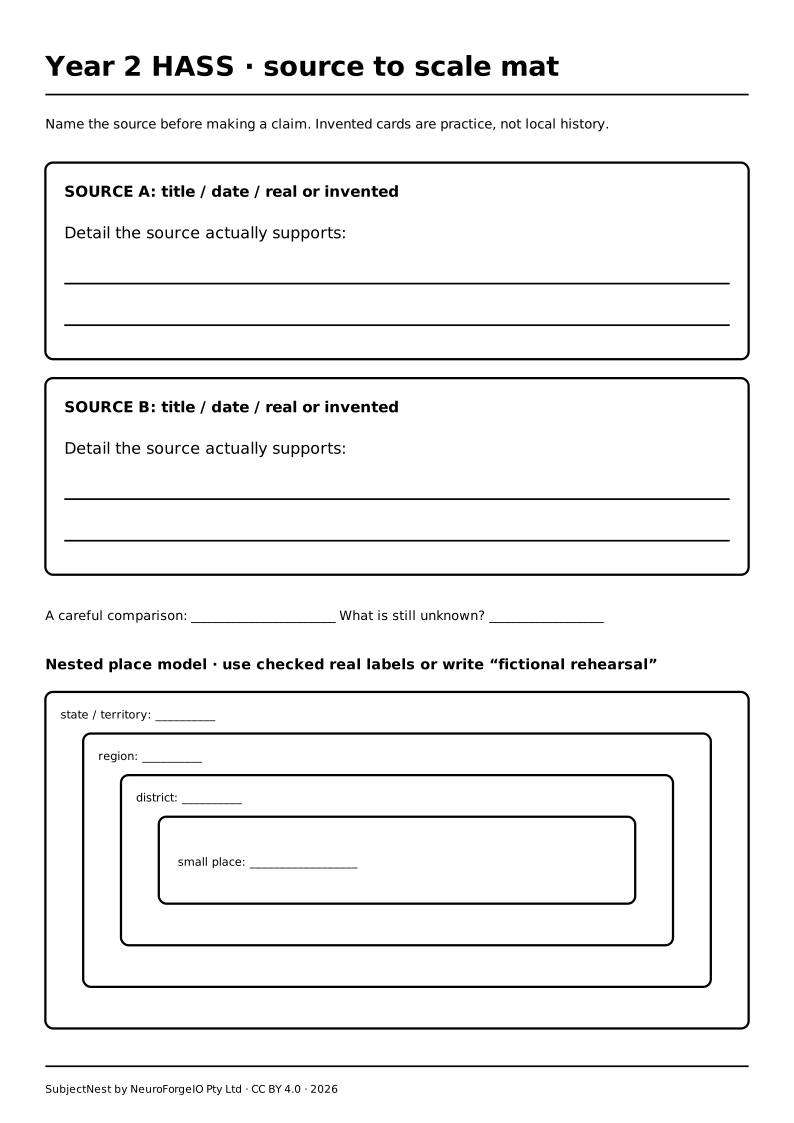
Week 1 domains: writing a note at a service desk, correcting it and choosing evidence for a technology claim. Week 2 domains: a fictional parcel depot, nested map scales and a locally approved source plan. An invented map teaches scale language, not the actual local-to-state geography in AC9HS2K03; only a checked, school-approved local map can support that part. AC9HS2K01 local significance and AC9HS2K04 First Nations Australians' local Country/Place connections are deferred until appropriately sourced and locally authorised work is available. Do not ask a child or an invented card to represent a community. See crosswalk and limits.
Read source notes verbatim if useful; offer large text, tactile nested boxes, pointing, sign, AAC, typed or child-directed adult responses. Mark evidence museum source / classroom demonstration / invented practice card / not yet known. A card's date is not proof that everyone at that date lived alike. Record source named | source detail | conclusion and limit | mode/support | next move without photographing pupils or private places.
Day 1 — Ask what an old writing tool did
Codes: AC9HS2K02, AC9HS2S01, AC9HS2S02. Prepare: learner Card 1 museum note; teacher checks source link before use.
- Notice · 2 min. Say, “This is a short note about a museum's typewriter. Which part tells us where the information came from?” Point to the museum name, not a copied image.
- Try · 7 min. Read: a typewriter key printed directly on paper; a typed mistake could not simply be undone with a computer's undo command. Learners place museum-supported and question to check labels, then ask one question about how a worker might correct a mistake.
- Show · 3 min. Child says one supported tool action and names the source. Do not conclude that all people had typewriters.
Home/low-material: Read the printed source note; no museum website or household interview required.
Day 2 — A changed tool changes a task
Codes: AC9HS2K02, AC9HS2S03. Prepare: museum note and a present-day teacher-made text-edit demonstration or Card 2.
- Notice · 2 min. Write a short invented label with one mistake on paper. Ask how it could be corrected here, and how a word processor might change that action.
- Try · 7 min. Compare the museum typewriter account with a teacher-demonstrated current editable document if an approved device is available. Otherwise compare the written descriptions while marking the present-day step described, not seen. Children state which action changes and which aim—readable words—stays.
- Show · 3 min. Child gives a two-source sentence: “The museum says ; the demonstration/description shows .” Record source and mode.
Home/low-material: Paper mistake and two printed descriptions; no device or account.
Day 3 — One invented worker is not everybody
Codes: AC9HS2K02, AC9HS2S04. Prepare: Card 3 fictional Jori/Mara work notes.
- Notice · 2 min. State that Jori and Mara are invented workers, not a record of a real workplace or era.
- Try · 7 min. Read: Jori values a neat physical copy; Mara values quick editing on a current device. Learners match a reason to its speaker and ask what else would matter to a worker with a different access route. Do not make a child disclose disability.
- Show · 3 min. Child reports two perspectives with speaker names and says what these made-up voices cannot prove.
Home/low-material: Two paper speech bubbles; no technology or family account.
Day 4 — Sort a strong claim from a guess
Codes: AC9HS2K02, AC9HS2S03, AC9HS2S05. Prepare: Card 4 claims.
- Notice · 2 min. Ask whether “the museum's typewriter printed on paper” and “everyone used one” have the same evidence.
- Try · 7 min. Children place four statements under supported by this source / needs another source / invented voice. Propose a better question, such as how a different worker communicated, instead of filling a gap with a stereotype.
- Show · 3 min. Child rewrites one over-wide claim with a source-bound phrase. Mark accuracy rather than polished handwriting.
Home/low-material: Read the four statements aloud and use three labelled scraps.
Day 5 — Fresh comparison of writing tools
Codes: AC9HS2K02, AC9HS2S02, AC9HS2S03, AC9HS2S06. Prepare: Card 5 new teacher-created note and separate key.
- Notice · 2 min. Reopen the museum source note. Give a new, clearly labelled current classroom demonstration or the printed current-tool description.
- Try · 7 min. Independently sequence type/print directly on paper versus type/edit before printing, then make a short first/now account using both source names. Name a likely task difference and one thing the examples cannot tell us about all people. Record whether the current tool was actually shown.
- Show · 3 min. Collect the source-labelled two-step account before modelling an answer.
Home/low-material: Two printed descriptions; no device, account or paid source.
Day 6 — A map can change its scale
Codes: AC9HS2K03, AC9HS2S01, AC9HS2S02 as fictional model only. Prepare: Card 6 invented map nesting.
- Notice · 2 min. Show four nested boxes labelled parcel desk → Lumo district → Weri region → Tava state. Say these names are made up to model scale, not actual geography.
- Try · 7 min. Child places a depot dot in the smallest box and traces how the smaller area sits within the next. Ask what a larger map shows and what it leaves out. Do not assign a real school location without a checked map.
- Show · 3 min. Child names smallest to largest and asks one question needed for an actual local map. Record model reasoning only.
Home/low-material: Four nested rectangles on scrap paper; no personal address.
Day 7 — Put a verified local map beside the model
Codes: AC9HS2K03, AC9HS2S02, AC9HS2S03 only with a school-approved local source. Prepare: source title/date/rights and verified local, regional and state/territory labels; otherwise use Card 7 as rehearsal.
- Notice · 2 min. Show the approved map's source and ask which labels are genuinely on it. If no approved map exists, explicitly remain in fictional rehearsal.
- Try · 7 min. Children locate a public, non-sensitive school-area feature at a smaller scale, then show which larger region and state/territory contains it, using the source's labels. Do not map a child's home or restricted site.
- Show · 3 min. Child names source and one nesting relation. Only the real, verified route contributes to the content-code evidence.
Home/low-material: Use the invented nested boxes and record actual local labels not yet checked.
Day 8 — A parcel links places in the model
Codes: AC9HS2K03, AC9HS2S03, AC9HS2S04 as fictional model. Prepare: Card 8 invented parcel route.
- Notice · 2 min. Say, “This made-up parcel starts in one invented district and goes to another. What does the arrow show? What does it not show?”
- Try · 7 min. Children trace depot → sorting point → destination on paper. Compare a sender's and receiver's possible questions, without claiming a real delivery time or service.
- Show · 3 min. Child reports the modelled interconnection and one missing piece of evidence for a real route.
Home/low-material: Move a paper token between three labelled circles.
Day 9 — A source can support a proposal
Codes: AC9HS2S04, AC9HS2S05. Prepare: Card 9 two fictional parcel-desk visitor comments.
- Notice · 2 min. Read two invented visitors: one wants a clearer label; another wants a quieter waiting spot. No real visitor is identified.
- Try · 7 min. Children match each comment to its speaker, then choose a provisional improvement for the invented desk. Ask what a responsible adult would check before a real change.
- Show · 3 min. Child says “Source A/B says , so I propose ; I would check __.” A preference is not a measured access finding.
Home/low-material: Two speech bubbles and a pencil, with no household question.
Day 10 — Plan a careful local inquiry
Codes: AC9HS2S01, AC9HS2S05. Prepare: Card 10 blank source plan and teacher check.
- Notice · 2 min. Offer a teacher-selected, public, locally approved place source if available; otherwise use an invented example and say it cannot prove local significance or Country/Place connections.
- Try · 7 min. Learner writes/chooses a question, records source title/date if real, proposes one respectful way to learn more and states a limit. No child asks a community member without school and community process.
- Show · 3 min. Collect the source-aware inquiry plan. Do not score local significance, spiritual meaning or First Nations connection from a fictional card.
Home/low-material: Use the blank source plan with source to seek; no visit or family disclosure.
Original SubjectNest teaching prose and invented cards © NeuroForgeIO Pty Ltd 2026, CC BY 4.0. Museum facts are paraphrased with source credit; no museum image/video is bundled.