Use the original teacher texts and word cards and text-purpose mat. Each lesson has 2 + 5 + 6 + 7 + 3 + 2 = 25 minutes. During short checks everyone responds, while the teacher watches 2–3 named focus learners; rotate and use a quiet later check for an independent sample. Mark “not yet observed” if unseen. Story A and Text B are read aloud/shared: do not report listening comprehension as independent decoding. The word cards give focused spelling–sound practice after checking what children already know. Codes denote partial Year 2 ACARA v9 links.
Day 1 — A story invites us to imagine
Codes: AC9E2LE02, AC9E2LY02, AC9E2LY05. Goal: identify character, setting, problem and a reasoned prediction. Prepare: Story A, three blank sequence cards, toy/paper optional.
- Invite · 2 min. Say: “I will read a made-up story about a toy. Listen for who tries something and what changes.” Show the title and ask for a possible problem; mark predictions as guesses.
- Read · 5 min. Read Story A naturally. Pause after “The sheet dipped” and ask: “What might Sol or Rae try? What in the story makes you think that?” Accept gesture, speech, drawing or AAC, then finish without confirming a guess prematurely.
- Model meaning · 6 min. Put three cards left to right. Say: “First the flat paper dipped. Next Rae folded a second sheet. Last they drew the result and planned another try.” Sketch a line on each. Ask: “Who is Rae? Where did this happen?” Point back to exact story sentences.
- Partner retell · 7 min. Pairs order cards and retell with “first/next/last”. Listener asks one question: “How do you know?” Repeat a sentence if needed. Invite a learner to note that one test does not mean “always”.
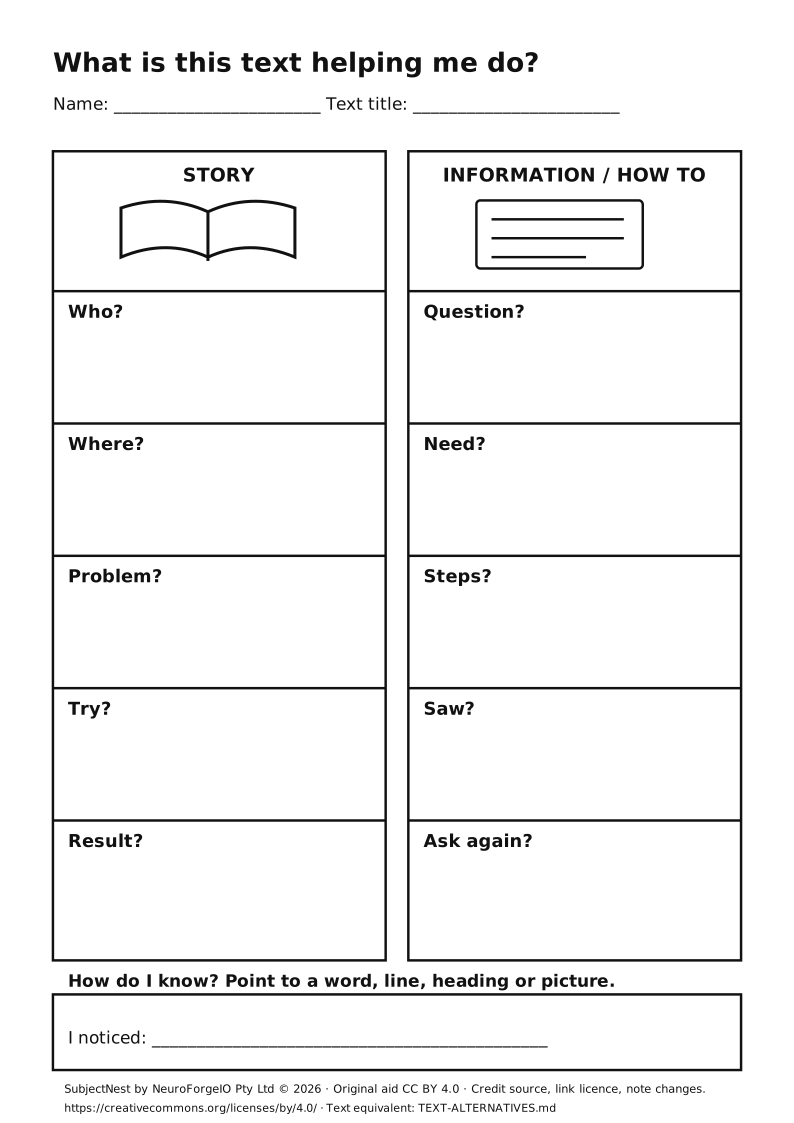
- Story or report? · 3 min. Say: “Sol and Rae are characters. The author chose events for us to imagine. Later we will read a text that gives directions for a real test.” Ask which detail shows this is a story.
- Check · 2 min. Everyone shows character and problem via card/sentence. Focus learners give one story-supported detail. If a child names the toy beetle as an acting character, reread who made and tested the bridge.
Access: teacher voice plus print for those who want it; quiet spot, tactile sequence objects, enlarged cards, AAC, home-language retell with suitable adult support. Record story understanding separately from English word reading.
Day 2 — Two spellings in some /eɪ/ words
Codes: AC9E2LY10, AC9E2LY04. Goal: read and sort taught examples with ai and ay for /eɪ/. Prepare: word cards from materials, large ai/ay cards; assess prerequisite consonant links first.
- Invite · 2 min. Say
rainandday. Ask: “What long vowel sound do you hear in both?” Let learners say, sign or select /eɪ/. - Model · 5 min. Show rain; underline
aitogether, sound through /r/ /eɪ/ /n/, then blend. Show day; point toayat the end and blend /d/ /eɪ/. Say: “These are two spellings for a sound in these words. We will look for a pattern, not make an always-rule.” - Guided sort · 6 min. Read and place
train,paint,play,traywith the class. Have learners point to the grapheme, read all parts and compare where it sits. Give immediate corrective model if they guess from a picture. - Partner word building · 7 min. Give mixed
rain, wait, day, staycards. One partner reads; the other findsai/ayand checks by blending. Switch. Invite a child to write a word on the text mat or with movable letters, then reread it. - Meaning · 3 min. Use two short oral sentences: “Rain fell on the tray.” “We can stay and play.” Children identify the target word; explain unfamiliar vocabulary without treating meaning as proof of decoding.
- Check · 2 min. Show paint and stay in fresh order. Everyone reads or chooses the heard word after seeing print; focus learners reveal the grapheme and blend. If other consonant links are missing, teach them in a short prerequisite group before calling this independent reading.
Access: large/tactile letters, clear mouth view, replay, quiet oral practice, AAC sound selection. Record if hearing an English contrast or speech production changes the access route; co-plan individual phonics assessment where needed.
Day 3 — Reread for meaning and fluency
Codes: AC9E2LY04, AC9E2LY05, AC9E2LE02. Goal: reread a familiar section with phrasing and support an inference from Story A. Prepare: Story A in large print; a separate learner-matched reading text if assessing independent reading.
- Invite · 2 min. Ask: “Why did Rae want to try again? We will listen for words that support our idea.”
- Teacher model · 5 min. Reread the last four story sentences, phrasing at punctuation. Think aloud: “Rae says one try is not enough for ‘always’. I infer Rae wants stronger evidence.” Point to the exact phrase.
- Echo and monitor · 6 min. Show two short sentences from Story A. Read one, invite echo or silent tracking, then ask: “Did that sentence make sense? What would you reread?” Model re-reading rather than replacing an unknown word with a picture guess.
- Paired meaning work · 7 min. One partner selects a story event and the other points to supporting words or describes what the teacher read. Swap. Learners with matched independent texts read a short familiar passage to teacher at a quiet station; record the text and whether phrasing/self-correction occurred. Do not score echoed Story A as independent fluency.
- Preference with reason · 3 min. Ask: “Which moment do you like and why?” Model: “I like when they save their drawings because they can compare tomorrow.” Accept a different text-linked preference.
- Check · 2 min. Everyone completes: “Rae wanted another try because ___.” Focus learners cite one story detail. If answer is unsupported, ask where the text gave the clue next lesson.
Access: adult read-aloud for meaning, enlarged/single-line display for tracking, tactile event cards, AAC choice and partner scribe. Note that read-aloud access changes the reading evidence, not the quality of the idea.
Day 4 — A noun group makes a clearer picture
Codes: AC9E2LA07, AC9E2LA09, AC9E2LY06. Goal: extend a noun with an article/adjective and choose a precise verb. Prepare: sentence-edit cards, real paper strip and drawings.
- Invite · 2 min. Say: “The paper moved.” Ask: “What might a reader still wonder?”
- Model · 5 min. Write
The paper moved.Underline paper; addthinand changemovedtodipped:The thin paper dipped.Say: “The words the thin paper make a noun group. Dipped tells more than moved in our story.” Read both aloud. - Guided revision · 6 min. Offer
A bridge stood.Ask for one justified detail:A folded paper bridge stood across the gap.Compare how much a listener can picture. Do not add an observation that contradicts the source. - Child choice · 7 min. Children choose one event card and write, dictate or build one accurate sentence with a noun group and precise verb. Prompts: “Which object? What feature did the story actually tell us? What did it do?” Partner draws what the sentence describes and asks for missing detail.
- Edit aloud · 3 min. Model rereading for sense and a sentence stop. Ask the author to choose one change, such as a clearer noun or verb, without requiring a longer sentence for its own sake.
- Check · 2 min. Everyone revises
The toy went.into a sentence that fits Story A, e.g.The small toy rolled onto the paper.Focus learners point to the noun group and action word. If an adjective is random, return to the story detail.
Access: movable word tiles, large print, keyboard/AAC/dictation, two-choice adjective cards. Judge the language decision separately from handwriting.
Day 5 — Change a story, keep it understandable
Codes: AC9E2LE05, AC9E2LY06, AC9E2LY02. Goal: adapt a familiar story structure with a new safe solution and revise for a listener. Prepare: story sequence cards, blank folded page.
- Invite · 2 min. Say: “A story can keep its problem and try a new idea. We will make our own small version, then check that someone can follow it.”
- Model · 5 min. On three cards draw a toy boat, a puddle drawn on paper and a wide cardboard path. Say three sentences with first/problem/attempt/result. State this is a new invented scene, not what happened in Story A.
- Plan together · 6 min. Ask for another classroom-safe toy or paper-path problem. Record three class ideas without judging the child's chosen interest; ask “What goes wrong? What could the character try? What changes?”
- Create · 7 min. Learners choose drawing with captions, 3–4 written sentences, dictation or performance with a written adult transcription. Require an identifiable character, place, problem and attempted solution. Partners listen and ask one clarifying question.
- Revision · 3 min. Say: “Which part was hard for your partner to follow?” Give time to add a detail, reorder a card or change one word. Retain the first version so the change is visible.
- Check · 2 min. Everyone points to their problem and solution. Sample focus learners and use check A. If the sequence is missing, model three blank cards again tomorrow.
Access: no public performance required; image, tactile objects, AAC, partner voice or teacher scribe are valid composition routes. Record whether wording was the child's or a prompt.
Day 6 — An information text helps us try a test
Codes: AC9E2LA03, AC9E2LY03, AC9E2LY05. Goal: identify purpose, audience and the role of headings/list/directions in Text B. Prepare: Information text B, two equal sheets; no test result required in English time.
- Invite · 2 min. Ask: “If someone wants to try a paper-span test, would Story A alone tell them all the steps?” Accept a reason.
- Read · 5 min. Read Text B aloud, showing headings. Say: “It gives a question, materials, steps and a think-again question. It speaks to a person doing the test.”
- Navigate · 6 min. Point to
You needand ask which items belong there. Point toTry itand ask where the directions begin. Contrast the story's characters and events with this text's directions. Ask where a reader would return to check the gap instruction. - Partner route · 7 min. Children use purpose mat to sort heading cards to
question / materials / steps / thinking. Partners explain to whom the text is helpful. A teacher reads headings aloud for anyone who needs it. - Check safety and limits · 3 min. Ask: “Does the text promise that one fold always works?” Reread “One try is a clue.” Clarify that an adult checks the space and small paper token.
- Check · 2 min. Everyone points to the heading that helps them find equipment and says who might use this text. Focus learners give a reason. If headings and content are confused, model navigation again with a grocery list.
Access: raised/tactile four-section mat, printed heading labels, adult read-aloud, AAC/pointing. The independent reading claim belongs only to text read without voice help.
Day 7 — ee and ea in some /iː/ words
Codes: AC9E2LY10, AC9E2LY04. Goal: identify, blend and sort taught examples of ee/ea for /iː/. Prepare: word cards from materials; check other letter links first.
- Invite · 2 min. Say
seeandteam. Ask learners to listen for the shared long /iː/ sound. - Model · 5 min. Show see and point to
ee; blend /s/ /iː/. Show team and point toea; blend /t/ /iː/ /m/. Say: “In these words two letter teams show one vowel sound.” - Guided read · 6 min. Read
feet,sheet,clean,leafwith sound-by-sound tracing. Learners place each beneath its spelling label. Then read the whole word for meaning. Showheadonly to the teacher/class as a counterexample; sayeacan sound different, so we check words and meaning. - Partner practise · 7 min. Partners select
see, green, team, beachin random order. One blends, the other points to grapheme and checks. Swap. Give a sentence context only after an attempted blend: “We can see the sheet.” - Spell · 3 min. Dictate
seeandteamwith movable letters or writing. Have learners read their result and compare the vowel spelling; explain spelling choice is learned word by word. - Check · 2 min. Everyone blends green and clean and underlines the vowel team. Sample focus learners. If consonant blending is the obstacle, practise that prerequisite separately.
Access: quiet voice replay, mouth visibility, enlarged/tactile graphemes, typing, AAC sound selection. Do not reduce a child's language knowledge to pronunciation of one accent-specific example.
Day 8 — Join two ideas with a reason
Codes: AC9E2LA06, AC9E2LY06. Goal: compose a compound sentence using two independent clauses joined by so or and. Prepare: sentence-edit strips.
- Invite · 2 min. Read: “The paper dipped. Rae folded it.” Ask: “How are these ideas connected?”
- Model · 5 min. Write
The paper dipped, so Rae folded it.Point to each side: “The paper dipped” and “Rae folded it” can each stand alone.Sosignals a reason/result link; say the comma helps a reader pause here. - Guided build · 6 min. Give
The sheet bent.andThe toy stopped.Children chooseandto join them. Read both parts separately and together; ask whether the link changes meaning. Trysoand ask which makes the intended cause clearer in this scene. - Child sentences · 7 min. With event cards or the information text, each learner makes one sentence with two full ideas. Offer frames on two strips, then ask the learner to choose the joining word. Partner underlines each complete clause, rereads and asks for clarification.
- Edit · 3 min. Model a run-on fix: add comma before
soin the displayed example, check capital at start and stop at end. Explain that not every long sentence is a compound sentence. - Check · 2 min. Everyone joins “We kept the gap the same. We could compare the shapes.” Expected: “We kept the gap the same, so we could compare the shapes.” Focus learners explain what
soconnects. If one side is incomplete, rehearse two sentences first.
Access: clause cards, speech-to-text checked by learner, dictation, AAC sentence builder, large print. Score the connection of ideas apart from fine motor control.
Day 9 — Same topic, different job
Codes: AC9E2LY01, AC9E2LY03, AC9E2LY06. Goal: compare Story A and Text B by purpose and create a short explanation for a familiar reader. Prepare: both texts and purpose mat.
- Invite · 2 min. Say: “Both texts mention paper across a gap. What does each help us do?”
- Model · 5 min. Point to Story A's character dialogue and Text B's headings. Say: “The story invites us to imagine Sol and Rae's attempt. The information text gives steps that a reader can try.” Ask children to challenge the statement with a feature from each.
- Guided compare · 6 min. Make a two-column chart
story / information text. Add one supported feature in each: characters/problem versus materials/directions. Ask: “Which would you use to find what you need for the test? Which tells how a character felt?” - Write for an audience · 7 min. Child chooses a classmate, younger pupil or family adult as reader and drafts 2–3 sentences: purpose of one text, one useful feature and why. Model: “Text B helps a reader try a paper span. Its list tells us what to collect.” Invite a labelled diagram or dictated text with an adult scribe.
- Reader test · 3 min. Partners read/listen and point to the feature described. Writer edits one unclear word or adds a text clue, keeping the original draft visible.
- Check · 2 min. Everyone chooses the best text for finding test materials and names a clue. Sample focus learners. If a child says “Story A because it is about paper”, prompt them to locate the needed list.
Access: read both texts aloud for purpose comparison, large-text headings, tactile two-column mat, AAC choice plus reason. Keep independent text-reading evidence separate.
Day 10 — Read, explain, compose, then decide what is next
Codes: AC9E2LY04, AC9E2LY05, AC9E2LY06, AC9E2LY10, AC9E2LY03. Goal: sample taught word patterns, text purpose/meaning and a clear sentence. Prepare: check B, fresh word cards, both teacher texts, private reading station.
- Set purpose · 2 min. Say: “Show what helps you read and explain. It is fine to reread. I will notice what to teach next.”
- Shared review · 5 min. Together compare a heading and a character line; blend previously taught rain and see. Say these are rehearsals, not the new check words.
- Word sample · 6 min. Everyone works with tray, paint, leaf, green. A focus learner reads or selects each printed word and identifies
ai/ay/ea/ee; note whether consonants or the vowel team needed a prompt. Others practise with a partner while teacher rotates. - Meaning and composition · 7 min. Reread a short part of Text B aloud. Ask: “Where would you find what to collect? Why would you try more than once?” Children then create one sentence for a family adult about a fair paper test; accept writing, dictation or AAC with a recorded transcript. This is comprehension/composition, not independent reading of Text B.
- Feedback · 3 min. State one specific observation and a next step: “You found the materials heading. Tomorrow we will practise explaining why the supports stay in place.” Do not group children by a fixed label.
- Close · 2 min. Learners choose a word or sentence to reread. Teacher marks
independent / after model / not yet observed, the chosen access route and one next teaching move.
Feasible collection: a whole-class 25-minute task does not allow one teacher to hear every learner read privately. Spread 3–4 minute individual word-reading checks across Days 8–10 and subsequent stations. Use a learner-matched independent text for broader reading evidence, with title/version recorded. Assessment separates the constructs.
Rights: Original lessons © NeuroForgeIO Pty Ltd 2026, SubjectNest, CC BY 4.0. Credit, link and note changes. ACARA codes retain separate source terms.