Five 35-minute blocks. Proposed partial Year 3 HASS links: AC9HS3K06 (who makes school/community rules, why they matter and effects of not following them), AC9HS3K07 (why people participate and how learners may contribute), plus inquiry AC9HS3S01, AC9HS3S02, AC9HS3S03, AC9HS3S04, AC9HS3S05, AC9HS3S06, AC9HS3S07 (questions, sourced information, interpretation, perspectives, conclusions, possible actions and presentation). All codes were checked against the Year 3 records of the pinned ACARA workbook. This small inquiry does not complete these descriptions. Daily English and mathematics periods remain separate.
Source gate before Day 6: choose one current, school-authorised rule or notice for a shared, accessible space: e.g. a path, library corner or equipment shelf. Record exact wording, issuer, date/current-status check, permission to show/reproduce and any restriction. Confirm who actually makes/maintains that rule with an authorised school contact. If the source is missing, use the original fictional “Keep the path clear” sign in Story A only to rehearse inquiry language; label every account fictional and withhold a claim about the actual school. Do not improvise local history, First Nations perspectives or cultural significance. Do not display children's names, home routes or photos without school consent. A proposal in class is not a school policy change.
Use evidence board to keep source, observation, perspective, proposal and uncertainty separate. Children can use text, tactile cards, speech, drawing, AAC or an adult scribe; preserve their ideas and exact supports. No child must disclose a personal access need to make the lesson work.
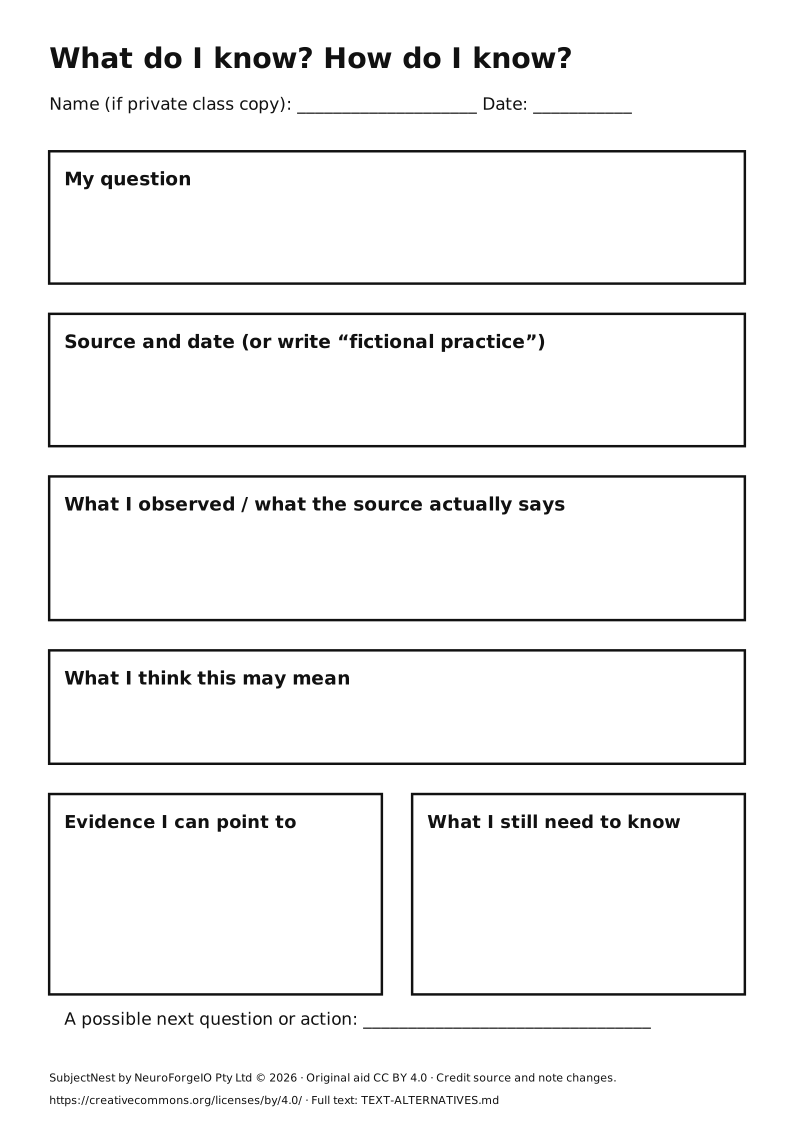
Day 6 — Find who says the rule and what it says (35 minutes)
- Question · 3 min. Say: “Rules for a shared place have a source. We need to know what this one actually says before giving an opinion.” Name the chosen space only if approved.
- Source model · 7 min. Display or read the dated authorised notice. Point to the issuer and exact instruction. Say, “This is what the source says; this is what I still need to ask the school.” If using fictional Story A, mark
invented signvisibly and avoid a real-school conclusion. - Child investigation · 15 min. Pairs use
source / words / what it might help / questioncolumns. They find a phrase in the rule and develop a question about why or who it helps. A teacher may read aloud. Learners identify one item from their own observation separately. - Ask about authority · 7 min. Use the pre-confirmed authorised answer to “Who makes or maintains this school rule?” If not confirmed, record it as a question for a staff member; don't guess. Ask how the same rule might affect two users differently without requesting personal disclosures.
- Close · 3 min. Each child names source versus their interpretation. Teacher samples a few independently and schedules others later.
If needed next: reread a short line and mark direct wording with a box, interpretation with a question mark.
Day 7 — Listen for different uses of a place (35 minutes)
- Recall · 3 min. Revisit the actual authorised wording or the labelled fictional model. Ask what is known and what remains open.
- Model perspectives · 7 min. Offer two clearly invented roles: a learner carrying equipment and a learner trying to pass through. Say: “Both have a purpose. A person is more than one need, and we cannot speak for a real group without asking.”
- Role-card dialogue · 15 min. Pairs choose or invent two fictional roles and say what each might want from a shared space. Give a frame: “From this role, I would need __ because __.” Partners paraphrase before disagreeing. Real staff/community comments are included only with permission and exact attribution.
- Compare with source · 7 min. Ask which role concern the rule appears to address, and which concern may need more information. Put a question on the board rather than declaring that everyone agrees or that a rule is unfair.
- Close · 3 min. Learners name one respectful question they could ask an authorised decision-maker. Teacher records whether a perspective was attributed or merely assumed.
Access: private pair or puppet/board response, no compulsory public role play, communication devices and written response accepted. Avoid making a learner embody a disability or culture as a classroom role.
Day 8 — Actions have possible effects (35 minutes)
- Prompt · 3 min. Say: “A proposal can help some people and cause a new problem. Let's think through more than one effect.”
- Model two choices · 7 min. Use fictional trays: leave them in path or move them to an approved shelf after asking the responsible adult. Put possible effects under
helps / may cause / need to check. Explain that only the school can approve a real location change. - Group option map · 15 min. Each group chooses two proposed actions about the verified shared space, or fictional practice if no source. They mark likely users, possible benefit, possible inconvenience and what permission/fact is missing. No child is asked to implement an action.
- Check the source · 7 min. Compare options with the actual rule and an observation. Ask: “Which part is supported? Which part is just our idea? Who would decide?” Let children revise an option after a concern.
- Close · 3 min. Each child states one possible effect with
couldormight, rather than promising an outcome.
If needed next: when a learner says “this will help everyone,” invite a counterexample or ask who has not been heard.
Day 9 — Draft a proposal someone can evaluate (35 minutes)
- Set audience · 3 min. Say: “Our audience is a school adult who can tell us whether the idea is safe and possible. They need the source, evidence and limits.” No outside message is sent without school approval.
- Teacher model · 7 min. Fill a blank template with a fictional example: “The invented sign says keep the path clear. In our story, trays blocked it. We propose asking the teacher for a storage place. This could help people pass; we need to check where the trays can safely go.” Explicitly label it practice.
- Child draft · 15 min. Each learner or pair uses a real verified source, or a clearly fictional case, to make a 4-part proposal: issue/source; observation/perspective; possible action; possible benefit/limit. A drawing with exact dictated labels is fine. Avoid private pupil details.
- Peer question · 7 min. Reader asks “How do you know?”, “Who else might be affected?” and “Who may approve?” Author revises one unsupported certainty to a question or conditional statement.
- Close · 3 min. Teacher keeps draft/revision and notes one next skill per focus learner: evidence, perspective or effect.
Access: sentence strips, enlarged source line, AAC, dictated text, quiet pair. Propose access for everyone without asking a child to disclose why they need it.
Day 10 — Present, question, revise (35 minutes)
- Purpose · 3 min. Say: “A useful proposal can be checked and improved. We will share with a small classroom audience or privately.”
- Rehearse · 7 min. Invite learners to point to the source line, say one observed/fictional event, then the possible action and effect. Remind them to label fiction and fact correctly.
- Present · 15 min. Small groups use a poster, spoken explanation, AAC or tactile model. Listeners ask one question about source or consequence. Teacher samples 2–3 scheduled focus learners closely; mark others not yet observed if their own reasoning was not heard.
- Revise · 7 min. Each learner changes one claim, label or action in response to evidence or a question; keep both versions. If a real-source proposal is sound, teacher may take it through normal school channels only under local permission; no child-facing promise is made.
- Next teaching · 3 min. Choose: locate/source exact wording; distinguish observed from inferred; compare perspectives; or weigh effects. Record an actual learner example. Return to the Year 3 HASS achievement standard only in the school's broader assessment process.
Rights: Original activities © NeuroForgeIO Pty Ltd 2026, SubjectNest, CC BY 4.0; credit, link and note changes. ACARA material has separate terms. School/local sources keep their own rights and permissions. Educator and local review pending.