Open teacher texts and word cards before the lesson. These shared passages are for the teacher to read and discuss; use a separately chosen text at the learner's taught point when gathering independent reading evidence. Each numbered day totals 25 minutes. During the final prompt, all respond and the teacher closely samples 2–3 focus learners; rotate names and use quiet checks where speech/reading must be individual. Assessment provides keys, example errors and next teaching. The ACARA Year 3 codes are partial links, never a two-week mastery declaration.
Day 1 — A setting can change how a story feels
Codes: AC9E3LE03, AC9E3LY05, AC9E3LY02. Aim: describe story place, problem and a mood change with a text clue. Bring: Story A, blank four-box strip.
- Invite · 3 min. Say: “I will read a made-up story. Notice what Mira sees first and how she feels by the end.” Show title; let learners predict but call it a guess.
- Read aloud · 5 min. Read with pauses at paragraph breaks. After paragraph 1 ask, “What might Mira be worried about? Which sentence gave you that idea?” Finish the story before accepting a final conclusion.
- Think aloud · 5 min. Put four boxes left to right. Sketch
blocked path / Jai explains / ask and move / plan. Say: “At first Mira is unsure because she fears spoiling a project. At the end she feels relieved; the text tells us so.” Point to “If she moved them…” and “Mira felt relieved.” - Partner retell · 7 min. Pairs use the four boxes to retell. The listener asks one “how do you know?” question; the speaker returns to a word or event. Invite a different response route: gesture, tactile objects, speech, AAC or sketch.
- Discuss preference · 3 min. Ask which action they would choose first—ask an adult or move the trays—and why. Clarify that the fictional event is not permission to change equipment at their school.
- Check · 2 min. Everyone marks the moment the mood begins to change and supplies one clue. Focus learners' exact words go in the record. If a learner says the path was “scary” without support, ask what the story actually says.
Access: adult reading plus large print, a quiet listening point, tactile four-box sequence and private response. Do not label a good retell as independent word reading.
Day 2 — Read a longer word in useful pieces
Codes: AC9E3LY09, AC9E3LY04. Aim: use spoken syllables, known letter patterns and meaningful parts to read longer words. Bring: word cards garden, notebook, remember, careful; check each learner's prerequisite letter patterns.
- Hear it · 2 min. Say garden naturally. Learners tap two beats. Explain that a beat helps us plan, but we still check the letters.
- Model and blend · 6 min. Show gar-den. Point to the parts and blend in your local classroom pronunciation; reread the whole word in “garden path”. Show note-book and ask what two known words make it. Do not force an unnatural vowel sound from the spelling.
- Guided word work · 5 min. Together read care-ful. Link the base care to the meaning “showing care”, then reread the whole word. Tap re-mem-ber and model the written chunks; state that a syllable split is a reading support, not always a morpheme split.
- Partner sort and use · 7 min. Partners draw a card, tap/say syllables, point through known graphemes and blend. Place it in a story sentence or an original spoken sentence. A learner unsure of an untaught grapheme gets a teacher model and a different known card for independent evidence.
- Meaning check · 3 min. Ask: “What would a careful helper do near a narrow path?” Accept a supported practical idea; distinguish word meaning from decoding.
- Check · 2 min. Show notebook and careful in changed order. Everyone marks parts and attempts a blend; focus learners read one without a model. Record which pattern was known and any cue given.
Access: large/tactile letter cards, visual mouth model, quiet rehearsal or AAC word selection. Never score speech clarity as phoneme knowledge without an accessible route.
Day 3 — An inference needs a clue
Codes: AC9E3LY05, AC9E3LE03, AC9E3LY04. Aim: infer Mira's hesitation and self-correct when a statement overreaches. Bring: first two paragraphs of Story A and learner-matched independent reading texts.
- Question · 2 min. Say: “Mira did not move the trays at once. Was she frightened of trays, or worried about someone's work? Let's find the clue.”
- Model rereading · 5 min. Read “If she moved them, would she spoil someone's project?” Think aloud: “The question names a project. I infer she was worried about interrupting it. I don't need to invent a new event.”
- Guided evidence · 6 min. Give two statements:
Mira knew who put the trays thereandMira wondered if moving them would spoil a project. Learners point to evidence or say “not shown”; reveal that Jai's explanation arrives later. Ask how the reader's understanding changes. - Reading station · 7 min. Most learners partner-reread the shared paragraph for meaning; teacher privately listens to 2–3 planned children read a separate matched passage and notes accuracy, phrasing and self-correction. Record title and help. Echoing Story A is not independent fluency evidence.
- New inference · 3 min. Ask why Jai drew a plan at the end. A plausible answer: to remember a better place for the trays, supported by the last paragraph. Accept a distinct supported answer.
- Check · 2 min. Everyone finishes “I infer __ because the story says __.” Sample evidence and inference separately. If the clue is missing, offer a two-line re-read tomorrow.
Access: teacher read-aloud for meaning, text magnification, tactile event cards and AAC response. A learner may show the exact line rather than speak.
Day 4 — Verb choice and tense hold a paragraph together
Codes: AC9E3LA04, AC9E3LA07, AC9E3LA08, AC9E3LY06. Aim: choose a precise past-tense verb and group related events in a paragraph. Bring: four event cards, sentence examples from materials.
- Notice · 3 min. Read “Mira looked” and “Mira stared”. Ask what each suggests. Return to Story A to check the stronger choice.
- Model · 5 min. Write
Mira worries.besideMira worried when she saw the blocked path.Say: “The story happened earlier, so worried locates it in the past. Saw names a different action.” Underline the verbs. - Paragraph model · 5 min. Put
saw trays / read sign / worriedin one box andasked Ms Vale / carried traysin another. Explain that the first group develops the problem; the next develops the attempt. A paragraph groups a related stage, not an arbitrary number of sentences. - Compose · 7 min. Children choose two story stages and write or dictate two short paragraphs of 1–2 connected sentences each. Offer action-verb tiles (
noticed,asked,carried,planned). Partner points to the transition and checks tense consistency. - Edit aloud · 3 min. Model changing a stray present verb in a past recount. Have learners choose one verb to improve without increasing length just for length's sake.
- Check · 2 min. Everyone revises
Jai carry the trays. Then he draws a plan.to a consistent past recount, e.g.Jai carried the trays. Then he drew a plan.Focus learners explain the change.
Access: keyboard, word tiles, speech/AAC composition or a scribe; preserve the child's wording and record which edit was prompted. Motor presentation is separate evidence.
Day 5 — A small story with a real revision
Codes: AC9E3LE05, AC9E3LY06, AC9E3LA04. Aim: create an original problem–attempt–result story in two simple paragraphs and improve it after a reader question. Bring: evidence board turned to its what happened / what changed spaces, blank paper.
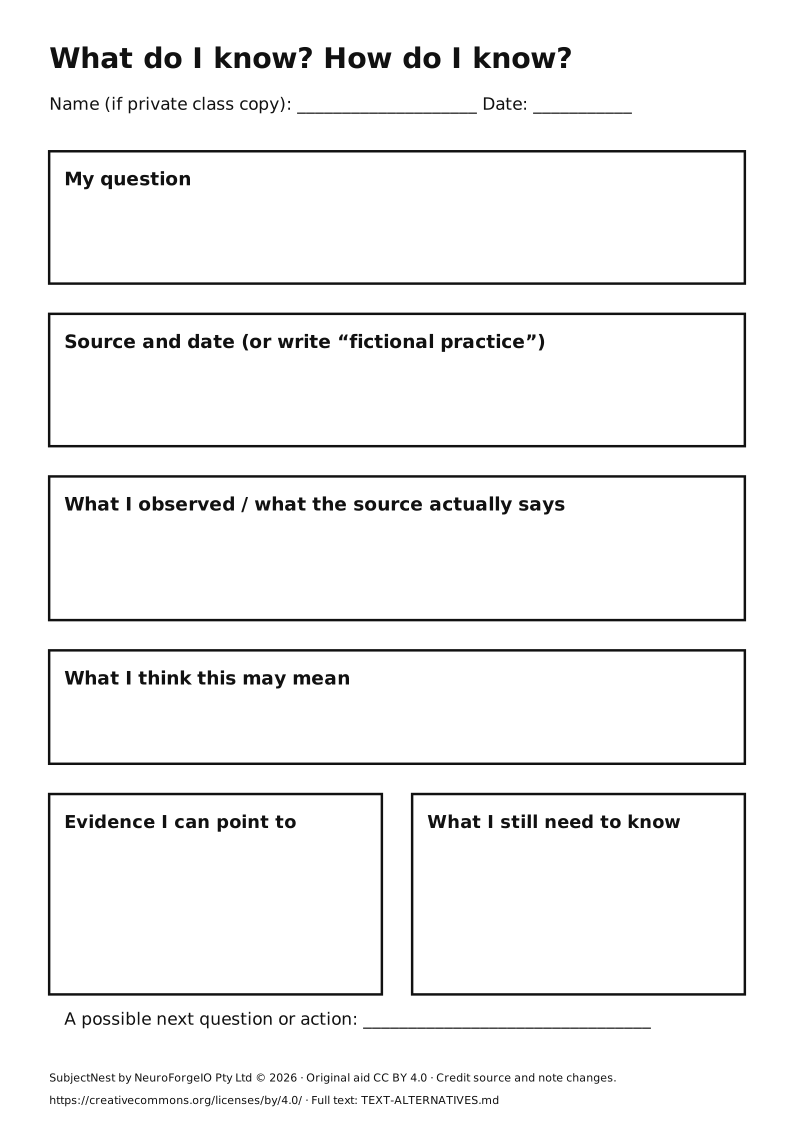
- Offer choice · 2 min. Say: “Invent a different shared-space problem. It can be a club table, sports-equipment shelf or art corner. Your character will notice, ask and try.” No child must describe a private real incident.
- Model a plan · 5 min. Sketch an invented craft table with a pile blocking the paint pots. Write
before/what goes wrongin paragraph 1 andattempt/resultin paragraph 2. State clearly that the example is fictional and not an actual school rule. - Plan with prompts · 6 min. Ask each learner: “Who? Where? What changes? What can they safely try? How will we know the result?” Learners choose a four-card sequence, a short outline or oral rehearsal.
- Create and read · 7 min. Draft two paragraphs through writing, keyboard, dictation or AAC transcription. Partner listens/reads and asks one real clarification, such as “Where did the box go?” Keep draft visible.
- Revise · 3 min. Child chooses a change: clearer place, verb, order or result. Say: “Show me the sentence you changed and how it helps your reader.” Avoid rewriting the child's story for them.
- Check · 2 min. Everyone indicates the problem and one revision; focus learners' versions feed Check A. If only a list of events appears, plan a paragraph stage together next time.
Access: private audience, drawing plus dictated text, object storyboard or AAC. Record narrative design separately from spelling/transcription.
Day 6 — An information text states what it can tell us
Codes: AC9E3LA03, AC9E3LA05, AC9E3LY03, AC9E3LY05. Aim: navigate headings, identify purpose and separate observation from inference. Bring: Information text B and evidence board.
- Question · 2 min. Ask: “If we wanted to compare two closed samples, would Story A give us the steps?” Ask for a reason, then show Text B.
- Shared read · 5 min. Read Text B aloud and point to each heading. Say: “This writer tells a reader how to observe safely, then asks them to compare. It does not claim to know our result before we look.”
- Navigate · 6 min. Ask children to find where to learn
what to look for,what not to do, andwhat we still cannot tell. They point to phrases; teacher checks each choice in the text. - Sort two claims · 7 min. Put on board
sample A looks darkerandsample A will grow better plants. Ask which could be observed from the containers and which needs other evidence. No claim about actual sample A is made until the class has a real record. - Audience · 3 min. Ask who could use this text (a class about to compare samples) and what they would do with it. Contrast a reader enjoying Story A; both may be useful for different purposes.
- Check · 2 min. Everyone points to the section that warns against a broad conclusion and says why. Focus learners' answer is recorded as listening/navigation if teacher read the text.
Access: headings in large/tactile cards, read-aloud, screen reader or AAC pointing. Do not call teacher-assisted reading an independent fluency sample.
Day 7 — A word part changes the message
Codes: AC9E3LY10, AC9E3LA10, AC9E3LY09. Aim: read meaningful base + prefix/suffix combinations and explain the change. Bring: check/recheck, fair/unfair, care/careful, help/helpful cards.
- Invite · 2 min. Say: “If I check a record and then recheck it, what do I do?” Accept “check again” with an example.
- Model · 5 min. Build
re + check → recheck. Point to the base and prefix. Read the whole word through, then use it in “We recheck our count.” State that not every word startingrehas this prefix. - Guided pairs · 6 min. Build
un + fair → unfairandcare + ful → careful. Ask how the meaning changes. Blend/say the whole words at a natural pace; use letter patterns taught locally. - Choice task · 7 min. Pairs choose two base/change pairs and make a sentence for a real classroom purpose:
It is helpful to label a sample;It is unfair to change only one person's rule. Teacher checks that a learner understands meaning, not just cuts a word visually. - Counterexample · 3 min. Show red. Its first two letters are
re, but they are not a prefix meaning “again” here. Say: “We check the whole word and its meaning; a matching start is not enough.” - Check · 2 min. Everyone reads recheck and careful, marks base and addition, and says the meaning. Focus learners receive a new card unhelpful to test transfer. Record untaught grapheme support separately.
Access: raised base/prefix/suffix tiles, spoken examples, visual print, AAC meaning choices and private reading. A family language can illuminate a concept, but no unreviewed translation is supplied.
Day 8 — One paragraph, one connected part of an idea
Codes: AC9E3LA04, AC9E3LA10, AC9E3LY06. Aim: group related observations and caution in separate simple paragraphs using precise words. Bring: Text B, evidence board and a child observation (or explicitly fictional practice if samples unavailable).
- Set goal · 2 min. Say: “A report can help a reader when each paragraph keeps related ideas together.”
- Model · 5 min. Read the
ObserveandCompare and ask againparagraphs in Text B. Explain that the first tells how to look, the next tells what to compare and what we still do not know. Highlightgrain,layer,evidenceas words needing meaning in context. - Guided sort · 6 min. Put sentence strips
We kept jars closed,A looked darker in our record,Colour alone does not show plant growthundermethod / observation / question or limit. If A did not actually look darker, label that strip a fictional practice sentence. - Learner report · 7 min. With real authorised records or marked fictional practice, children make two short paragraphs: one about method, one about an observation and remaining question. Offer a heading for each. Ask for an exact visible detail rather than “the soil was good.”
- Reader check · 3 min. Partner points to the sentence that belongs with the method and one that is a claim. Author moves or revises a sentence if it interrupts the idea.
- Check · 2 min. Everyone explains where
We kept both jars closedbelongs and why. Focus learners' report shows whether grouping and vocabulary are meaningful.
Access: movable strips, tactile sections, dictated/AAC paragraphs, read-aloud headings. A child need not physically handle a sample to describe a documented observation, but record the source.
Day 9 — Same topic, different reader
Codes: AC9E3LY01, AC9E3LY03, AC9E3LY06. Aim: compare purposes/audiences and draft a short useful message for a selected reader. Bring: Story A, Text B, two-column evidence board.
- Start · 2 min. Say: “Both texts involve school spaces. Who might read each, and what would they get from it?”
- Model comparison · 5 min. Point to dialogue and plot in Story A, then headings and safe steps in Text B. Say: “A person may enjoy Mira's problem and solution. Someone observing a sample can use Text B's instructions.” Avoid saying a story cannot also teach.
- Find proof · 6 min. Children locate one feature in each text that fits its likely purpose. Ask why a materials/procedure section would matter to a test reader, and how dialogue lets a story reader hear character views.
- Write for choice of reader · 7 min. Learners choose a classmate or an adult at home. Draft 2–3 sentences explaining how to observe a closed sample safely or how a school community could check a proposed path rule. Require a clear purpose, one sourced detail and a question/limit where needed. Local claims need the actual authorised source.
- Reader response · 3 min. Partner says what action or idea the message gives. Author changes one confusing phrase. An adult scribe writes only the child's chosen words.
- Check · 2 min. Everyone selects which text they would consult for closed-sample safety and names the heading or phrase. Sample focus learners and distinguish text navigation from independent reading.
Access: choice of audience and written/oral/AAC drafting, private partner, large/tactile headings. Do not ask a learner to reveal private home details.
Day 10 — Three kinds of evidence, three next moves
Codes: AC9E3LY04, AC9E3LY05, AC9E3LY06, AC9E3LY09, AC9E3LY10. Aim: sample longer-word reading, shared-text comprehension and an audience-ready paragraph without conflating them. Bring: Check B, unseen word-card order, Text B, private reading station.
- Purpose · 2 min. Say: “Show a way you can read, explain and improve. I will name one useful next step for each part.”
- Warm review · 5 min. Together reread garden and check/recheck and recall Text B's headings. These familiar demonstrations are practice, not new assessment.
- Word sample · 6 min. All see
notebook, careful, helpful, recheckin a new order. Quietly hear planned focus learners blend/parse while others work with a partner. Record what was read unaided, which letter pattern/morpheme was prompted and whether meaning was understood. - Meaning and paragraph · 7 min. Read the final Text B paragraph aloud. Ask what appearance cannot prove. Learners then create a short paragraph for a class reader: one observation from actual authorised record or marked fictional practice, plus a limit or next question. Keep any adult transcription and prompt visible.
- Specific feedback · 3 min. Respond to the evidence: “You found the word careful and explained it. Our next reading practice will be the unfamiliar vowel pattern in notebook.” For composition, name a sentence to keep and one useful edit.
- Close · 2 min. Learner chooses one word and one sentence to keep. Teacher records separate word-reading, comprehension and composition decisions; others can be assessed in later stations.
Feasibility/access: a 25-minute class activity cannot give everyone an individual oral reading interview. Use several 3–4 minute quiet checks across Days 8–10 and later; record matched independent text separately. Offer large print, tactile tiles, AAC/dictation and a private audience as appropriate.
Rights: Original lessons © NeuroForgeIO Pty Ltd 2026, SubjectNest, CC BY 4.0. Attribute, link and indicate changes. ACARA content retains its terms.