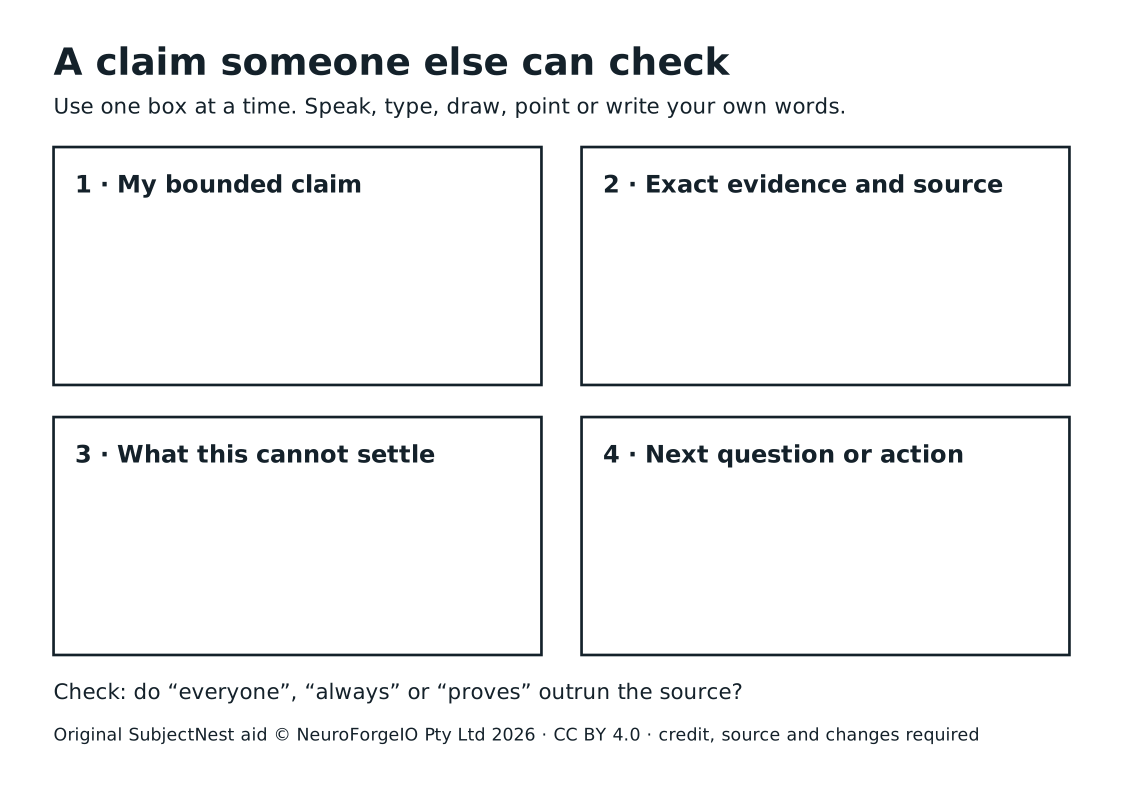
Use the original Texts A–C and claim/evidence mat. Each day has 2 + 4 + 5 + 7 + 4 + 3 = 25 minutes. Teach the rich text through a suitable access route; do not label a read-aloud answer as independent reading. Codes indicate partial learning links: AC9E5LA02, AC9E5LA04, AC9E5LA05, AC9E5LA06, AC9E5LY02, AC9E5LY05, AC9E5LY06, AC9E5LY07. See assessment and keys.
Day 1 — A count is not a conclusion
Success: identify an observation, a claim and a limit in Text A. Prepare: Text A, three labelled slips observed / claimed / still unknown. (AC9E5LA02, AC9E5LY05)
- Hook · 2 min. Read “5, 8, 7” and ask, “What can we say for sure from these numbers?” Accept “three counts” before adding.
- Model · 4 min. Read Text A aloud or provide accessible text. Say: “The source tells me the same person may be counted again. I can total 20 observations, not 20 different children.” Put the two phrases on separate slips.
- Guided sort · 5 min. Read Sam's sentences one at a time. Class sorts “on Tuesday counts were 5, 8, 7” as observation, “everyone wants” as unsupported claim, “some may want shade” as inference. Ask which source detail changes the answer.
- Independent turn · 7 min. Each learner marks one exact sentence from Sam as too strong, revises it to a bounded claim, and names a missing fact. Offer highlight, dictation, AAC or typed response; keep authorship clear.
- Compare · 4 min. Pairs paraphrase each other's revision before agreeing or disagreeing. Teacher asks 2–3 planned learners, “Could the counts include repeats?”
- Exit · 3 min. Prompt: “Were there 20 different users?” Key: cannot tell; there were 20 counted observations. Record exact response and support.
Day 2 — Who knows, and how?
Success: distinguish an observation note from a proposal and ask a question that would improve the source. Prepare Text A and Text B. (AC9E5LA02, AC9E5LY02)
- Recall · 2 min. Display “20 different children”. Learners signal whether Text A establishes this; ask for the limiting line.
- Model source check · 4 min. Point to Text A's source label. Think aloud: “One Tuesday, same place, same method; useful for what happened then, weak for everybody's preference.” A staff member responsible for the space could confirm permissions; a qualified installer could advise on structure safety. Neither opinion or fact has been supplied here, so do not invent it.
- Guided compare · 5 min. Read Text B and identify the four labels. Ask, “Which text tells us what is still unknown? Does either text prove a roof is best?”
- Independent turn · 7 min. Learners write or record two questions for a real decision group: one about the users and one about options or safety. They choose which school staff member could legitimately help, without making up an answer.
- Partner check · 4 min. Partners test whether each question could be answered. Replace “Do you like it?” with a clear choice or open question as appropriate.
- Exit · 3 min. “Why might asking one friend be insufficient?” Key: it represents one view and cannot stand for all users. Record a reason, not a yes/no.
Day 3 — Lead a reader through an idea
Success: start with the message and connect evidence, limit and next step. Prepare Text B and four sentence strips. (AC9E5LA04, AC9E5LY06)
- Find · 2 min. Learners point to Text B's question. Ask why it appears first.
- Model · 4 min. Write “We need more evidence before changing the lunch space.” Add “On one Tuesday…” and “However…” Explain how each sentence moves the reader.
- Order together · 5 min. Shuffle strips: message; Tuesday counts; same user may repeat; ask users and staff. Class sequences them and proposes
for example / however / thereforewhere the link fits. - Independent paragraph · 7 min. Learners make a four-sentence note with a lead, exact evidence, limit and next step. Voice, keyboard or paper all work; record if scribed.
- Peer navigation · 4 min. Listener states the first sentence's message and points to the sentence that stops overclaiming. If they cannot, writer moves or rewrites one sentence.
- Exit · 3 min. Write a stronger first sentence for “The counts were 5, 8, 7.” Example: “One day's counts are a useful start, but we need more evidence before choosing shade.”
Day 4 — Precision without invention
Success: expand a noun group with only details a source supplies. Prepare Text A and three cards: counts, three ten-minute counts, three ten-minute counts from one Tuesday. (AC9E5LA06, AC9E5LY06)
- Notice · 2 min. Read the cards. Which is most informative, and what details make it so?
- Model · 4 min. Build “three end-of-interval counts from one Tuesday”. Cross out “sunny” because the source did not state the weather.
- Guided challenge · 5 min. Learners expand “space” and “observer” using only the source. Test “crowded, hot, uncomfortable space” against the actual note: none is established.
- Independent edit · 7 min. Revise Day 3's paragraph with two accurate expanded noun groups. Mark every added detail and trace it to Text A or label it opinion.
- Read-back · 4 min. Partner asks “Where did that detail come from?” Teacher samples 2–3 learners; invite a tactile or spoken card sort.
- Exit · 3 min. Choose the supported phrase:
three ten-minute countsorthree sunny lunchtime counts. Key: the first; weather was not recorded.
Day 5 — A note that could survive a question
Success: independently write a bounded proposal and identify its evidence limit. Prepare new prompt and no shared model in view. (AC9E5LA02, AC9E5LA04, AC9E5LY06)
- Retrieve · 2 min. Learners say or select the four parts: message, evidence, limit, next step.
- Clarify task · 4 min. Teacher says: “Write to a fictional decision group. You may recommend finding out more. Use Text A, but do not claim the school made a decision.” Read prompt aloud if needed.
- Plan · 5 min. Learners use four blank boxes, their own outline or the print mat. No sentence is supplied to copy.
- Independent response · 7 min. Produce 4–6 sentences, audio/AAC response or another agreed format. Record whether handwriting or spelling is the construct being checked.
- Self-check · 4 min. Learners underline their exact source fact, circle a limit, and strike any
everyone / always / provesthat outruns evidence. - Exit · 3 min. Submit first and revised versions. Teacher uses Day 5 key and next moves rather than a single grade.
Day 6 — A claim needs a criterion
Success: question an attractive but unsupported claim in Text C. Prepare Text C, counters and claim / evidence / missing cards. (AC9E5LA02, AC9E5LY05)
- Hook · 2 min. Read “Five boxes will be cheaper, so five is fair.” Ask, “What is the person assuming?”
- Model · 4 min. Read Text C; mark the number 36 and available six boxes. Say: “We have no prices. Cheaper has not been established.”
- Guided talk · 5 min. Learners name two criteria besides cost: equal whole-number shares, capacity, availability, waste, ease of carrying. Avoid judging a peer's personal circumstances.
- Independent note · 7 min. Each learner writes one fair restatement of the volunteer's idea and one question they would ask before agreeing.
- Paraphrase circle · 4 min. A partner paraphrases before responding: “You want fewer boxes because …; we still need …”. Teacher notices whether disagreement is about the idea, not a person.
- Exit · 3 min. “Does the card prove five boxes are cheaper?” Key: no cost information is given.
Day 7 — Give the other view its best version
Success: use evidence to respond to a counterclaim without a straw person. Prepare Text C and factor array. (AC9E5LA02, AC9E5LY02, AC9E5LY06)
- Recall · 2 min. Ask what five equal boxes of 36 would require. Accept “check divisibility” rather than guessing.
- Model · 4 min. State fairly: “The volunteer may want to use fewer boxes.” Then: “But 36 is not divisible by five into equal whole books; cost is unknown.”
- Guided comparison · 5 min. Contrast “That volunteer is silly” with the model. Learners identify which sentence addresses the decision and which attacks a person.
- Independent response · 7 min. Write a three-sentence reply: recognise the fewer-box goal, use one mathematical fact, ask for one missing cost or availability fact.
- Source check · 4 min. Pairs underline the given fact and mark an unprovided assertion with a question mark. Teacher checks one complete response per focus learner.
- Exit · 3 min. “Can four boxes of nine be equal?” Key: yes mathematically, but those boxes are not yet available.
Day 8 — Conditions change conclusions
Success: use a dependent clause to state a condition clearly. Prepare cards If we can obtain four boxes and we could pack nine books in each. (AC9E5LA05, AC9E5LY06)
- Hear · 2 min. Read each card separately. Which is unfinished by itself?
- Model · 4 min. Join: “If we can obtain four boxes, we could pack nine books in each.” Name dependent and main clause. Explain that if protects the condition.
- Guided repair · 5 min. Repair “Although five boxes cheaper, equal shares.” Example: “Although five boxes might cost less, we cannot divide 36 whole books equally among them.” Do not assert cheaper as fact.
- Independent edit · 7 min. Learners revise yesterday's reply with
if,althoughorbecause. Require one complete main clause and a condition that matches the card. - Partner test · 4 min. Remove the dependent clause. Can the main clause stand alone? Does the full sentence still say what the writer means?
- Exit · 3 min. Complete: “If the four boxes are available, …” Key example: “… each can hold nine of the 36 books.”
Day 9 — Speak so a listener can decide
Success: present a 45–60 second proposal with a claim, a fact, a limit and a question. Prepare Text C, notes and a timer. (AC9E5LY02, AC9E5LY07)
- Set audience · 2 min. Learners choose a fictional librarian or class decision group. Ask what that listener needs to decide.
- Model · 4 min. Teacher gives a short example, then labels claim, “36 books”, condition and next question. Speak at a pace a listener can follow; no memorisation requirement.
- Plan · 5 min. Learners choose speech, AAC sequence, recorded audio with consent, or spoken plus visual. They may use notes, not a full script.
- Rehearse · 7 min. Pairs deliver; listener paraphrases the recommendation and asks one clarifying question. Teacher samples focus learners and arranges later quiet time for the rest.
- Revise · 4 min. Learner moves the source fact earlier if listener missed it, or adds the condition that was absent.
- Exit · 3 min. Listener writes: “I heard the claim ___ and still need to know ___.” This checks clarity, not acting confidence.
Day 10 — Fresh decision, honest evidence
Success: independently evaluate a new fictional claim and give an audience-ready response. Prepare the fresh assessment card, not yesterday's model. (AC9E5LA02, AC9E5LA05, AC9E5LY06, AC9E5LY07)
- Start · 2 min. State task and audience. Check accessible format and whether independent writing or idea quality is the target.
- Read · 4 min. Present the assessment card once through the selected access route. Learners may reread; record read-aloud use.
- Plan · 5 min. Learners identify one supplied fact, one overclaim and one question; teacher gives no content answer.
- Independent response · 7 min. Write or compose a bounded claim plus a reason and condition. Keep the unedited original.
- Deliver · 4 min. Learner gives a brief spoken/AAC/recorded pitch or private one-to-one explanation. Record content separately from mode demands.
- Exit · 3 min. Ask “What would change your mind?” A valid answer names a relevant new source or result. Use key and rubric.
Rights: Original lesson prose © NeuroForgeIO Pty Ltd 2026, SubjectNest, CC BY 4.0; credit, link and indicate changes.