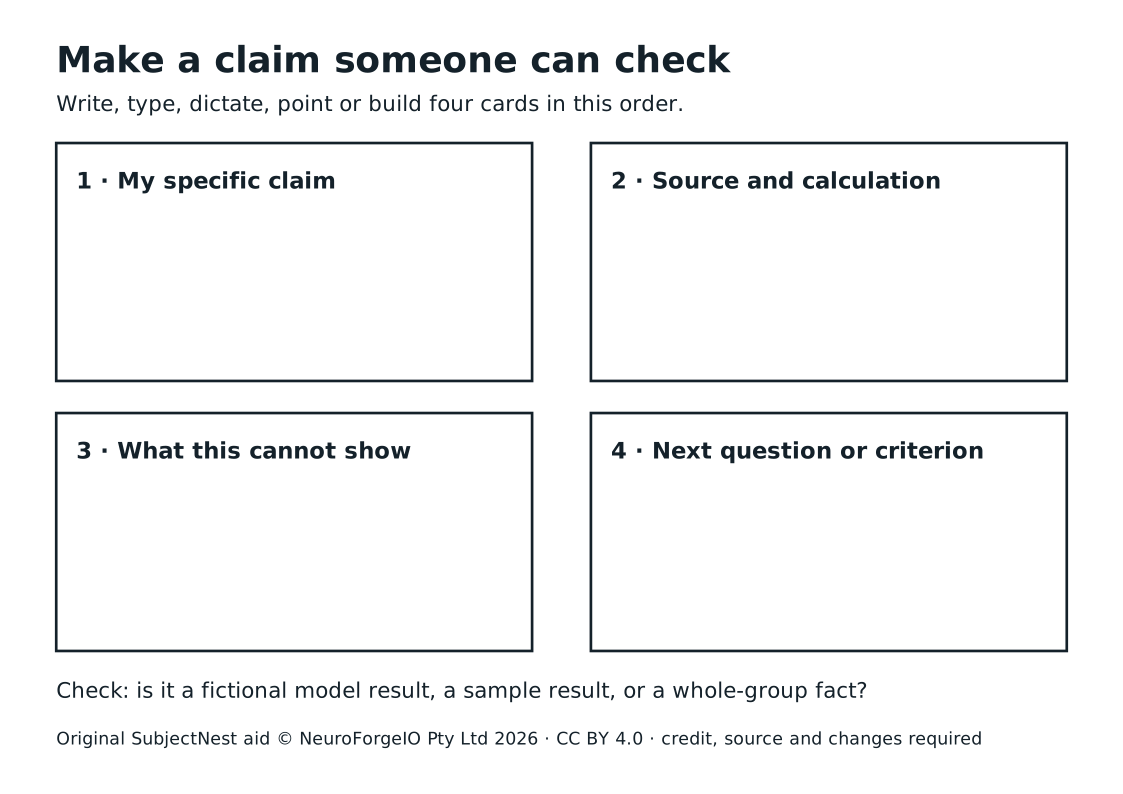
Use fictional Texts A–C and the claim/source/limit mat. Each session totals 2 + 4 + 5 + 7 + 4 + 3 = 25 minutes. Read rich text aloud or provide alternative access while recording independent reading separately. Codes are narrow partial links: AC9E8LA03, AC9E8LA04, AC9E8LA05, AC9E8LA06, AC9E8LY02, AC9E8LY03, AC9E8LY06, AC9E8LY07. Use assessment keys to reteach.
Day 1 — The headline against the table
Success: distinguish a per-repair charge from total cost and identify who made a claim. Prepare Text A and two colour marks. (AC9E8LY03, AC9E8LA03)
- Notice · 2 min. Read only “Join Plan A and save on every repair!” Ask what a reader might think “save” means.
- Reveal · 4 min. Show the flyer and small print. Model the two readings:
$7 rather than $10 per extra repairandlower total bill. Point out the $18 start cost. - Check together · 5 min. At zero repairs, A=$18 and B=$0; at two, A=$32 and B=$20. Ask whether the headline clearly explains both meanings.
- Independent annotation · 7 min. Learners mark one phrase that sells, one exact model fact, and one omitted condition. Then rewrite the headline to avoid promising a lower total at every count.
- Audience swap · 4 min. Pairs ask whether a person planning two repairs would be misled. The teacher samples 2–3 learners' own words, not their partner's.
- Exit · 3 min. “Is A's total lower at two repairs?” Key: no, $32 versus $20; a per-repair price is not the whole cost.
Day 2 — Substantiate a paragraph
Success: place a claim, worked example and limit in a cohesive paragraph. Prepare Text A and a four-card sequence. (AC9E8LA04, AC9E8LY06)
- Recall · 2 min. Learners name the $18 that the headline leaves easy to miss.
- Model · 4 min. Write: “Plan B costs less for two repairs. In the supplied model, A is $32 and B is $20. This comparison excludes parts and travel.” Show how the numbers substantiate, and the last sentence limits.
- Sequence · 5 min. Shuffle
claim / formula / substitution / limitcards. Class orders them and removes a sentence that repeats the claim without adding evidence. - Independent paragraph · 7 min. Learners write or dictate a paragraph for someone planning eight repairs. Key figures A=$74, B=$80; they choose an opening message and include a source label and caveat.
- Source audit · 4 min. Partner points to the phrase supported by Text A and asks whether an unprovided cost was invented.
- Exit · 3 min. Complete “At eight repairs, the model total for A is , so .” Key: $74; A is $6 lower than B's $80 under the model.
Day 3 — A flyer can also be an explainer
Success: explain why Text A combines promotional and explanatory stages. (AC9E8LA03, AC9E8LY03)
- Scan · 2 min. Learners mark the sales headline and the small-print formulas with different symbols.
- Model · 4 min. Teacher names purposes: attract attention, then specify a calculable model. Neither part is automatically false; purpose changes language choice.
- Guided comparison · 5 min. Replace “save on every repair” with “Plan A's per-repair charge is $7 after an $18 joining cost.” Ask what persuasive effect is lost and what clarity is gained.
- Independent designer note · 7 min. Learners write two sentences explaining the hybrid text to a fictional editor, citing one feature of each stage. They may annotate a large-print or tactile two-section version.
- Challenge · 4 min. Partner asks whether the mathematical small print can rescue an ambiguous headline for every reader. Invite evidence-based disagreement.
- Exit · 3 min. Key prompt: “Which part lets you calculate a total?” The formulas/small print, not the slogan.
Day 4 — Who made the decision?
Success: notice when nominalisation hides an actor, then revise with a named actor or honest uncertainty. (AC9E8LA06, AC9E8LY06)
- Hear · 2 min. Compare “A decision was made to raise prices” and “The club raised prices.” Ask what the first hides.
- Model · 4 min. Circle “decision” as a noun made from “decide”; the fictional flyer does not actually name who set the plan. Rewrite “The club set these model prices” only because Text A says the club drafted the flyer; do not invent a named manager.
- Guided repair · 5 min. Turn “The removal of the bus shelter was proposed” into “The fictional post proposes removing the shelter.” Ask how responsibility becomes clearer.
- Independent edit · 7 min. Learners annotate two sentences, one from Text A or B and one teacher sentence: “Approval of the new price was announced.” They revise the teacher sentence without inventing an actor, for example: “Someone announced approval, but the sentence does not say who approved the price.”
- Tone test · 4 min. Pairs compare effect: does naming the actor make a claim more accountable? When can an impersonal form be useful?
- Exit · 3 min. “Who proposes removing the shelter in Text B?” Key: the fictional School Travel Group post, not necessarily the school.
Day 5 — Price-note check A
Success: independently write a sourced, bounded explanation for one audience. (AC9E8LA04, AC9E8LY03, AC9E8LY06)
- Set purpose · 2 min. Ask learners to write to a fictional person considering five repairs. No preferred plan is announced.
- Clarify · 4 min. Text A stays available. The answer needs a total comparison, source, an honest limit and a question the model cannot answer.
- Plan · 5 min. Learners use their own outline or claim mat. Teacher does not supply a sentence to copy.
- Independent note · 7 min. Produce 4–6 sentences in an agreed response mode. Keep the first version.
- Self-audit · 4 min. Underline a calculation, circle an uncertain claim, revise any “always/guaranteed/best for everyone”.
- Exit · 3 min. Submit the revision. Check A keys five repairs at A=$53, B=$50; mode/independence recorded.
Day 6 — Who was asked?
Success: explain why a correct sample percentage can still support an invalid population claim. Prepare Text B. (AC9E8LY03, AC9E8LY02)
- Hook · 2 min. Read only “That proves 80% of all students cycle.” Ask what information a reader needs.
- Reveal · 4 min. Read the rack location and 16/20 response. Model: 80% is accurate for those 20 reported responses; selection near bicycle racks makes “all” unsupported.
- Guided sort · 5 min. Class marks
reported sample result / population claim / policy recommendation. Ask which leap needs a better source. - Independent margin note · 7 min. Learners write a question to the poster and a bounded replacement sentence. Do not ask classmates how they travel.
- Discuss · 4 min. Partners paraphrase the post fairly before critique. Teacher records who distinguishes “false arithmetic” from “unfair inference”.
- Exit · 3 min. “What does 80% describe here?” Key: 16 of the 20 people by the racks in the fictional post, not all students.
Day 7 — A quotation is selected
Success: evaluate how a source and chosen quotation position a reader. Prepare Text B plus Text C's ledger. (AC9E8LY03, AC9E8LY06)
- Find · 2 min. Underline “Everyone cycles to school now!” and identify it as the poster's wording, not a population fact.
- Model · 4 min. Quote accurately: “We asked 20 students standing beside the bicycle racks.” Explain why cutting off “beside the bicycle racks” changes the reader's judgement.
- Guided compare · 5 min. Display full and shortened quotation. Learners say which limitation disappears in the short version.
- Independent revision · 7 min. Write a two-sentence reply that quotes the location exactly, computes 16/20 and avoids a whole-school claim.
- Check quotation · 4 min. Partner matches quotation to source text and labels an interpretation as interpretation. Do not invent a second source.
- Exit · 3 min. “Which words must stay in that quotation to understand selection?” Key: “beside the bicycle racks.”
Day 8 — Language can steer a decision
Success: replace emotionally forceful certainty with accurate, consequential language. (AC9E8LY03, AC9E8LA05)
- Contrast · 2 min. Read “Everyone cycles” and “In this rack sample, 16 of 20 reported cycling.” Ask which reaches further.
- Model · 4 min. Join a condition and main clause: “Although 16 of 20 respondents by the racks reported cycling, this location may overrepresent cyclists.” Label both clauses. Compare the embedded clause in “The rack sample, which was taken beside bicycles, may overrepresent cyclists”; it adds a source detail inside the main sentence.
- Guided consequences · 5 min. Ask who could be affected if a bus shelter were removed. Keep focus on the decision, not personal travel disclosures. Learners choose which of the two model sentences makes the sampling limit clearest.
- Independent revision · 7 min. Learners recast the post into a short cautious update with one complete complex sentence and one evidence question.
- Peer check · 4 min. Remove dependent clause: does the main clause still stand? Ask whether the wording acknowledges people not counted.
- Exit · 3 min. “Does the rack sample justify removing the shelter?” Key: no; it is not representative and does not establish needs or effects.
Day 9 — Challenge without flattening the other view
Success: challenge the inference while retaining the valid reported sample result. (AC9E8LY02, AC9E8LY07)
- Recall · 2 min. Learners identify the one true fraction in the post: 16/20 of its reported rack responses.
- Model · 4 min. Teacher says: “Your post reports a high cycling share at the racks. I cannot generalise it to everyone. Could we compare a fair sample before changing a shelter?”
- Plan · 5 min. Learners make a 45–60 second response with acknowledgment, reason and request. Notes, AAC sequence or text-to-speech are fine.
- Rehearse · 7 min. Partner listens, paraphrases the concern and asks one question. Teacher samples planned learners; others get a private later check.
- Revise · 4 min. Move the sampling method before the conclusion if the listener missed it; remove a personal attack.
- Exit · 3 min. Listener writes the challenge in one sentence. Key: the sample was selected at racks, so its 80% cannot establish school-wide cycling.
Day 10 — Fresh source check B
Success: independently test a new claim, then explain it to an audience without overclaim. Use fresh arts-club card. (AC9E8LY03, AC9E8LY06, AC9E8LY07)
- Set task · 2 min. State the audience: a fictional school decision group. Check accessible text/response mode.
- Read · 4 min. Present the new card. Do not label its overclaim for learners.
- Plan · 5 min. Learners note one exact source fact, one selection problem, a better next question and a possible effect of acting too soon.
- Independent response · 7 min. Write or compose a short note; retain the original before edits and record any adult prompting.
- Brief pitch · 4 min. Present to partner, teacher or private recording with consent. Score reasoning separately from speech confidence.
- Exit · 3 min. “What could change your conclusion?” Key: a fairer sample or additional evidence about access, cost and need. Use key/rubric.
Rights: Original lesson prose © NeuroForgeIO Pty Ltd 2026, SubjectNest, CC BY 4.0; credit, link and indicate changes.