Everything written or drawn for this pack is original. Adult texts A–D use unrestricted vocabulary and are read by the teacher; hide their print during decoding checks. A local recording may use these exact scripts with a transcript, but sharing that recording requires a separate voice/recording rights record. Child-reading strings appear in their own section below. The printed commands are used only after an adult has offered the class materials and checked a safe route.
Oral story A — The Ten Board (Days 51–52)
Quin wanted a classmate to see ten counters without losing track. The first board had ten spaces in a long row. Their classmate found the spaces near the end hard to follow. Quin drew a second board with two rows of five. They put the same ten large counters on it and asked the classmate which arrangement was easier to check. The classmate preferred the new board, but Quin kept the first drawing too, so they could explain what changed.
Teacher questions: What stayed ten? What changed? Whose view mattered? This is a fictional design story, not evidence that one board layout works for every real learner. Counters should be large where small parts are unsafe. The name Quin becomes child-readable only after the q-u lesson; the rest of this passage remains teacher-read.
Oral rhyme B — Moth and Thud (Days 53–54)
A moth on a cloth.
A thud in the mud.
Teacher note: In the intended Australian English pronunciation, moth/cloth and thud/mud rhyme. Read aloud; the print is adult-only because cloth includes a consonant cluster and other text patterns are not the day's child-reading target. Ask for the rhyming pair by sound before showing child-readable moth or thud. A learner may answer through an agreed AAC or pointing route; a matching letter ending alone is not proof of hearing rhyme.
Oral procedure and story C — A Box for Two Makers (Days 56–59)
Two pretend makers wanted to use a class box and large paper counters. First, one asked the teacher for the shared box. The teacher offered it to them. Next, they placed a few large counters inside and closed the lid. Then they set the box on a mat so the path stayed clear. When another maker asked to use the box, the first maker said, “Not yet; I need one more turn.” They agreed to check again after the turn. Nobody had to give away a personal item.
Teacher questions: What happened first, next and last in the object procedure? What did the second maker ask? What did “not yet” mean? The printed child instructions below cover only get, pack, set after permission. The adult story supplies permission, clear path, turn-taking and the fact that a refusal can be respected. If a real problem arises, use the school's local safety and consent process rather than this fictional script.
Oral assessment story D — A New Counting Board (Day 60 only)
Ari and Dev made a board with ten large spaces for a class game. Ari asked Dev before moving the pieces Dev had arranged. Dev said, “Please wait while I check this row.” Ari waited and drew a second row on paper. After Dev finished, they counted the ten pieces together, changed one crowded space, and showed the board to a new user.
Read twice with print hidden. Assessment questions ask for request, reply, sequence and revision. This is fiction. Do not treat it as a measured result that every child can see ten in that design.
Child-reading cards by first-use day
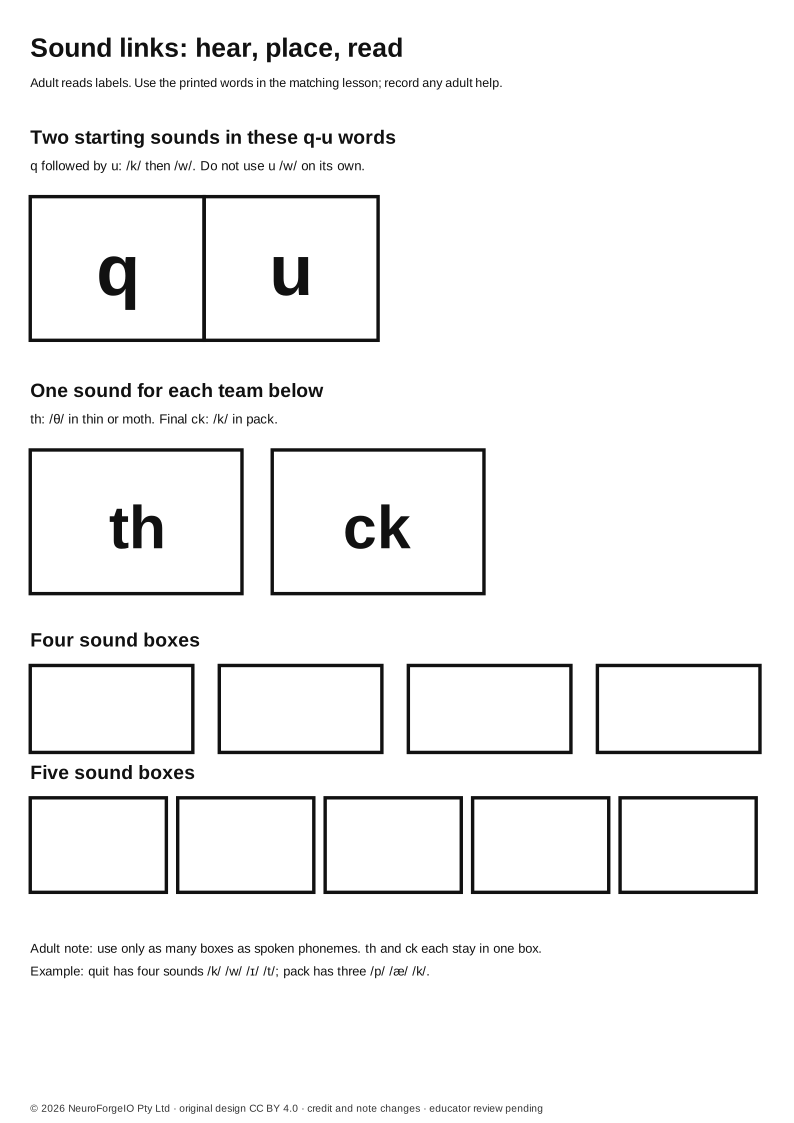
One card at a time, no picture-first guesses. Explain a new word's meaning after the blend. qu at the start is a fixed two-letter sequence cueing /k/ then /w/; put those sounds into two phoneme boxes even though teachers may point to the spelling pair together. th and ck each take one phoneme box in their controlled words.
| Day | Child-facing print | Boundary |
|---|---|---|
| 51 | q, Q, qu, quit, quiz, Quin, ten | Say /k/ /w/ /ɪ/ /t/ for quit and /k/ /w/ /ɪ/ /z/ for quiz. Q begins fictional name Quin. |
| 52 | quip, Quin got a box. Quin had a quiz. | quip means a short, witty remark after blending. quiz here is a friendly question game, not a graded test. |
| 53 | th, thin, thud, moth | th is /θ/ once in each word. Do not show printed the/this/that for child reading. |
| 54–55 | spot; Quin got a mat. A moth is on it. Quin can spot it. | spot starts /s/ /p/ separately. The story is imagined; it does not prove that a real moth was observed. |
| 56 | ck, back, neck, duck, sock, pack, deck | Final ck is one /k/ sound after the short vowel in this set. |
| 57 | G, Get a box. Pack it. | Capital G starts Get; lower g /g/ was previously taught. Adult supplies the items to pack. |
| 58 | Get a box. Pack it. Set it on a mat. | Three ordered object actions after adult permission. Set uses taught capital S. |
| 59 | Get a bag. Pack it. Set it on a mat. | Child-made controlled variation; check it against actual safe materials. |
Teacher-only spoken examples queen, quick, this, that, the, school, backache may enrich talk but are not child-reading cards here. queen has ee, quick has ck before Day 56, this/that/the have voiced /ð/, school has untaught patterns, and backache has other values. The word quilt is reserved as a new printed assessment transfer on Day 60 after the q-u sequence has been taught.
Child-reading mini-text S — Quin and a Moth (Days 54–55)
Quin got a mat.
A moth is on it.
Quin can spot it.
The short text has a person, an imagined moth and a possible observation. It does not say where the mat is or what Quin does next. Ask which sentence states that Quin notices the moth. Read can carefully /kæn/ to blend, then allow natural reduced speech on rereading. A richer spoken ending can be adult-scribed separately and is not independent decoding evidence.
Child-reading procedure P — After an adult offers the class materials (Days 57–59)
Get a box.
Pack it.
Set it on a mat.
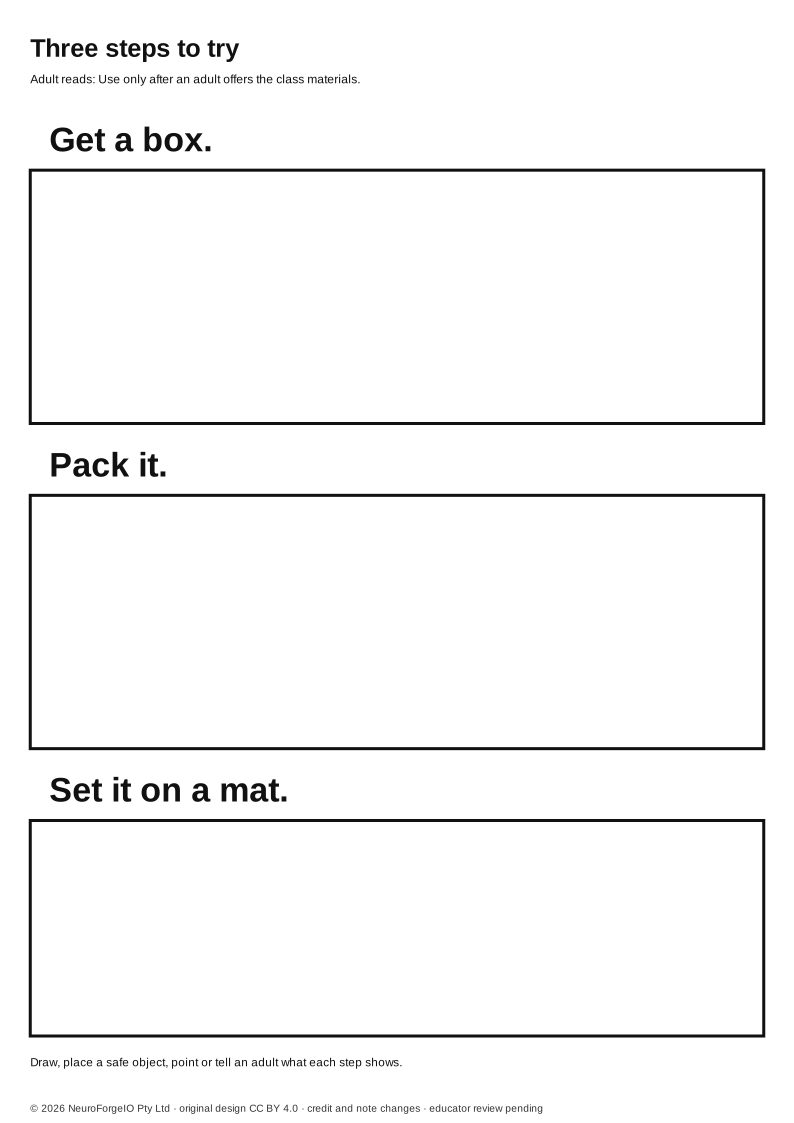
The teacher chooses a safe class box, large paper counters or drawn tokens and a mat. Before use, an adult offers the items and models the oral request from text C. Pack it refers to the box; a teacher indicates the offered counters. The child-facing print does not mean “take someone's box” or require a learner to hand over a personal item. A controlled variation can replace both occurrences of box/it only if reference stays clear: Get a bag. Pack it. Set it on a mat.
Printable text alternatives and evidence
The sound-link mat has separate printed q and u in two adjacent boxes under an adult-read “two sounds” label, separate th and ck tiles under an adult-read “one sound each” label, a row of four empty phoneme boxes and a row of five empty phoneme boxes. For quit, use four boxes /k/ /w/ /ɪ/ /t/; for moth, use three boxes /m/ /ɒ/ /θ/ and leave extra boxes unused; for pack, /p/ /æ/ /k/ in three boxes. Quilt has five sounds /k/ /w/ /ɪ/ /l/ /t/ for assessment.
The three-step card prints the three controlled procedure lines above in large type, each with a blank response box. An adult reads the small label “Use only after an adult offers the class materials.” A learner may draw the action, place an object, point, dictate or use AAC in each box. Plain text is the three-line procedure above. The boxes are not picture cues to guess the printed words.
Reusable evidence line: date / learner code / exact prompt and response / independent or prompted / format and route / next teaching move. Keep identifiable child records in the school's approved local system.