Each lesson is 25 minutes. Use the original passages and controlled print in MATERIALS.md. Adult passages are for listening and meaning; do not present them as child decoding. Codes are proposed links to ACARA v9 Foundation English, not official approval or proof that a description is completed. Keep a roster with exact exit item and response, independent/after model/not observed, meaning response and access route. After recording an independent attempt, give one short model and retry.
Week 11 · Day 51 — q followed by u in two sounds
Proposed codes: AC9EFLE02, AC9EFLY05, AC9EFLY09, AC9EFLY10, AC9EFLY11, AC9EFLY12, AC9EFLY13.
Goal: Recognise q/Q with following u, say /k/ then /w/ in this spelling sequence, and decode quit/quiz/Quin from print.
Prepare: adult story A, q/u and prior cards, four sound boxes, quit, quiz, Quin, ten cards.
- Cumulative retrieve · 3 min. Show a, is, x, sh, ch, ten in mixed order. Ask for three independent reads/links across the group and note one uncertain link without slowing the new model.
- Adult-read story · 4 min. Read The Ten Board aloud. Ask “What stayed ten? What changed on the second board?” Accept ten large counters, marks, AAC or speech for meaning; this is not a maths assessment.
- Oral-to-print model · 5 min. Say quit with print hidden: /k/ /w/ /ɪ/ /t/. Place four counters. Reveal q u i t, pointing to q followed by u for the starting /k/ then /w/. Say “These two printed letters work as a fixed starting pair in our words, but we still hear two starting sounds. Do not call /kw/ one sound or use u /w/ by itself.” Show capital Q in the fictional name Quin; use the school's formation cue.
- Guide and try · 7 min. Model quit with four boxes; guide quiz /k/ /w/ /ɪ/ /z/, then invite Quin /k/ /w/ /ɪ/ /n/. Explain quit means stop an activity and quiz can be a friendly question game only after blending. Read familiar ten /t/ /ɛ/ /n/ as a word under the ten-counter board.
- Meaning and difference · 4 min. Ask “Which board did the classmate prefer? Does the adult story say all learners would choose it?” No. Contrast quiz with Quin: same /k/ /w/ /ɪ/, changed last sound and capital name. Do not ask children to decode other q words yet.
- Exit check · 2 min. Show quit in a changed order. Ask for the blend and number of phonemes; expect four. Record both and whether the q-u sequence was independently identified.
Access routes: tactile/large separate q and u in adjacent boxes, counters, digital tiles, quiet response, teacher-read story with transcript, speech/AAC/pointing for meaning. A child can select /k/ then /w/ through AAC if oral production is inaccessible.
Week 11 · Day 52 — The pair stays together in words
Proposed codes: AC9EFLA09, AC9EFLY04, AC9EFLY05, AC9EFLY10, AC9EFLY11, AC9EFLY12, AC9EFLY13.
Goal: Keep the starting q-u sequence in order, read a new word and two controlled sentences, and spell one q-u word.
Prepare: four boxes, quip, Quin got a box. Quin had a quiz. strips, word tiles, adult story A for recall.
- Retrieve · 3 min. Reblend quiz, Quin, quit without a picture. Ask for the two starting sounds, then reread ten. Give one model to a learner who merges /k/ and /w/.
- Oral memory · 4 min. Ask what Quin did after the classmate found the long board hard to check. Reread one relevant sentence of adult story A if needed. “The long story words are mine to read; the short strip is yours to decode.”
- New-word model · 5 min. Say quip /k/ /w/ /ɪ/ /p/ into four counters; reveal q u i p and blend. Explain a quip is a brief clever remark after decoding. Keep q followed by u as the selected spelling pair; no broad q spelling rule is claimed.
- Sentence reading · 7 min. Show Quin got a box. and Quin had a quiz. Model tracking the first name, then listen to independent blends. Read a as the taught unstressed article, and use a careful form for natural reduced words. Ask which sentence mentions a question game. Record any adult-supplied word.
- Encode · 4 min. Hide print and dictate quiz. Learners segment /k/ /w/ /ɪ/ /z/, select/write q u i z and reread. Ask where capital Q would be needed for a person's name, not for the common word quiz.
- Exit check · 2 min. Show quip again in a fresh position and ask for an independent blend; then ask whether Q in Quin begins a name. Record reading and capital knowledge separately.
Access routes: adjacent large/tactile q-u tiles, four counters, one sentence per strip, AAC sound sequence, typing/tiles for spelling, quiet/private turn and adult-read story replay with transcript.
Week 11 · Day 53 — th for the quiet tongue sound
Proposed codes: AC9EFLA08, AC9EFLE04, AC9EFLY09, AC9EFLY10, AC9EFLY12, AC9EFLY13.
Goal: Hear /θ/, link th to one sound in thin/thud/moth, and distinguish it from two starting sounds in q-u.
Prepare: oral rhyme B, th tile, three sound boxes, thin, thud, moth cards.
- Retrieve · 3 min. Read Quin, quiz, ten. Ask how many beginning sounds q-u cues; expect /k/ then /w/. Mark an exact error for later practice.
- Oral rhyme · 4 min. Read Moth and Thud twice. Ask which spoken words rhyme with moth and thud. Do not display cloth as child print.
- Sound-team model · 5 min. Say thin /θ/ /ɪ/ /n/ with print hidden. Model a natural voiceless /θ/ without requiring children to put a finger on their mouth. Reveal th i n: “Here t and h together write one sound /θ/.” Put th in one sound box. Say that the/this/that use another th sound and stay adult-read.
- Guide and try · 7 min. Model thin, guide thud /θ/ /ʌ/ /d/, and ask for moth /m/ /ɒ/ /θ/. Keep th together at the start or end. Explain thud as a dull sound and moth as an insect after the blend; no live insect handling is needed.
- Encode and compare · 4 min. Dictate thin with print hidden. Learners say three sounds, choose th i n, and reread. Ask “Why does this word have four letters but three sound boxes?” Two letters write one /θ/ sound.
- Exit check · 2 min. Show moth out of order. Ask for a blend and the two letters that write its last sound. Record independently.
Access routes: large/tactile th tile kept together, raised three boxes, clear mouth model or visual sound-choice board, quiet response, AAC/pointing/typing, and adult-read rhyme with transcript. Do not treat inability to produce /θ/ orally as failure to recognise its spelling.
Week 11 · Day 54 — Read a tiny imagined moth story
Proposed codes: AC9EFLE02, AC9EFLE05, AC9EFLY04, AC9EFLY05, AC9EFLY10, AC9EFLY12.
Goal: Blend spot with two starting consonants, read the controlled Quin/moth mini-text, and retell only its stated events.
Prepare: mini-text S, four boxes, spot card, three blank event cards.
- Retrieve · 3 min. Read moth, thin, Quin in mixed order. Ask which word has th at its end. Note whether q-u still gives two sounds.
- Oral anticipation · 4 min. Say “A moth can be in an imagined story. We have not observed a real one here.” Ask where a character might notice something; accept fictional ideas without treating them as facts.
- Model adjacent sounds · 5 min. Say spot /s/ /p/ /ɒ/ /t/ into four boxes, then reveal s p o t. Touch s and p separately; do not teach sp as one sound.
- Read the mini-text · 7 min. Show Quin got a mat. A moth is on it. Quin can spot it. Model tracking on the first name, guide one missed blend, then listen to what children read independently. Use a /ə/ and is /ɪz/ as taught; read can carefully for blending, then naturally. Do not reveal a moth drawing before decoding.
- Retell and check · 4 min. Learners place three blank event cards for Quin getting a mat, a moth on it and Quin noticing it. Ask “Does the print say where the mat is?” No. Any further detail is an imagined addition, not a decoded fact.
- Exit check · 2 min. Show spot without the story. Ask for an independent four-sound blend and which two consonants begin it. Record both.
Access routes: one sentence per large/tactile strip, four counters, plain-text story, blank props only after print attempt, quiet reading, speech/AAC/pointing for retell. Adult-supported words are marked as supported.
Week 11 · Day 55 — Ten as a word and story evidence
Proposed codes: AC9EFLA09, AC9EFLE05, AC9EFLY04, AC9EFLY05, AC9EFLY06, AC9EFLY10, AC9EFLY13.
Goal: Reread the controlled story, spell a known word, and use ten as a decoded label without turning the English check into a counting score.
Prepare: mini-text S, ten card, ten large counters or marks, Quin / moth / mat / spot tiles, blank evidence strip.
- Retrieve · 3 min. Flash q-u, th and three earlier links; read quit, moth, ten once. Record the exact link still uncertain.
- Word and quantity boundary · 4 min. Blend t e n → ten from letters. Show a board of ten large marks. Say “The printed word says ten. The separate maths lesson checks how we know the board shows ten.” Do not count a picture match as decoding.
- Reread with purpose · 5 min. Child rereads mini-text S, first silently tracking or through an accessible route, then to a chosen listener. Record which words are independent now compared with Day 54. Give a model after the first record if needed.
- Retell and adapt · 7 min. Use blank cards to retell the three printed events. Replace mat with the taught word box on a separate variation strip; ask whether A moth is on it still makes sense as an imagined story. Check the changed word by letters and meaning, then restore original for evidence.
- Spell and inspect · 4 min. Dictate ten with print hidden; learners place/write t e n, then add the word label to their own ten-mark board if relevant. Ask for a capital and stop mark in Quin got a mat. without scoring maths.
- Exit check · 2 min. Present A moth is on it. in a fresh strip. Ask for an independent read and what it refers to in the original story. Record decoding and pronoun meaning separately.
Access routes: large/tactile counters or drawn marks, movable labels, text-only mini-text, private listening, AAC/pointing, typing/handwriting or dictated retell. A child may choose the board format; no fixed style label is assigned.
Week 12 · Day 56 — Final ck as one sound
Proposed codes: AC9EFLY05, AC9EFLY10, AC9EFLY11, AC9EFLY12, AC9EFLY13.
Goal: Link final ck to one /k/ phoneme after a short vowel in the selected words and hear the order in an adult-read shared-material story.
Prepare: oral procedure/story C, ck tile, three sound boxes, back, neck, duck, sock, pack, deck cards.
- Retrieve · 3 min. Revisit q-u as two sounds and th as one. Blend quiz, moth, ten once; note an actual missed link.
- Adult-read situation · 4 min. Read A Box for Two Makers aloud. Ask what the first maker did before using the class box. Answer: asked and waited for an adult to offer it. Do not turn the printed command later into permission to take an item.
- Sound and print model · 5 min. Say back /b/ /æ/ /k/ with print hidden, three counters. Reveal b a ck. “At the end of these words, c and k together write one /k/ sound.” Put ck in one phoneme box. This is a selected pattern, not a claim every /k/ ending is written ck.
- Guide and try · 7 min. Model back, guide neck and duck, then invite sock, pack, deck. Keep final ck joined during each blend. Explain deck as a flat outdoor platform or a set of cards after reading; do not show a meaning picture first.
- Encode · 4 min. Dictate pack with no printed model. Learners segment /p/ /æ/ /k/, choose p a ck, and reread. Ask why three sounds use four letters. Revisit the adult story's first/next/then order orally.
- Exit check · 2 min. Show sock in a new position and ask for an independent blend and last sound-spelling team. Record both.
Access routes: tactile/large ck tile, raised sound boxes, word-by-word strips, quiet private read, digital/loose letters, AAC sound selection and adult story transcript. Learners may direct an adult to place counters.
Week 12 · Day 57 — Two child-readable actions
Proposed codes: AC9EFLA09, AC9EFLY01, AC9EFLY04, AC9EFLY06, AC9EFLY11, AC9EFLY12, AC9EFLY13.
Goal: Read Get a box. Pack it. as ordered commands after adult permission, recognise capital G, and match each line to a safe object action.
Prepare: class-owned light box, large paper counters, G/Get, Get a box. Pack it. strips, three-step card partly covered.
- Retrieve · 3 min. Read pack, back, sock. Ask what one sound final ck writes. Re-model pack if needed.
- Permission in adult speech · 4 min. Use fictional puppets and say “Can I use the class box after you?” Model “Not yet” and “Okay, I will wait.” Then the teacher explicitly offers a class box. The two printed lines begin only after that offer; no learner must hand over a personal item.
- Capital and word model · 5 min. Show lower g /g/ from earlier lessons beside capital G. “Same letter, new shape at the start of Get.” Blend G e t → Get; use the school's formation cue. Show a as the taught article /ə/.
- Read and act · 7 min. Present Get a box. Pack it. one line at a time. Model first-line tracking, guide Pack /p/ /æ/ /k/ and it /ɪt/, then allow a private or partner-directed enactment with the offered box and safe counters. Ask what it names. Stop marks end each instruction.
- Sequence and revise · 4 min. Swap the two strips. Ask whether Pack it works before we know which class box was offered. Put the original order back and have learners explain in speech, AAC, pointing or objects. Do not score a motor action as independent word reading.
- Exit check · 2 min. Show Get and Pack without objects. Ask for an independent read and which line comes first. Record print and order separately.
Access routes: large/tactile strips, teacher-offered light object or paper symbols, child-directed adult placement, AAC/gesture, quiet rehearsal, typing/tiles. Follow local access and permission policy; no physical passing of a personal item is required.
Week 12 · Day 58 — Three steps with first, next, last
Proposed codes: AC9EFLA03, AC9EFLA05, AC9EFLA09, AC9EFLY01, AC9EFLY04, AC9EFLY05, AC9EFLY06, AC9EFLY07.
Goal: Read a complete three-step controlled instruction, retell its order orally and make a clear page for another user.
Prepare: three-step card, exact text alternative, offered class box, counters and mat, blank step boxes.
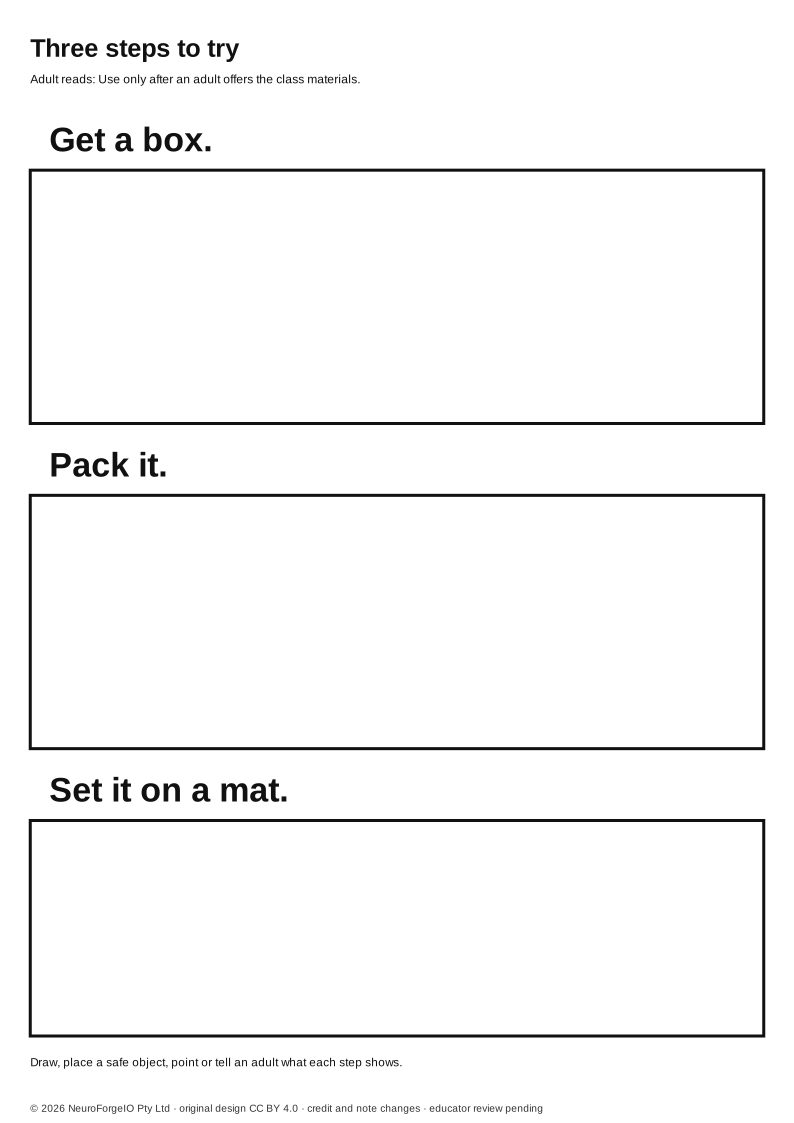
- Retrieve · 3 min. Read Get a box. Pack it. from yesterday without object cues. Ask where capital letters and full stops are.
- Teacher-read ordered meaning · 4 min. Reread adult text C's object actions with first, next, then. Ask what permission preceded them. The teacher offers the class materials before any printed step is acted.
- Model the last line · 5 min. Say Set it on a mat. and reveal the print. Blend Set, it, on, a, mat from taught links; note capital S and stop. Model placing the offered box on the mat after packing it.
- Guided full read · 7 min. Show Get a box. Pack it. Set it on a mat. Read one line at a time with the child, recording independent words before support. Ask who it refers to in the last two lines. The box should be light and safe; drawing or adult-directed placement is an equal response route.
- Make the user card · 4 min. Learners place the three text strips in order on a blank mat/card, add drawing or tactile marks only after the words are read, and tell a partner first/next/last in their own language or AAC. Adult scribes unrestricted oral words separately from child-read print.
- Exit check · 2 min. Shuffle the three lines. Ask the learner to select the first and last, read one chosen line, and explain its action. Record sequence, decoding and meaning separately.
Access routes: original SVG or exact plain text, large/tactile strips, digital sorting, quiet private audience, objects or picture-free cards first, AAC/sign/pointing/drawing. A copied procedure is not automatically independent composition.
Week 12 · Day 59 — Change a step and test the user
Proposed codes: AC9EFLA09, AC9EFLY04, AC9EFLY05, AC9EFLY06, AC9EFLY07, AC9EFLY13.
Goal: Create a controlled variation, check that it has a clear referent, and listen to a user follow the ordered instructions.
Prepare: original card, box/bag tiles, safe offered bag and mat or paper model, blank three-step strip, one willing user or adult puppet.
- Retrieve · 3 min. Blend pack, moth, Quin, Get in mixed order. Note the exact spelling that needs review; do not re-teach everything indiscriminately.
- Adult request recall · 4 min. Ask what a maker says before using a shared tool. Model “Can I use it after you?” and an acceptable “Not yet.” The teacher offers a class bag for the variation; the print does not override a no.
- Model one controlled change · 5 min. Replace box with bag in first line: Get a bag. Read the whole first line and ask what it now refers to in Pack it. Set it on a mat. Keep capitals and stops.
- Create and read · 7 min. Learners assemble Get a bag. Pack it. Set it on a mat. or restore the box version. Have them read each line, then add a small original mark/object for a user. Any richer oral detail about what goes inside is adult-scribed separately and never scored as decoded print.
- User trial and revision · 4 min. A willing partner/teacher follows the child card with safe paper objects. Ask “Which step was clear? What would you change?” Child may keep a working version. Record whether the child composed, copied or repeated an adult model.
- Exit check · 2 min. Show Get a bag. and Pack it. without the object. Ask for an independent read and what it names. Record word reading and reference understanding separately.
Access routes: class-owned light bag or drawn symbol, large/tactile tiles, switch/digital sorting, adult placement under child's direction, quiet/private user, speech/AAC/sign/pointing. No child has to share a personal object or perform publicly.
Week 12 · Day 60 — Two-week evidence check
Proposed codes: AC9EFLA09, AC9EFLE05, AC9EFLY01, AC9EFLY04, AC9EFLY05, AC9EFLY06, AC9EFLY07, AC9EFLY09, AC9EFLY10, AC9EFLY11, AC9EFLY12, AC9EFLY13.
Goal: Show new q-u, th and ck links, transfer to unseen words, listen/retell an ordered fictional event, and create a clear short instruction with a next step.
Prepare: ASSESSMENT.md, oral story D, shuffled links, word cards, safe paper objects, blank three-step strip.
- Set purpose · 2 min. Say “Show me what is ready and what we should practise next. There is no race. You can ask me to repeat a direction.” Offer private and accessible response routes.
- Fresh oral story · 5 min. Read A New Counting Board twice with print hidden. Ask learners to notice the request, reply and order of checking/change.
- Meaning and sounds · 5 min. Ask the assessment's four story questions and a short oral sound sample. Record first independent responses, direction repeats and content hints.
- Print sample · 5 min. Show quilt, thick, dock, check, best and q-u/th/ck cards separately, plus one fresh controlled sentence. Observe private individual blending during planned rotations; do not claim to hear a whole class here.
- Encoding and creating · 6 min. Dictate quiz, moth, pack, ten with print hidden. Invite one new two- or three-line ordered card from taught tiles after adult permission; ask what it refers to. Record first independent work before feedback.
- Exit check and close · 2 min. Ask the learner to choose th or ck, read a practised word using it and name/point to one next step. Give one precise observed strength; finish rubric after the lesson.
Feasible administration: The 25-minute block gathers group evidence. Private link and unseen-word checks take about 7 minutes per learner in ordinary independent-work periods across Days 56–60; extend the checking window if needed. A missing observation stays not observed, not zero. The English check does not decide maths equal-sharing or real-life social fairness.
Access routes: adult-read story with transcript, tactile/large cards, phoneme boxes, physical/digital tiles, private quiet check, AAC/sign/pointing/typing/drawing, extra response time and child-directed adult object placement. Adult-read words are meaning evidence, not independent decoding.