Use: combine Day 70 with at least one dated child mini-text response and, only if a real approved plant was safely viewed, the child's two dated plant records. This is a formative next-teaching decision, not a standardised test, diagnosis, report-card grade, full-year achievement judgement, science score or assessment of a child's family. Proposed ACARA v9 Foundation English links: AC9EFLA09, AC9EFLE02, AC9EFLY01, AC9EFLY03, AC9EFLY04, AC9EFLY05, AC9EFLY06, AC9EFLY09, AC9EFLY10, AC9EFLY11, AC9EFLY13, AC9EFLY14. Human educator, local curriculum, safeguarding and accessibility review pending.
Administration and evidence boundaries
The class's 25-minute Day 70 block gathers common listening, spelling and work-sample evidence. Hear each learner read the link cards and unseen words in a private approximately seven-minute check during independent-work rotations across Days 66–70 or a longer realistic window. Do not infer individual reading from choral answers. Keep first independent responses, any direction repeat, answer hint and taught retry as separate records. A missing/inaccessible item is not observed, never a zero.
Read all directions aloud. Offer large/tactile print, movable or digital letters, quiet setting, extra time, speech, AAC, sign, pointing, typing, drawing or child-directed scribing as appropriate. If hearing or oral production changes a phoneme task, plan an equivalent and its interpretation with the learner, family and relevant specialist. Note actual source and route: a fictional line, a 2021 Census-based account and a real plant record answer different questions. No child must report private family facts, ring a bell, handle a plant or perform publicly. Identifiable work stays in the school's approved local system.
A · Adult-read fiction and dated factual source
With print hidden, reread the specific adult passage in story A where Sam and Nell thought differently, and the whole short factual account B. The second account is an original paraphrase of AIFS's 2021 Census-based summary and ABS's 2021 family-composition definition, accessed 29 September 2026; it is not a present-day count. Ask exactly:
- “Which text has invented Sam and Nell, and which names a real source and year?” Expect story A and factual account B / 2021 Census. A pointer to the two adult-labelled mats plus the year is valid.
- “What did Sam want, and what did Nell want checked?” Expect Sam wanted to ring the bell; Nell wanted Pat to check the loose loop. This identifies different viewpoints from fiction.
- “Name one kind of family household reported by the 2021-source account.” Expect couple family with children, one-parent family or other family type as the adult passage states. Do not ask which category a learner's own family fits.
- “Does either text tell us how Pat felt or who is in your family?” Expect no. The fiction does not give Pat's feeling, and neither source identifies the learner's family. Follow “How do you know?” with no request for a private disclosure.
Record exact source reasoning. Naming a plausible feeling not stated is an inference and should be labelled as such, rather than treated as source fact.
B · Oral sound sample, print hidden
Use a locally clear pronunciation, voice/counters/AAC/pointing route and no printed word:
- “Say the sounds in ring in order.” Expect /r/ /ɪ/ /ŋ/, three, with /ŋ/ one sound.
- “Say the sounds in bell in order.” Expect /b/ /ɛ/ /l/, three, with /l/ one final sound.
- “Say the sounds in hiss in order.” Expect /h/ /ɪ/ /s/, three, with /s/ one final sound.
- “Put /h/ /æ/ /z/ together.” Expect has.
- “Which rhymes with ring: sing or bell?” Expect sing, based on sound rather than letter matching.
An accent or speech difference alone is not evidence of a missing concept when the learner shows it through an agreed route. Record exact item-level response and access.
C · Print-link boundaries and five unseen transfer words
Shuffle ng, ll, ss, has and three earlier links from q-u, th, ck, sh, ch, x, is. Ask for the value taught in the controlled set and a word it can help read. Expect final ng one /ŋ/, final ll one /l/, final ss one /s/, has /hæz/ with s /z/ in this word; prior q-u remains /k/ then /w/, two phonemes. Record the actual link missed, not merely a total.
Present each new printed word without picture or context. These exact five words are held out of the Days 61–69 child cards. Ask “Touch each letter or team, say the learnt sound or sounds in order, and blend.” Give meaning after the first attempt.
| Word | Sound path | Meaning after blend |
|---|---|---|
| wing | /w/ /ɪ/ /ŋ/ | A part some animals use for flight; not every wing is the same. |
| sell | /s/ /ɛ/ /l/ | Exchange something for money in an appropriate adult-managed context. |
| miss | /m/ /ɪ/ /s/ | Fail to catch or reach something, or feel someone's absence; explain the intended spoken use. |
| quill | /k/ /w/ /ɪ/ /l/ | A feather shaft, or an old writing implement; q-u has two sounds, final ll one. |
| thing | /θ/ /ɪ/ /ŋ/ | An object or matter being discussed; th and ng are each one sound. |
Show the fresh controlled sentence A bell is in a box. Ask for an independent word-by-word read and “Where is the bell in this print?” A /ə/ and is /ɪz/ are previously taught. Do not show a bell-in-box picture first. Record exact independent words, self-corrections and content hints.
D · Four exact dictations
Keep print hidden; say each short context and then repeat the target word without segmenting it for the learner. Allow tiles, tactile letters, accessible typing or pencil. Ask for one self-reread; record the exact first sequence.
| Spoken context and target | Expected written response | What it samples |
|---|---|---|
| “I can ring a bell after an adult offers it. Write ring.” | r i ng | Final ng in one sound box. |
| “The offered handbell is a bell. Write bell.” | b e ll | Final ll in one sound box. |
| “Our word card says moss. Write moss.” | m o ss | Final ss in one sound box; no claim moss was observed. |
| “Sam has a bell in the invented sentence. Write has.” | h a s | s /z/ in this bounded common word. |
Adult-spelled letters do not count as independent encoding. A handwriting barrier can be bypassed with ordered letter tiles while spelling knowledge is recorded.
E · Read, make and check an evidence-grounded sentence
First ask the child to read one line of the original mini-text S, then ask one literal question: “What does it mean in Sam can ring it?” Expect the bell, not a family relationship. Keep adult fiction A separate from what this child print actually states.
If a safe real plant view exists, show the child's dated record(s), approved viewing place and plant evidence card or its exact text alternative. Say “Make one readable sentence true for this plant and this view. Show me where your record supports it.” Choices in taught print are It is a plant., It is in a pot., It has a stem., It has a bud. Only offer a feature line when actually observed or accurately described live through the agreed access route. Ask one adult-read What/When/Where question and record the response, source and adult help. A child may dictate an additional richer observation; mark it adult-scribed meaning, not child-decoded print.
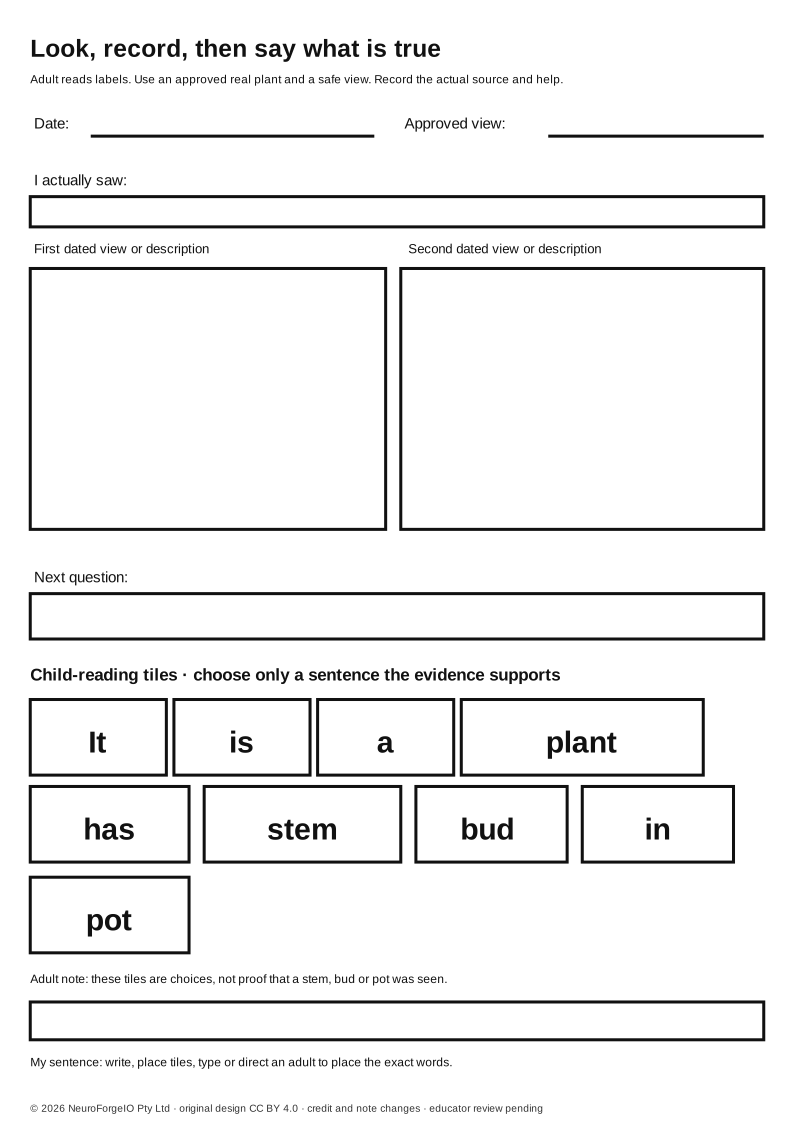
If no valid view exists, mark the real-plant evidence portion not observed and make a later safe opportunity. A clearly labelled fictional plant card can still assess decoding and sentence boundaries, but it cannot replace real observation. If two dated views exist, ask what looks same, different or unclear in one feature; an unchanged record is legitimate. Preserve original and revised sentences with dates rather than overwriting history.
Before scoring plant as decoded through short a, check the learner's own pronunciation. Some Australian speakers have a longer vowel in that word; use an explicitly taught local word variant or another truthful controlled line instead. Record the route, and never score a dialect difference as a phonics error. See the Macquarie University Australian Voices pronunciation note.
Analytic rubric
Use separate domain levels; do not add them or set a pass line. Independent means the standard direction plus non-content access route, without an answer hint. A completed accessible check with no independent evidence is 0. A missed or invalid check is not observed.
| Domain | 0 · No independent evidence | 1 · Emerging | 2 · Developing | 3 · Secure in this sample |
|---|---|---|---|---|
| A. Source type and viewpoint | 0/4 exact prompts | 1/4 | 2–3/4 | 4/4, including the 2021 source/year and a stated unknown |
| B. Oral sound work | 0/5 items | 1–2/5 | 3–4/5 | 5/5 with one sound for each ng/ll/ss example |
| C. New printed links | 0/4 of ng, ll, ss, has independently identified | 1/4 | 2–3/4 | 4/4 with /ŋ/, /l/, /s/, /hæz/ correctly bounded; earlier links recorded separately |
| D. Unseen-word reading | 0/5 independently sounded and blended | 1–2/5 | 3–4/5, or 5/5 with fresh sentence/meaning still prompted | 5/5 plus fresh sentence and literal meaning independently |
| E. Dictated encoding | 0/4 exact sequences independently | 1/4 | 2–3/4 | 4/4 and at least one self-reread |
| F. Child mini-text and referent | No line independently read or referent shown in a completed check | One line read after a word hint or it resolved only after a model | One line independent and it resolved with a non-answer prompt | One line independently read and it linked to bell without a content hint |
| G. Real-plant sentence and source | Completed accessible real-view task, but no independent true line or source link | A true line copied/modelled, or independent line with source unsupported | Independently read/made true line and pointed to a dated real view; one detail needs a prompt | Independently read/made true bounded line, showed exact dated view supporting it, and named an honest question or same/different/unclear comparison where two views exist |
Learner code: __ Date(s): _ Teacher: Access and exact view/source: _____
| Evidence | Exact first response; direction repeat, content hint, adult scribe and retry |
|---|---|
| A1 fiction/source/year; A2 two viewpoints; A3 family category; A4 unknown | |
| B1 ring; B2 bell; B3 hiss; B4 blend has; B5 rhyme | |
| C ng; ll; ss; has; which three earlier links? | |
| D wing; sell; miss; quill; thing; fresh sentence/meaning | |
| E ring; bell; moss; has; reread | |
| F mini-text line; it referent | |
| G actual plant/view/date; child line; source support; comparison/question or not observed |
A–G level or not observed: __ / _ / / / / /
Observed strength with exact item: __ Next teaching move and recheck date: __
Source, access or human-review question: _____
Choose next teaching
| Evidence pattern | Responsive move and recheck |
|---|---|
| ng split into /n/ /g/ | Put ng in one final box for ring/sing; contrast changed first sound, then recheck wing after teaching. |
| ll or ss counted as two phonemes | Segment bell or hiss into three counters; place joined final tile in one box and compare sell/miss after teaching. Do not turn a selected pattern into an every-word rule. |
| has s read /s/, or all s read /z/ | Compare familiar is /ɪz/, has /hæz/ and hiss /hɪs/ as whole bounded words. Recheck in a fresh controlled line after modelling. |
| quill/thing exposes an earlier q-u or th gap | Re-teach that exact earlier correspondence, count q-u as two sounds or th as one, then recheck the mixed word. Do not call the new ng/ll lesson the cause without item evidence. |
| Fiction treated as a record about a learner or Census category treated as a complete family definition | Lay out adult A and B with labels and year, ask which sentence each actually supports, and restate the no-disclosure choice. A private family conversation is governed by school policy, not by this English check. |
| Child print credited with adult-story feelings or relationships | Reread one child line and one adult sentence separately; ask what each actually says before an inference. |
| Plant feature invented, view undocumented or inaccessible | Mark real evidence not observed; arrange a safe and accessible real view with date/source, then choose a true sentence. If the plant looks unchanged, record exactly that rather than forcing change. |
| Reading and source use are secure | Continue the planned explicit sound sequence and richer adult information/literary texts, with cumulative review and another dated source-backed sentence. This check does not certify the whole Foundation year. |
Sources: ACARA v9 official workbook, ACARA English, AIFS 2021 Census-based summary, ABS 2021 family-composition definition, and AERO Monitor progress. External rights remain separate; original passages and assessment prompts are CC BY 4.0 as described in the pack guide.