The adult passages and factual paraphrase below are for listening, discussion and source comparison. Hide their print during child-decoding checks. A teacher may make a local voice recording of these original words with a transcript; sharing any recording needs a separate record of voice and recording rights. The short child-reading lines are isolated below and use only the selected links taught by their first-use day. Fictional people are never evidence about any learner's own family. A sentence about a real plant is used only when a teacher has checked the actual observation.
Adult oral fiction A — The Bell at the Table (Days 61–65)
Sam and Nell were cousins. Their aunt Pat brought a small handbell to a table for a pretend shop. Sam wanted to ring it at once. Nell saw that the loop on its handle was loose and asked Pat to check it first. Sam thought the wait was unnecessary. Nell worried that the bell might fall. Pat fixed the loop and offered the bell. Sam rang it once while Nell sang. Later Sam asked, “What did you notice before I did?” Nell showed the loose loop.
Teacher meaning prompts: Who are Sam and Nell in this invented story? What did Sam want? What did Nell see and think? Does the short child-readable text below state that they are cousins? No; only this adult passage does. Ask what source would tell us how Pat felt; the passage does not state Pat's feeling. The handbell is optional: use a picture-free prop or no sound if a bell is uncomfortable or unsafe. There is no invitation for learners to describe their own households.
Adult factual account B — What one family count can and cannot tell (Days 64–65)
The Australian Institute of Family Studies explains information from the 2021 Australian Census. That count included family households described as couple families with children, one-parent families and other family types. The Census groups households by set rules about relationships and who usually lives together. The Institute also explains that families extend beyond one household. A count of households does not tell us how the made-up Sam or Nell felt, and it does not tell us who is in any particular child's family.
This is our original age-appropriate paraphrase, not a copied source passage or an estimate for 2026. Check the official AIFS 2021 Census-based family summary and ABS 2021 family-composition variable, accessed 29 September 2026. The categories are statistical tools, not a definition of whose relationships matter. Keep the year in speech; do not call it a current headcount. Questions: Which text has invented Sam and Nell? Which text reports categories from a real 2021 source? Can either tell us who is in this classroom's families? No. The class may use the separate integrated guide's fictional source cards, but those remain fiction too.
Adult oral rhyme C — Ring and bell (Days 61–63)
Ring, sing; hear a sound.
Bell, tell; turn around.
Read aloud with a steady beat and let learners identify ring/sing and bell/tell by sound. The full printed rhyme is teacher-only because hear and around use spelling patterns outside the child cards. Rhyming is an oral sound task; matching the printed ng or ll ending alone is not proof of hearing a rhyme. A learner may choose a quiet, non-vocal answer route.
Adult plant observation script D — fill only after a real view (Days 66–69)
At a school-approved plant, from a safe fixed view, the teacher first looks and makes a dated note. Only then read aloud:
“Today is [actual date]. From [actual viewing place or accessible description route], I can see [one exact visible feature] on our approved plant. I think [a clearly labelled question or prediction, not an invented observation]. We can look again on [planned date]. I do not yet know whether it will look different.”
On a later day, after a real second view, read:
“Our first record on [date] says [exact first observation]. Today's record on [date] says [exact second observation]. The view was [same/different/unclear]. In the feature we checked, the records look [same/different/unclear] because [point to the two records].”
If access or safety prevents viewing, read “We have no new observation today. We can ask a question and plan another safe view.” Do not fill a visible-feature blank from hope, an illustration, a memory with no source, or someone else's unlabelled photo. The integrated Week 14 guide holds the longer science record and safety routine; this English script teaches evidence-grounded description and question language. Adult-read question words Who, What, Where, When, Why, How may be said and shown as adult labels, not scored as child decoding. A child may ask “What can we see?” or “When did we look?” using speech, AAC, sign, pointing or a verified home-language interpretation.
Child-reading cards by first-use day
Show one card or line at a time without picture-first cues. After a child blends a word, explain an unfamiliar meaning. For final ng, ll and ss, place the two letters together in one phoneme box in these words. The common word has has s /z/ only in its taught context here. All other spelling values remain bounded by the prior pack.
| Day | Child-facing print | Boundary and meaning after blend |
|---|---|---|
| 61 | ng, ring, sing, bang, song | Final ng is one /ŋ/: ring /r/ /ɪ/ /ŋ/, sing /s/ /ɪ/ /ŋ/. A song is something sung; a bang is a sudden noise. |
| 62 | Sam can sing. Sing a song. | All other links were taught earlier; a is the unstressed article /ə/. This is a short imagined statement and invitation, not a public singing requirement. |
| 63 | ll, bell, hill, fill, doll, Nell | Final ll is one /l/ in this selected short-vowel set. Nell is a fictional person's name with capital N. |
| 64–65 | Sam got a bell. Sam can ring it. Nell can sing. | See mini-text S below. it refers to the bell in the middle line; the print does not name a family relationship. |
| 65 | Nell can sing. Sam can ring a bell. | A new order for reread. Fact B remains adult-read; do not present its longer words as child decoding. |
| 66 | ss, hiss, mess, moss, fuss | Final ss is one /s/ in this set. Moss is a word card; do not claim it is on the class plant without observation. |
| 67 | has, Sam has a bell. Nell has a box. | has /hæz/ uses s /z/ in this word. The broader s rule is not taught. |
| 68–69 | It is a plant. Optional if observed: It has a stem. It has a bud. It is in a pot. | Choose a line only after a real, appropriate view supports it. plant /p/ /l/ /æ/ /n/ /t/ in the common short-vowel Australian pronunciation and stem /s/ /t/ /ɛ/ /m/ keep adjacent sounds separate. See the dialect note below. |
Never offer family, cousin, aunt, Census, Who, What, Where, When, Why, How, leaf, grew, flower or the full adult observation script as child decoding in this fortnight. Adult speech may use these words freely to build meaning. A child's richer sentence can be adult-scribed beside the controlled print, clearly labelled as dictated words.
Child-reading mini-text S — a bell and two fictional people
Sam got a bell.
Sam can ring it.
Nell can sing.
The text states three events or abilities; it does not state whether Sam and Nell are cousins, who brought the bell, what Nell felt, or whether the loop was loose. Those details are in adult story A. Ask “Who can ring the bell in this print?” and “What does it mean?” After the text attempt, the adult can compare it with story A. A reader may use a strip, large or tactile print, digital tiles or a quiet listener. Record adult-supplied words separately.
Plant sentence choices and evidence rule
- It is a plant. Use only with the school-approved real plant as the referent. The classification is known from the approved source, but the sentence alone does not report a detailed visible feature.
- It is in a pot. Use only if the observed plant really is in a visible pot at that view.
- It has a stem. Use only if a stem is visible or is described precisely from the permitted live view; record whether the child directly saw it or used an adult description.
- It has a bud. Use only if a bud is genuinely visible and confirmed by the responsible adult. Do not create a bud for the sentence.
For an unrepresented feature such as a leaf's edge, the child may make a drawing/AAC description or dictate richer words; mark that as meaning evidence, not independent decoding of untaught print. Keep a dated record and the view. An unchanged plant is a valid result. If no safe real view occurs, defer the factual plant sentence and use a clearly marked fictional practice sentence for decoding only.
Local speech variation: Macquarie University Australian Voices reports that plant usually has /æ/ as in cat in Australian English, but a longer vowel as in cart occurs for some speakers, especially in South Australia. Before calling plant independently decodable from taught short a, ask how the learner says it. If the vowel is not the taught /æ/, adult-read or explicitly teach that word as a local variant; a different truthful child sentence can still show evidence. Do not mark a dialect pronunciation wrong.
Printable exact text alternatives
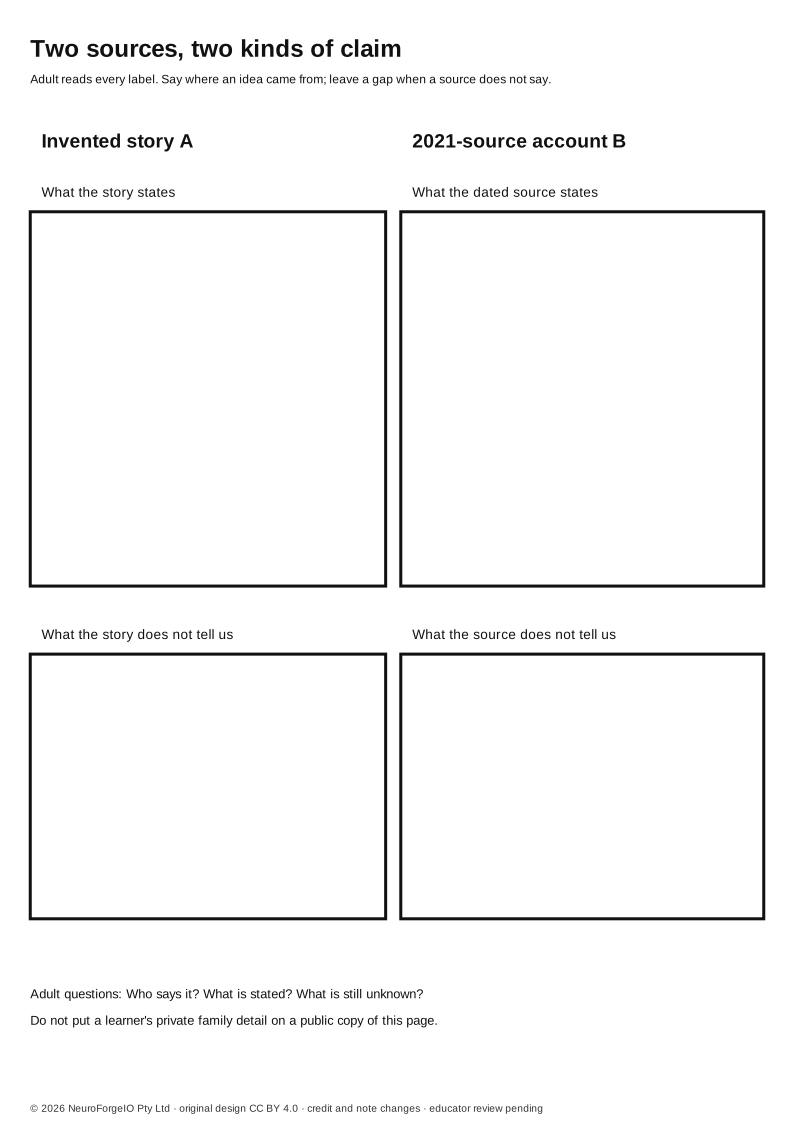
The fiction-and-fact source mat has two adult-labelled columns Invented story A and 2021-source account B, each with a large blank box for a dictated detail, symbol or object. An adult asks Who says it? What is stated? What is still unknown? The mat is not a child-decoding card. A child may place a mark in one column, point, sign, use AAC or direct an adult to scribe. Do not put a child's personal family detail in a public copy.
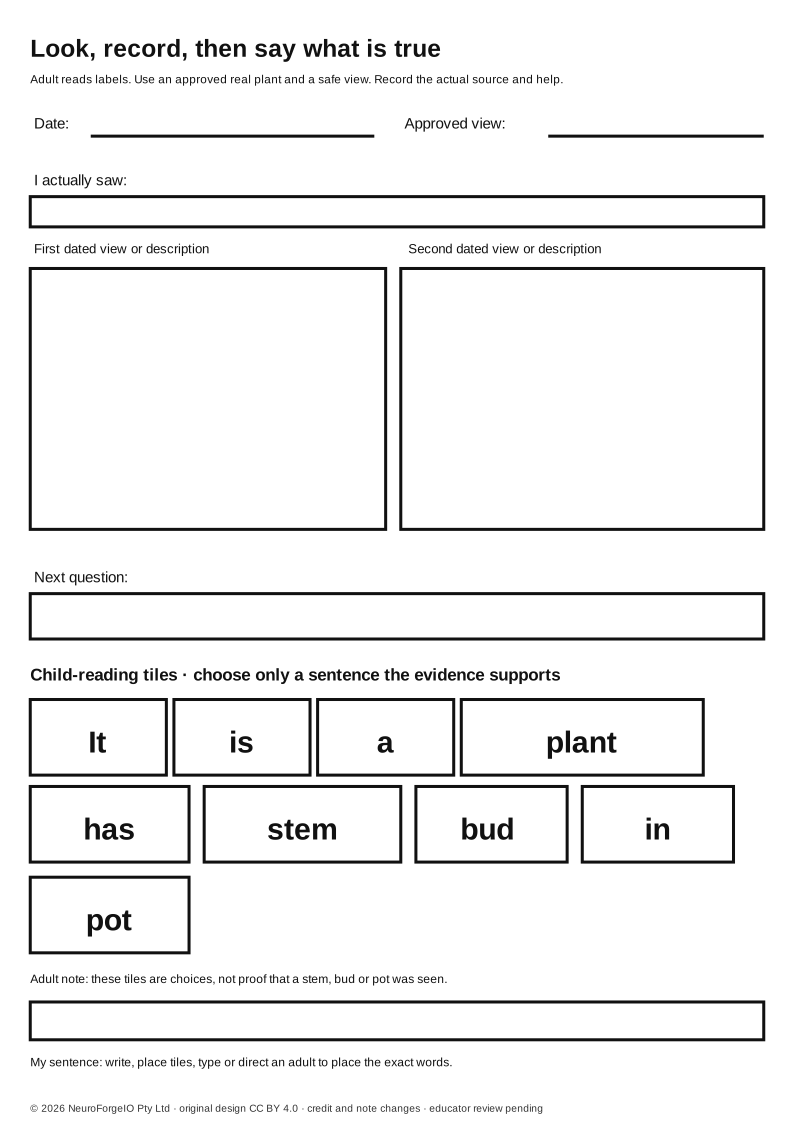
The plant evidence card has adult-only fields date, approved view, I actually saw, next question and two blank observation boxes. Below is a child-reading sentence-building area with large tiles It | is | a | plant | has | stem | bud | in | pot and one blank line. The teacher offers only a sentence supported by the real view, or labels an imagined practice sentence fictional. The printed tiles are not a claim that each feature exists. Copy the final child sentence and exact observation in the local record; note independent/copy/model and response route.
Reusable evidence line: learner code / date / exact prompt and response / source or real view / independent versus after model / format and access route / next teaching move. Identifiable learner details stay in the school's approved private system.