Status: original teaching draft; human educator, local curriculum, accessibility, safeguarding and accuracy review pending.
Scope: ten 25-minute English lessons (Days 61–70), original fictional and source-based adult texts, controlled child-reading, plant observation language, two printable aids with exact text alternatives, and a two-week formative assessment. These are two weeks of a longer draft sequence, not a complete Foundation English year.
Year label: Australian Curriculum Foundation Year; Prep in Queensland. This is not pre-Prep kindergarten.
Open, download and adapt
- Ten daily teacher scripts
- Original adult and child-reading texts, source notes and exact aid alternatives
- Assessment, rubric and next-teaching decisions
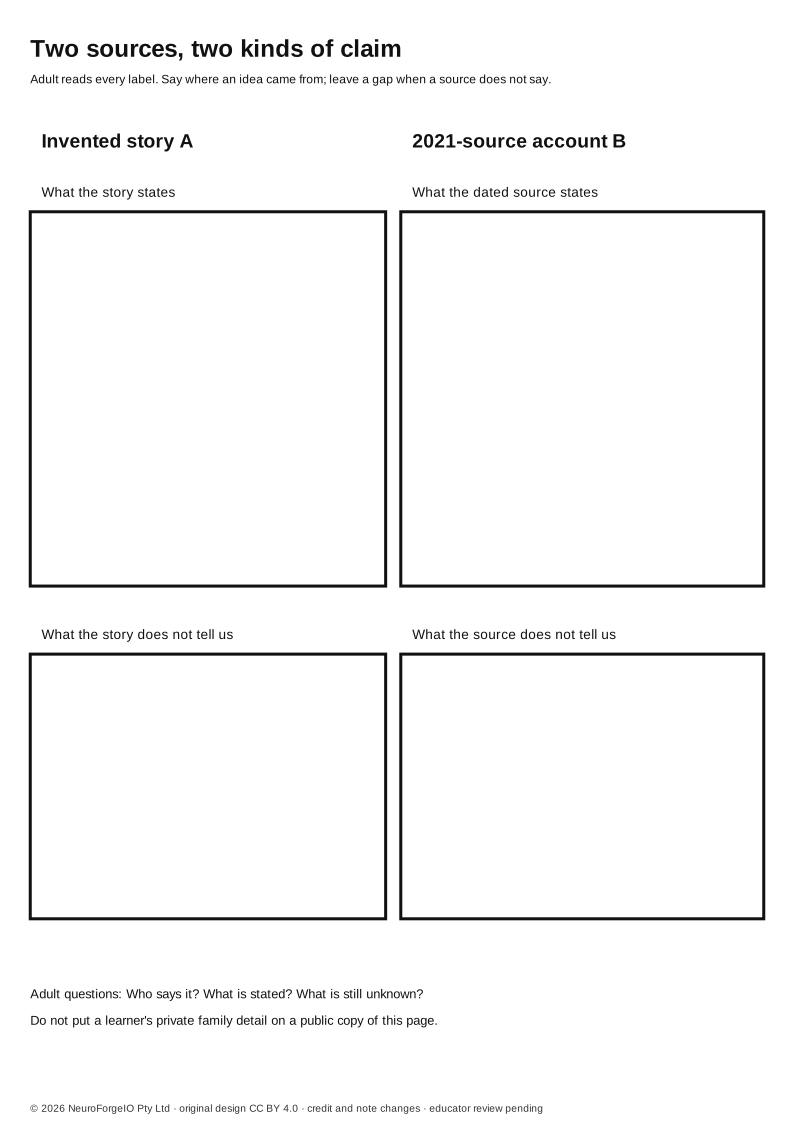
- Printable fiction-and-fact source mat
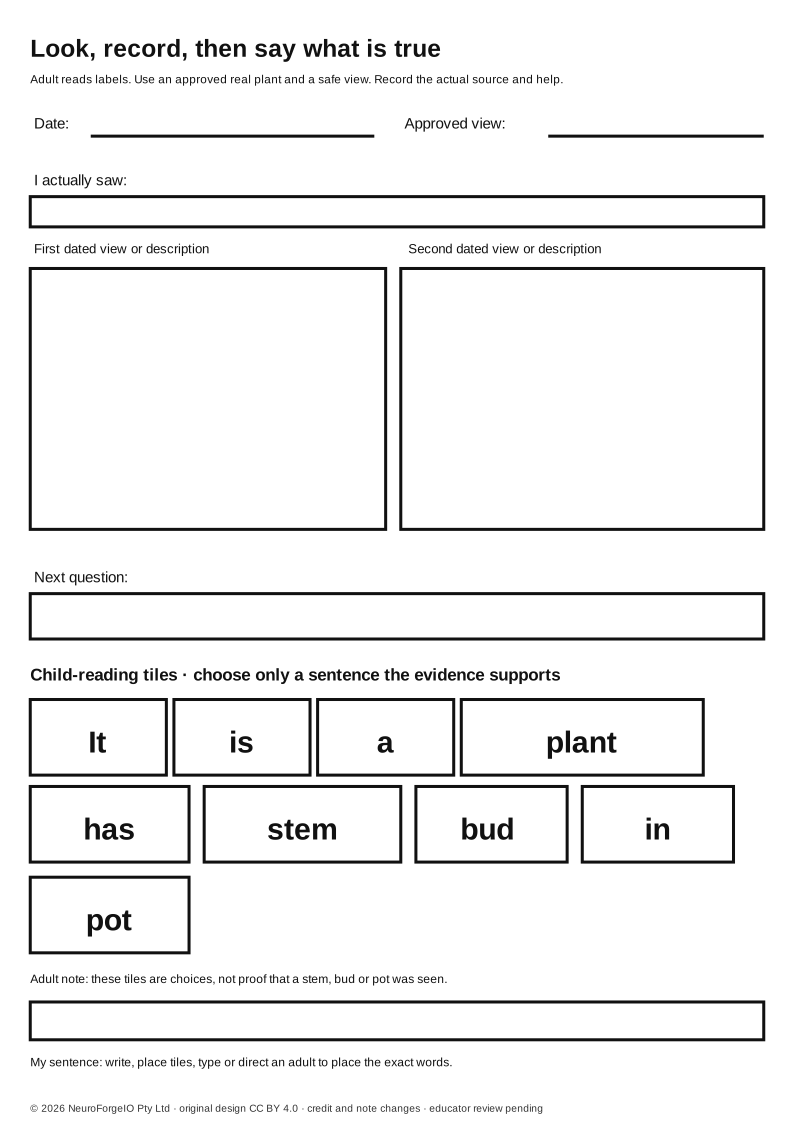
- Printable plant evidence and sentence card
- Curriculum mapping, rights and file hashes
The original lesson wording, texts, assessment and vector designs are © 2026 NeuroForgeIO Pty Ltd and licensed CC BY 4.0. Print, share, adapt and reuse them, including commercially, with attribution and an indication of changes. Suggested credit: “SubjectNest Foundation/Prep English Weeks 13–14, NeuroForgeIO Pty Ltd, CC BY 4.0.” Link the pack and licence where possible. ACARA, ABS, AIFS and AERO material retains its own rights; the SubjectNest licence does not cover it. No third-party text, image, worksheet or recorded voice is embedded.
Fit with the class week
The 40-week planning map calls for fiction/factual account and character viewpoint in Week 13, then question words and an observed-plant sentence in Week 14. Pair these 25-minute English lessons with the separate people-in-a-story integrated guide and looking-again-at-plants guide. The English work builds oral meaning, phonics, reading and writing evidence. It does not infer a child's family knowledge from fiction, require public disclosure, or turn a fictional plant model into a real observation.
Days 1–60 established 25 single-letter links except q on its own; selected starting q followed by u cues /k/ then /w/, two phonemes, in words such as quit; sh, ch, voiceless th and final ck each represent one phoneme in selected words; x represents /k/ then /s/ in the taught position. The separate article a/A /ə/, is /ɪz/ and it/It /ɪt/ were taught in bounded contexts. This fortnight adds:
| First day | Printed link | Selected child-read examples | Exact boundary |
|---|---|---|---|
| 61 | final ng → /ŋ/ | ring, sing, bang, song | Two letters represent one sound at the end of these words. Do not read final ng as /n/ then /g/ here. |
| 63 | final ll → /l/ | bell, hill, fill, Nell | Two letters represent one /l/ in this selected short-vowel set. No claim that every final /l/ is written ll. |
| 66 | final ss → /s/ | hiss, mess, moss, fuss | Two letters represent one /s/ in this selected short-vowel set. Do not apply it to every final /s/. |
| 67 | common word has → /hæz/ | It has a stem. | h /h/, a /æ/, s /z/ in has. This extends the previously taught is /ɪz/ but does not generalise every s to /z/. |
Week 13's adult-read fiction and factual account are separate source types. A 2021 Census-based AIFS summary reports family household categories; it cannot tell what a fictional character felt or who is in any particular learner's family. The child's own family information is optional, private and governed by the school's procedures. Who, What, Where, When, Why appear only in adult speech or adult-read labels; their spelling patterns are not child-decoding targets here.
Week 14's adult observation script has blanks that the teacher fills only after a real, safe view of a school-approved plant. The child makes a controlled sentence from what was actually visible: It is a plant. is available for an approved real plant; It has a stem., It has a bud. or It is in a pot. require that exact feature or setting to be observed. Child-reading and the quality of plant evidence are recorded separately. A plant may look the same between dated views; neither print nor a hoped-for change can create an observation.
Pronunciation check for plant: Macquarie University's Australian Voices research says plant commonly has the short /æ/ of cat in Australian English, while some speakers use the longer vowel of cart, especially in South Australia. The child-reading path /p/ /l/ /æ/ /n/ /t/ applies only when it matches the learner's spoken word. For a longer-vowel pronunciation, treat plant as an adult-read or explicitly word-taught local variant and use another truthful, fully taught child line when available. A dialect difference is not a reading error.
Sources, access and review
Codes are exact proposed Foundation English links in the ACARA Australian Curriculum v9 workbook, retrieved 29 September 2026; original workbook SHA-256 db446882d2c00cf7c085a03e250e2442fda6c44011fc114680c46c1dc7a822c3. Consult ACARA English, version history and rights terms before local use. ACARA does not endorse SubjectNest. The exact sound sequence is our instructional choice, not an ACARA mandate.
The Week 13 original factual paraphrase is checked against AIFS families and family composition and the ABS 2021 Census family-composition definition, accessed 29 September 2026. It is a dated account about 2021 Census categories, not a current count or a definition of each child's family. AERO Teach explicitly and Monitor progress inform the model–guide–try and recheck cycle; links are paraphrased, not certifications.
Offer live adult reading or a locally made recording with transcript, plain text, large/tactile print, movable or digital tiles, phoneme boxes, a quiet/private audience, and speech, AAC, sign, pointing, drawing, typing or handwriting for meaning. Record what was independent and the route used; do not equate a picture match with decoding, handwriting speed with understanding, or public sharing with confidence. If hearing or speech access changes a phoneme check, co-plan its valid route and interpretation with the learner, family and relevant specialist. Follow school policy for child records, safe plant access, image capture and family information. No ready-made translation or audio recording is claimed.