Teacher copy. Read the two original stories aloud; show the separate learner cards for the child's first print attempt. Keep the assessment unseen. These stories and names are invented. A real room route must follow the school's own safety procedure; this paper map is not an evacuation plan.
Adult oral text A · The picture with room for everyone
Jules made a paper picture for an imaginary community room. A large blue circle became a window. Two small triangles became roofs over two drawn houses. Jules put a square near the bottom and called it a table. “I chose a circle for the window because its edge curves all the way around,” Jules said. A visitor said, “I can tell where to look first, but could the table have a place for more than one person?” Jules added a second square beside the first and said, “Now my picture shows a place to sit together.” The visitor did not say every real community room should look like this one.
Ask what Jules made, which exact shape clue supports the window label, what the visitor requested and why Jules revised the artwork. This is one fictional maker and visitor. Children may disagree about what a shape could represent, with a reason; the story gives no universal cultural meaning to a circle, roof or house.
Adult oral text B · Two turns for the paper visitor
In a pretend room drawn on paper, a large star marks the starting mat. A book picture is above the mat, and a cup picture is beside the book. Jules tells a paper visitor, “First go from the star to the book. Then go from the book to the cup.” The visitor points to the book after the first move and to the cup after the second. When Jules moves the cup picture to the other side of the book, the old second direction no longer points to the new cup. Jules checks the new paper map before giving another direction.
Ask for the starting point, the two connected legs and why the old second instruction needs checking after the cup moves. Above and beside depend on the paper orientation and named reference. No child should be sent to a real location based only on this story.
Child print, separate from adult vocabulary
Previously taught links only: common single-letter correspondences, selected ee in see, word-final ay in play, and bounded A/a, I, is, on, in, can. Confirm each child's actual taught point. These short lines are proposed practice, not an assertion that every child has learnt them.
| Day | Child line or word set | Adult boundary |
|---|---|---|
| 101 | map, mat, cap, cup | Shuffle and hear individual blending before any shape image. |
| 102 | A red cap is on a mat. | Seven words; cap is an object in a fictional picture, not a shape name. |
| 103 | I can see a map. | Do not show map until after first read. |
| 104 | map, red, cup, ten, see | Check /m/ /a/ /p/ and ee separately. |
| 105 | A map is on a mat. | Practice retention before the shape-description check. |
| 106 | I can see a map. | A map picture supports comprehension, not first decoding. |
| 107 | A cap is on a mat. | Distinguish spoken on from under; under remains adult oral vocabulary. |
| 108 | map, mat, play, see | Mix familiar graphemes in a new order. |
| 109 | A map is on a mat. | Child checks that the line matches a supplied paper drawing. |
| 110 | Held-out items in ASSESSMENT.md only | Do not rehearse Day 110 transfer cards. |
The teacher may write a child's richer sentence in adult spelling after the child gives the idea. Keep child-controlled sound/letter work separate from adult scribing. A spoken, signed or AAC direction can be valid evidence of understanding without being independent reading evidence.
Exact text alternative · descriptor and direction mat
The A4 landscape SVG has two labelled areas. Left: “Describe it” with four prompts: What shape or object? What do you notice about its edge or corners? Where is it relative to another object? What reason can you give? Right: “Two-step route” with three blank boxes labelled Start, First stop and Next stop, joined by arrows in that order. The mat supplies no correct route or shape answer. A nonvisual version is four spoken or tactile description cards and three numbered place cards with a moveable marker; say the same question aloud and record the child's exact response. Colour distinguishes areas but labels carry the meaning.
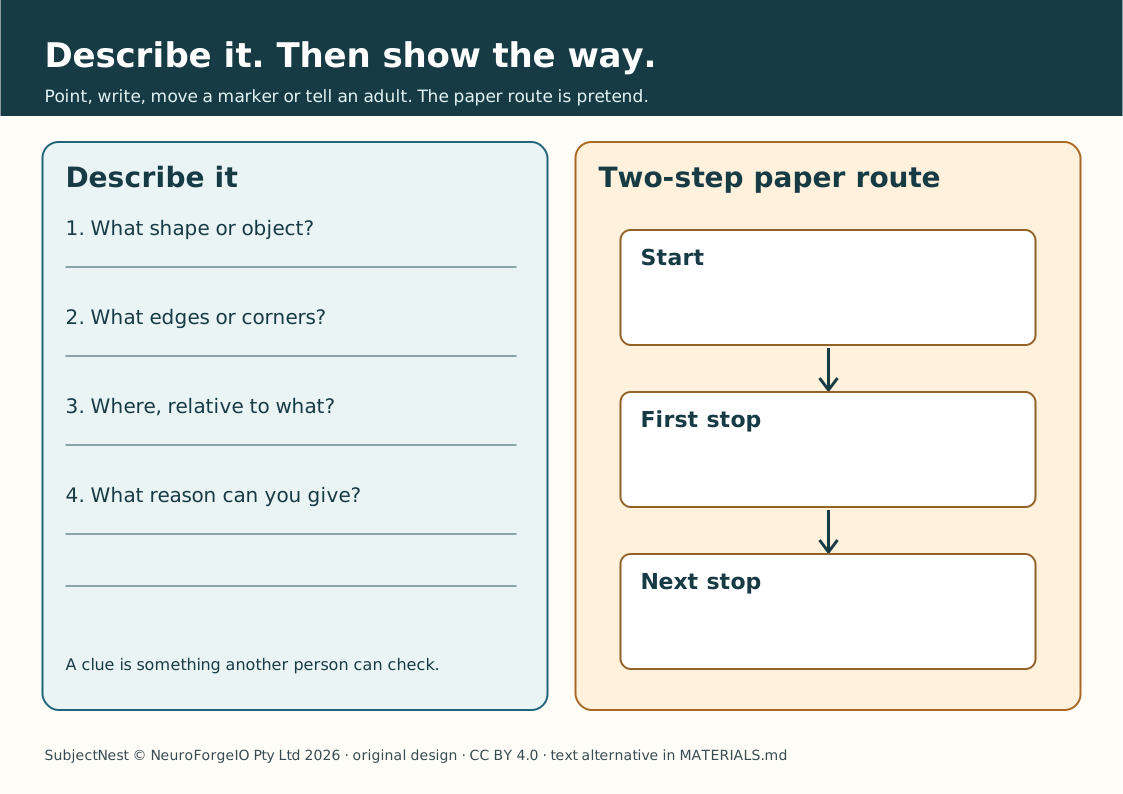
Optional family or educator use: draw a made-up room on paper, place two large paper shapes and invite the child to say where one is relative to the other. Ask “How do you know it is a triangle?” if the child uses that name. A family need not submit homework or disclose a home layout. Avoid small loose parts for children who mouth objects; use large paper/digital versions.
Original fiction, card inventory and aid description © 2026 NeuroForgeIO Pty Ltd, CC BY 4.0. Credit and indicate changes.