These are formative samples for next teaching, not a reading-age score, diagnosis, complete Foundation achievement-standard judgment, family-history measure or safeguarding assessment. Keep the fresh Day 115/120 stories and print unseen. Record the child's exact first response, source/access route, adult prompt and later revision separately. Speech, sign, AAC, pointing, drawing, typing or child-directed scribing can show comprehension; record independent reading/spelling separately. If an item cannot be accessed with the available route, mark not observed and arrange another. No personal family or emotional disclosure is required.
Day 115 · new event-order story
Read aloud twice, with adult print hidden:
In an imaginary class, children drew a large paper poster on Tuesday. On Friday morning, they showed it to a neighbouring class that wanted to see it. On Friday afternoon, they put the poster in a folder and wrote down one question the visitors asked. The story does not say any family member came or what every child thought of the poster.
Give three large adult-read cards in mixed order: draw poster, show poster, put poster away and note a question. Ask the child to order them as before/during/after, retell to one chosen listener and give one detail from the story that supports the order. Ask “Can we say all families came?” Expected no; the story names a neighbouring class only. “Tuesday came before Friday” is a valid additional clue. The child may use the blank order mat, tactile cards or a private AAC route. Record the first order before checking.
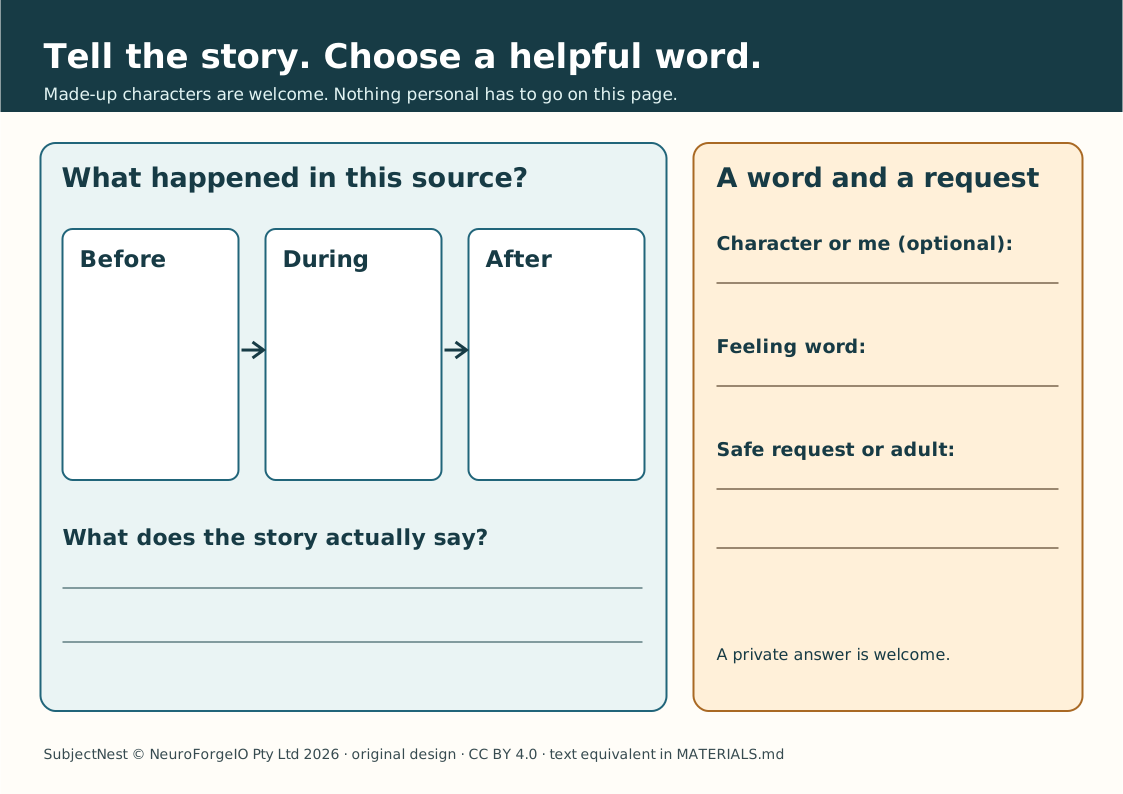
Diagnostic next move: if Wednesday/Thursday are invented events, revisit only the three source clauses. If cards are correctly ordered but retell is unclear, model the spoken connectors before / then / after with a new two-step fictional task. Do not infer AC9HSFK02 family-event knowledge from this fiction.
Day 120 · new emotion and request story
Read aloud twice, with adult print hidden:
Ren's paper tower fell over during a made-up building game. Ren said, “I feel disappointed because I wanted it to stay up.” Ren asked a familiar school adult, “Can you help me try a wider base?” The adult helped Ren find a large piece of paper. The story ends there; it does not say whether the next tower stood or how every child would feel.
Ask (1) what Ren said they felt; key disappointed; (2) why, using the paper tower detail; (3) what help Ren requested; key help to try a wider base; (4) what remains unknown; key whether the next tower stood and how another child would feel. Ask the child to give a short, fictional report and one respectful request in an agreed mode. If the child offers a different possible feeling, accept it only as a clearly labelled inference about another possible person, not as a replacement for Ren's stated word. No child needs to share a real disappointment.
Held-out print: show pot, rim, net one at a time, no picture or sentence; underlying single-letter links were taught earlier, but these exact items are not in this fortnight's learner cards. Hear first blends. With print hidden, dictate net for child-controlled tiles, digital letters or handwriting. Expected /p/ /ɒ/ /t/, /r/ /ɪ/ /m/, /n/ /e/ /t/ in the selected classroom pronunciations; check local English variety with the learner and do not penalise accent. Record sound sequence, grapheme selection and motor route separately.
| Evidence | Next teaching move and fresh recheck |
|---|---|
| Event order reversed or new event invented | Reread two exact story clauses, place two cards, then retell a different three-event fictional scene. |
| Retell ordered but source limit absent | Model “This story says …; it does not tell us …” with a new invented source. |
| Emotion inferred from face instead of quoted words | Contrast “Ren said …” with “we might ask …”; recheck a different character who names a feeling. |
| Request too vague for a listener to act | Ask “Help with what?”; practise a specific ask to an approved school adult in a fresh paper-game scene. |
| Taught CVC link missed | Explicitly reteach that one sound–letter relation with two familiar words and later use a new held-out CVC. |
| Accurate and independently explained | Offer a new event or character and ask the child to compare two possible retellings while keeping routine print review. |
Private record: learner code ; date ; Day 115 order/retell first ; exact source clue ; Day 120 feeling/reason/request first ; uncertainty named ; print blends ; net spelling ; access/adult cue ; revision ; next action/recheck date ___. Follow school-approved storage and safeguarding processes. Do not write a personal disclosure on a public class mat.
Original stories, checks and keys © 2026 NeuroForgeIO Pty Ltd, SubjectNest, CC BY 4.0. Curriculum and rights scope in README.md. Educator and local review pending.