Teacher draft. Ten 25-minute scripts continue the Days 101–110 sequence. Week 23 retells an invented shared event with before / during / after and checks what a source actually says. Week 24 uses precise feeling words in fictional situations, respectful turns and a safe request for help. The child print remains tied to already taught graphemes; adult-read stories carry richer vocabulary. This is a fortnight, not a full literacy course or a diagnosis.
| Open | Use |
|---|---|
| Daily scripts | Ten model–guide–try–respond lessons, 25 minutes each. |
| Teacher texts and access script | Original fictional events, controlled child-print inventory, exact SVG text equivalent. |
| Learner cards | Clean print/meaning prompts without answer keys. |
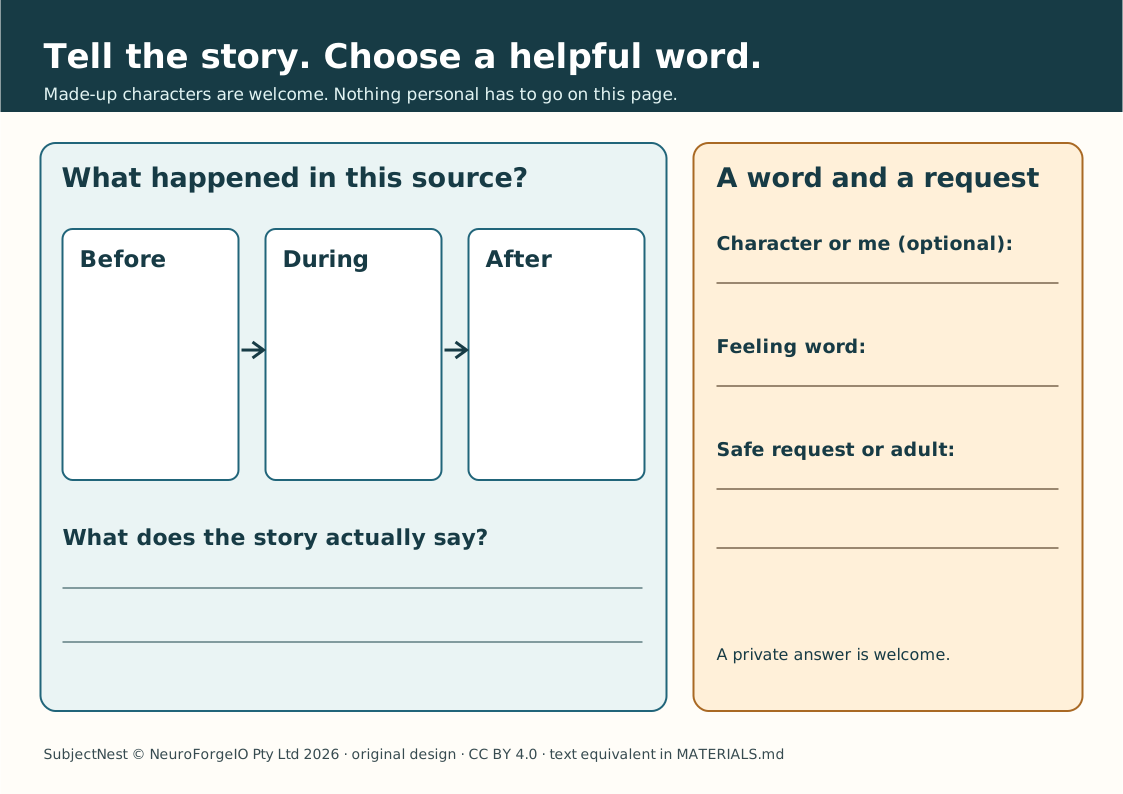
| Story and choice mat | A4 landscape original visual with before/during/after and “feeling / can ask” spaces. |
| Assessment | Held-out Day 115 and Day 120 items, keys and next moves. |
| Source, rights and use review | Exact-code boundary, original-asset ledger and teacher/student/funder desk walkthrough. |
| Week 23 and Week 24 guides | Separate HASS and HPE learning/evidence boundaries. |
Print sequence: no new grapheme is introduced. Revisit day, play, tray, mat, map, cap, cup, red, ten, see and previously taught a/A, I, is, can, on, plus CVC am, sad, sit, nap only where the child's actual taught links support them. In day/play/tray, word-final ay stands for /eɪ/ in these taught words. Do not show a picture before the first blending attempt or call a memorised sentence independent decoding. Words such as celebration, lunchtime, disappointed, anxious, safe adult are adult oral vocabulary. A child may use them in speech/AAC without being asked to decode their spelling.
Curriculum proposal: partial Foundation English links AC9EFLE03 (story event order), AC9EFLA08 (precise familiar vocabulary), AC9EFLY02 (listening/turns), AC9EFLY04 (taught print), AC9EFLY05 (comprehension), AC9EFLY06 (shared short-text editing), AC9EFLY07 (short communicated account), AC9EFLY10 (sound/word work) and AC9EFLY13 (spelling). Exact code/year checked in the official Australian Curriculum v9 workbook, retrieved 29 September 2026, pinned SHA-256 db446882d2c00cf7c085a03e250e2442fda6c44011fc114680c46c1dc7a822c3. A code link supports a part, not attainment, endorsement or local adoption. Check the school's applied syllabus and each child's actual taught point. AERO early literacy informs the oral-language and explicit-print mix; it has not evaluated this pack.
Privacy and access: no child is required to share family structure, celebrations, faith, emotion, safety incident or help-seeking history. Fictional texts are available to every child. A real event contribution is opt-in, child-chosen, private and checked against an appropriate source; declining never lowers participation. Offer adult reading with transcript, plain/large print, tactile or moveable letters, AAC/sign/gesture, drawing, typing, quiet/private narration and child-directed scribing. Record which construct was observed, exact adult help and response mode. For a disclosed safety concern, follow school safeguarding procedures rather than continuing a public class discussion. No translation or recorded narration is claimed.
Original prose, cards and SVG © 2026 NeuroForgeIO Pty Ltd, SubjectNest, CC BY 4.0. Credit, link the licence and indicate changes. ACARA/AERO material retains its own terms. Human teacher, access, cultural and local-syllabus review pending.