Live source review: 29 September 2026. The QCAA 2025 v1.4 syllabus requires both Unit 1 topics and an Ancient Australia site within Topic 1. The 2012 original paper was checked for the actual dated charcoal in channel infill and later side-wall phase. The 2019 UNESCO decision 43 COM 8B.14 was checked for inscription under criteria (iii)/(v), not misread as ownership or a direct archaeological measurement. The 2026 LiDAR research explicitly discusses false positives, missed sites and ground truthing, and includes Gunditj Mirring Traditional Owners Corporation among authors. The Gunditjmara-led program says school groups have a Gunditjmara guide and Tyrendarra access by special request. These are current-page checks, not an external cultural approval.
Seat 1 · a teacher with five minutes to start
Open Day 1, A and the site-source trail. A is an attributed present-day custodian account, not a fiction script. Read it aloud, put the maker on the board and have each learner ask one source-answerable question. The 2+4+5+7+4+3 plan is genuinely 25 minutes; the teacher can use a swap for longer periods. Days 5 and 10 introduce F/G/H only at assessment time. The teacher key is public, so the checks are formative, not secure. The school still needs a full 55-hour Unit 1 and Topic 2.
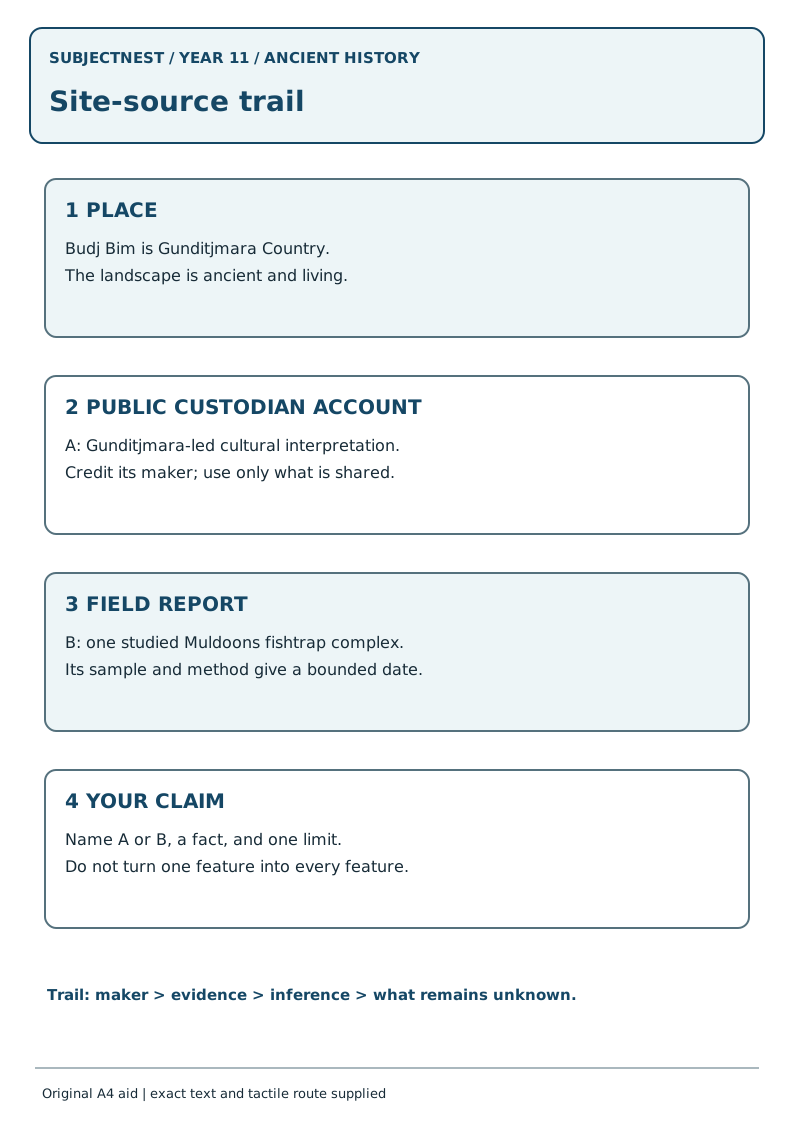
Seat 2 · a learner using another route
Try Day 3 without handwriting: hear B, move EARLY CHANNEL and LATER WALLS on the phase clock, then speak “charcoal in channel infill ≈6,600 cal BP; side walls were later; this does not date every wall.” The source, inference and limit are visible. Reading ability is considered separately from historical reasoning. All aids have text, size, source IDs and full-word labels, with no colour-only meaning. The student need not say why they chose this route. A pause and quiet-text option are available.
Day 10's two-source task tests a real overclaim. G is a 2026 research report with uncertain digital candidates; H is a current tour/access page. A good response rejects “all features found” and unrestricted visits, while proposing a location-free classroom method comparison. Do not convert student curiosity into site hunting or publishing coordinates.
Seat 3 · assessor or potential funder
Defensible claim: ten original 25-minute scripts, 30 same-target route options, 20 optional evidence swaps, 20 analogy bridges, one optional hands-on lab, two new public checks with teacher feedback, six original A4 SVG/PDF aids and exact text/tactile alternatives. The content names current QCAA v1.4 and primary research/custodian pages. The outputs are authored materials, not evidence of classroom uptake, learning gains, cultural endorsement, translation quality, complete Year 11 coverage or an official assessment. A funder should see the explicit rights boundary: external maps, photos, research figures and cultural knowledge are linked and attributed but not redistributed. Traditional Owner review and local school planning remain required before a public exhibition or visit.
Mechanical and visual review
python3 verify_pack.py checks scope markers, ten 25-minute scripts, 30 distinct daily routes, 20 swaps, source isolation, local links, A4 SVG semantics, extracted PDF text and a SHA-256 file inventory. The six PDFs are regenerated from original SVG code, inspected for full-page boundaries and provide high-contrast blue/white with an exact-text alternative. This audit catches omissions and drift, but cannot establish historical truth if a linked page later changes. No classroom test or independent cultural review has occurred.