All six aids have A4 (210 × 297 mm) SVG and PDF versions. The instructional words below repeat the visual cards in order. Full-word/number labels carry meaning without colour. A teacher can enlarge the text, read it aloud, or cut each numbered/labelled block into a tactile card and arrange it in the stated order. Do not reproduce external photographs, maps, stories or logos. The spoken transcript is for live reading; there is no audio file in this pack.
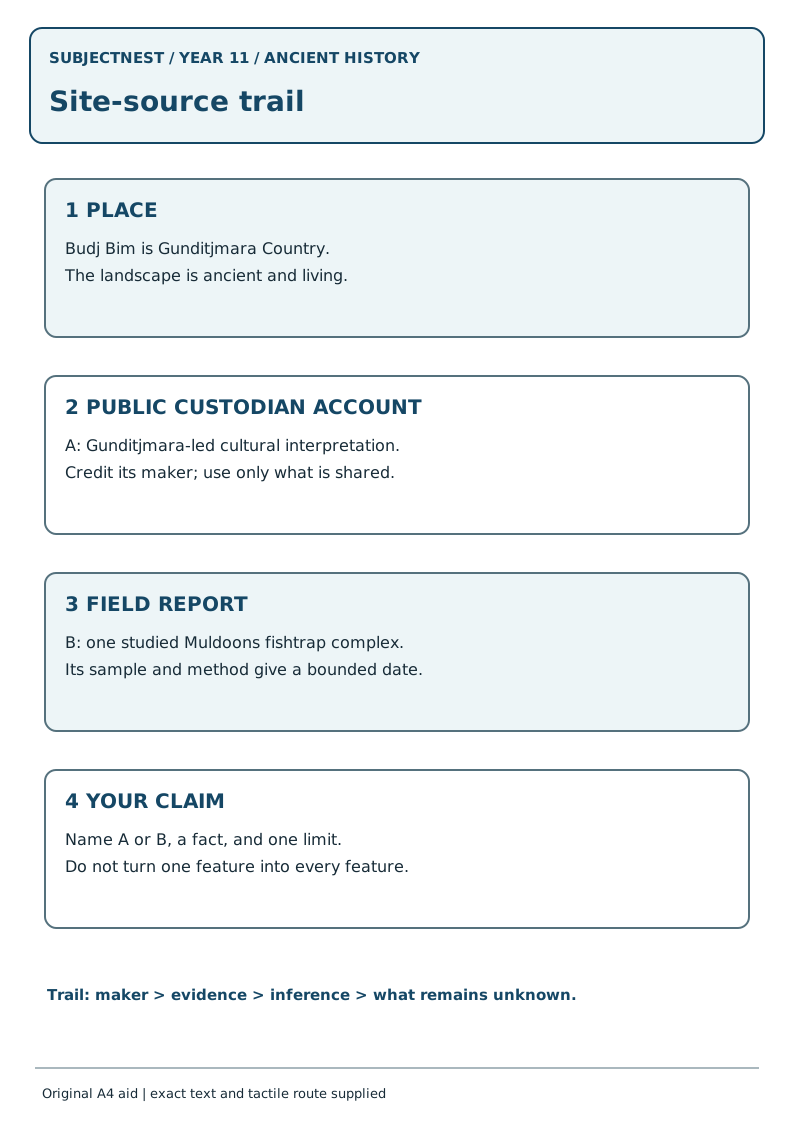
Site-source trail
- PLACE — Budj Bim is Gunditjmara Country. The landscape is ancient and living.
- PUBLIC CUSTODIAN ACCOUNT — A: Gunditjmara-led cultural interpretation. Credit its maker; use only what is shared.
- FIELD REPORT — B: one studied Muldoons fishtrap complex. Its sample and method give a bounded date.
- YOUR CLAIM — Name A or B, a fact, and one limit. Do not turn one feature into every feature.
Trail: maker > evidence > inference > what remains unknown.
Evidence-kind sorter
- ANCIENT MATERIAL — A surviving channel is a material trace. We do not collect or copy a cultural object.
- MODERN CUSTODIAN ACCOUNT — A: public Gunditjmara interpretation. Primary for a current public position.
- MODERN RESEARCH — B: 2012 report of excavated context. Primary for the team's investigation.
- LATER PUBLIC HISTORY — C / E: government or museum summaries. Useful for their framing; check their sources.
Ask: useful for which question? No source kind wins every question.
Phase clock
- SAMPLE — B: charcoal in sediment filling a channel. cal BP = calibrated years before AD 1950.
- EARLY CHANNEL PHASE — About 6,600 cal BP for studied feature. The team infers early basalt removal.
- LATER SIDE-WALL PHASE — Walls added roughly 600-800 years ago. Construction had more than one phase.
- LIMIT — One complex is not every Budj Bim feature. Charcoal is not a direct basalt-wall date.
Keep sample, context, inference and broader landscape separate.
Claim-boundary ladder
- SOURCE FACT — C: government names three components. Say who made the page and when.
- SUPPORTED CLAIM — The listed landscape spans several areas. Name north, central and south only.
- UNSUPPORTED LEAP — Not every place is open for self-guided entry. A description does not grant access.
- NEXT CHECK — D: current Gunditjmara visitor protocol. Arrange a guided program where appropriate.
A narrow claim can be strong; an unsupported broad claim is weak.
Custodianship grid
- READ A PUBLIC PAGE — Cite A or D with its maker and link. A shared page is not all cultural knowledge.
- REUSE AN IMAGE OR MAP — Ask its rights holder and custodians. Attribution alone may not be permission.
- VISIT A CULTURAL SITE — Check current Gunditjmara-led guidance. Do not assume entry or share coordinates.
- DISPLAY AN INTERPRETATION — Attribute evidence and seek review. Never invent an Elder's words or ceremony.
Living Country has living decision-makers.
Argument weave
- QUESTION — What does evidence show about waterworks and their present-day interpretation?
- SOURCE THREADS — A: custodian account. B: phased dating. C: landscape overview. D: access protocol.
- BOUNDED JUDGEMENT — Gunditjmara aquaculture has deep history. One feature does not date every structure.
- TWO DIFFERENT LIMITS — Method: sample scope. Authority: public account is not permission to invent voices.
Speak, type, write or move labelled source cards.
Original SubjectNest exact-text alternatives © NeuroForgeIO Pty Ltd 2026, CC BY 4.0.