These are tabletop composition scores, not a dance genre, body instruction or set technique. One marker represents a chosen movement idea; a learner may direct it, annotate it or opt in to a teacher-approved small personal gesture. On every card, H = home, L = left, R = right, N = near edge, F = far edge on the path grid. “Travel” can be a marker slide or a hand/eye direction within a comfortable range. A held count is still part of the phrase. No one has to use the floor path. The imaginary contexts are fictional, not representations of existing communities or dance works.
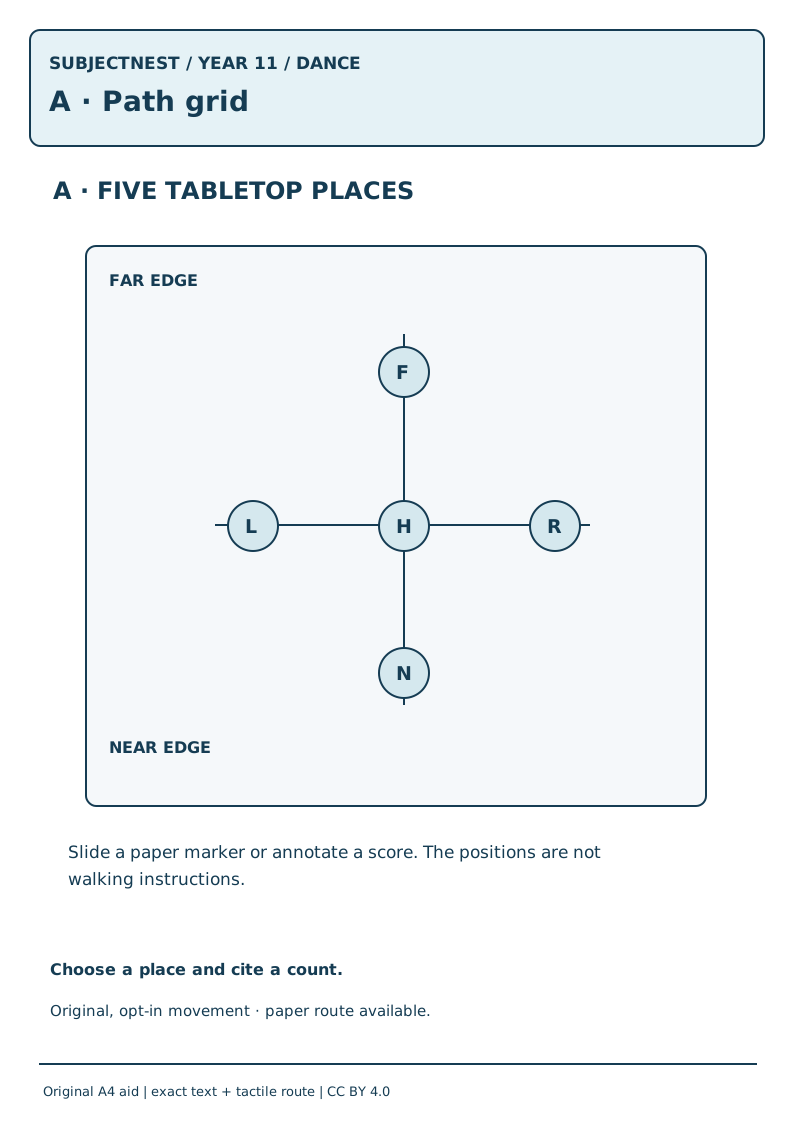
A · Four-count signal
Score: 1 H → 2 R → 3 HOLD R → 4 H. The purpose is to make a moment of attention to the right visible, then return. In a tabletop version, slide a marker; in a quiet movement version, a tiny self-chosen pointing/turning intention may trace the same order. The score says nothing about force, speed within the count or meaning to every audience. Claim to test: “The held R on 3 may make the right-hand space seem significant because the marker stays there for an extra count.”
B · Two paths, same four counts
Version 1: 1 H → 2 F → 3 R → 4 H. Version 2: 1 H → 2 N → 3 R → 4 H. Only count 2 changes. A fictional museum guide may use F to point viewers towards the far side; a tabletop food-bank map might use N for the near pickup edge. These are prompts for purpose, not claims about actual venue choreography. Comparison evidence must name the changed count and possible reading.
C · Time and dynamic contrast
Keep A's locations: H, R, R, H. Version 1 glides the marker gradually during count 2, then rests on 3. Version 2 stops clearly at R at the start of 2, then rests on 3. The visual comparison is sustained versus sudden arrival, not a request to move a body forcefully. A word or drawn length of line can replace action. “Sudden” means a timing choice, not high impact.
D · Relationship to an object
Place an invented lamp marker at F and a mover marker at H. Version 1 approaches F on count 2, waits at centre on 3, then returns H on 4; Version 2 keeps the mover at H and turns its arrow toward F on counts 2–3. No real lamp or person is needed. The object relationship is a compositional device: neither version proves what an audience feels. Do not require partner work or touch.
E · Motif transformation
Start from A's movement locations H, R, R, H. Reverse the spatial emphasis while keeping count structure: H, L, L, H. This is a lateral mirror, not reverse time. A true reverse of A's order would be H, R, R, H, identical at this coarse location level; that is why the worksheet asks learners to name the precise operation. A second change, H, R, H, H, removes the held R and returns early. Explain which element changed, not just that it feels different.
Compact score reminder: original H–R–R–H; lateral mirror H–L–L–H; early return H–R–H–H.
F · Repeat and contrast
Phrase P = A: H–R–R–H. Phrase Q = E's left variant: H–L–L–H. Eight-count structure P|Q contrasts direction; P|P repeats direction. The two versions use equal counts and equal rests. A possible purpose is to guide attention to two sides versus one side twice. Only the chosen direction and structure change; do not infer a cultural style.
The A–F examples are rehearsed and worked in the teacher scripts. G/H are new check material and do not appear here.