Use learner Texts A–C, release the fresh Day 5 and fresh Day 10 cards only on those days, and use the perspective mat or text version. Keep the teacher key separate. Each day has 2 + 4 + 5 + 7 + 4 + 3 = 25 minutes. These lessons explore a narrow part of QCAA General English Unit 1 Perspectives and texts (ENG-U1, source ledger). A read-aloud can give access to ideas; note if independent reading was not observed.
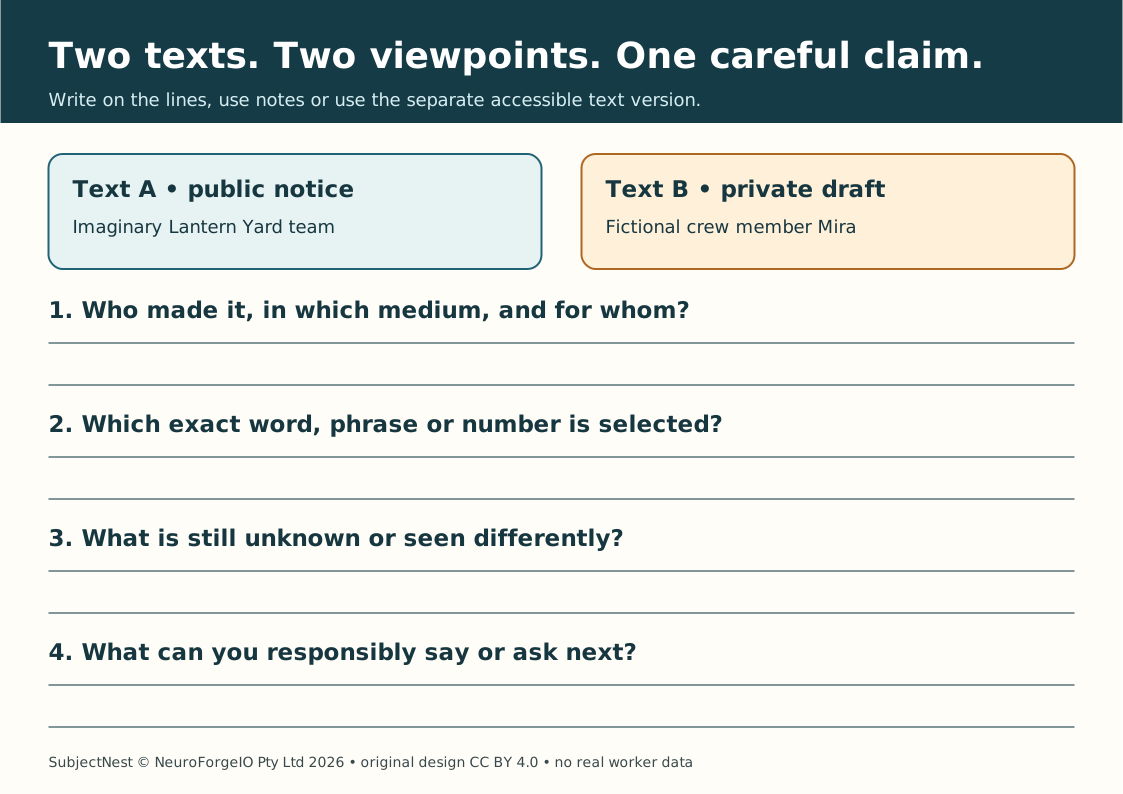
Day 1 — Whose “same pay”?
Success: name a text maker, intended reader and bounded claim. Prepare Text A with its source label.
- First read · 2 min. Display “same pay, more ways to take part.” Ask learners to jot what they think same compares; do not resolve yet.
- Context model · 4 min. Read Text A and source label aloud. Model: organising team seeks crew; the stated comparison is five weekday hours and four Saturday hours, each $120 in a fictional model.
- Locate · 5 min. Learners highlight writer, audience, exact amounts and the clause “before any unlisted deductions or additions.” Ask which phrase stops “everyone earns the same” being an accurate summary.
- Independent annotation · 7 min. Each learner writes
maker / reader / exact claim / one unknown; a quiet annotation, keyboard or AAC card is fine. Teacher retains independent first response. - Partner test · 4 min. One learner reads the other's claim back with “in this notice”; partner confirms or narrows it. Invite disagreement grounded in exact words.
- Exit · 3 min. “Can Text A prove equal pay for every role and shift?” Key: no; only two specified model shifts total $120 each and terms are incomplete.
Day 2 — A second point of view
Success: explain how Text B's diary voice differs from Text A's public notice without claiming either is false.
- Recall · 2 min. State the two model totals from Text A: $120 and $120; ask what that does not tell a person planning a day.
- Read · 4 min. Read Text B, including diary source label. Pause at Mira's “two boxes”; ask what each box means.
- Contrast · 5 min. Model a two-column note: A selects listed shifts and invitation; B selects whole-day uncertainty and role fit. Neither source supplies actual travel time.
- Independent compare · 7 min. Learners write two evidence-led sentences: “A invites … with …”; “B asks … because …”. They must quote or accurately paraphrase one detail per text.
- Pair exchange · 4 min. Partners check whether a sentence wrongly turns one imaginary diary into all workers' views. Revise the subject of that sentence.
- Exit · 3 min. “What does Mira still need to ask?” Key: duties/role availability and/or travel/whole-day implications; no actual answer has been supplied.
Day 3 — What the notice leaves open
Success: distinguish an omission from a negative fact. Use perspective mat.
- Spot · 2 min. Ask whether Text A gives paid break rules; learners mark
given / absent. - Model · 4 min. Write “The notice does not state break rules.” Compare the unsupported “The team refuses paid breaks.” Explain that absence cannot establish a refusal.
- Guided sort · 5 min. Sort travel support, role access, $24 base and weekend multiplier into
stated / not stated. Ask which two are useful questions rather than conclusions. - Independent revision · 7 min. Give learners a flawed sentence: “Because the poster omits travel costs, nobody can afford Saturday.” They recast it as an accurate observation plus a question, using text evidence.
- Audit · 4 min. Peer circles any invented actor, fact or universal word; writer decides whether to revise and explains why.
- Exit · 3 min. Key revision: “The poster does not state travel support; a reader could ask about it before deciding.” Other bounded versions accepted.
Day 4 — How medium and wording position us
Success: explain one effect of website notice versus private diary and test a change in wording.
- Read lines · 2 min. Compare A's heading “A shift that fits your week” and B's “I circled same pay first.”
- Model · 4 min. Name medium, audience and purpose: public recruitment webpage versus private reflective diary. Identify the inviting second-person “your” and B's first-person “I”.
- Guided recast · 5 min. Replace the headline with “Two example shifts total $120 under the listed assumptions.” Ask what certainty/appeal changes; the recast is clearer but less inviting.
- Independent editor note · 7 min. Learners write 80–100 words to the fictional editor: identify two specific language choices, their likely effects and a possible limit on each interpretation.
- Evidence check · 4 min. Partner points to the exact phrase behind each claimed effect; revise any psychological certainty such as “all readers will feel”.
- Exit · 3 min. “Which text is addressed directly to prospective crew?” Key: A; B is a private diary-style draft.
Day 5 — Independent comparison check A
Success: produce a short, sourced comparison that retains two perspectives and one uncertainty. See Check A.
- Purpose · 2 min. Give the task: note to a fictional newsletter editor, 80–120 words or equivalent agreed response mode.
- Source access · 4 min. Show A and B with labels; clarify the task but do not point to the best quote or supply a sentence to copy.
- Plan · 5 min. Learners independently mark maker/purpose, one exact detail per text, a contrast and an unanswered question.
- Compose · 7 min. Write, type or record a first response; save it before feedback. Teacher logs source-reading and help level.
- Self-audit · 4 min. Learners check source names, quote accuracy, “one speaker versus everyone” and whether an omission was called a fact.
- Exit · 3 min. Submit the revised version with one sentence stating what additional information would help Mira decide. Use rubric for next teaching move, not an A–E grade.
Day 6 — The rhetorical weight of a number
Success: explain how an exact $120 can be accurate and still incomplete for a reader's decision.
- Hook · 2 min. Display
$120 = $120; ask “What question does this equality answer?” - Model · 4 min. Point to A's “before any unlisted deductions or additions.” Teacher calculates two shifts only, then labels travel, duties and allocation as unknown rather than zero.
- Guided contrast · 5 min. Compare “The two model shifts pay the same stated amount” with “Both shifts are equally good.” Ask which is supported and why.
- Independent paragraph · 7 min. Learners write a 3–4 sentence explanation using one number, one phrase from A, one concern from B, and a limit. Spoken/AAC option preserves their exact wording.
- Listener challenge · 4 min. Partner asks “Where does that inference come from?” Writer either identifies a source line or narrows the sentence.
- Exit · 3 min. Key:
$120is the stipulated amount for each of two examples; it does not prove equal overall suitability or actual take-home pay.
Day 7 — Quote small, contextualise fully
Success: quote accurately while retaining the source and qualification; prepare Text C.
- Notice · 2 min. Read Text C's “quote at most six words”; ask why a small quote still needs a source label.
- Model · 4 min. Use “same pay” from A and pair it with “for the two stated model shifts”; do not splice it into a claim about all crew.
- Guided repair · 5 min. Repair a draft sentence: “The organiser guarantees everyone the same pay.” Learners find why “guarantees” and “everyone” exceed Text A.
- Independent quote bank · 7 min. Each learner selects up to six consecutive words from A and B, identifies speaker/type and writes a cautious interpretation of each.
- Check · 4 min. Partner compares every quote to original, checks no omitted words change the meaning and asks what the chosen quote leaves out.
- Exit · 3 min. Example key: A says “same pay” about two example shifts; B's “two boxes” shows Mira weighing shift time against whole-day effects.
Day 8 — Draft for a real reader, with fictional facts
Success: organise a short newsletter response for the stated audience without pretending to know missing terms.
- Audience · 2 min. Read Text C's editor request; ask what a prospective crew reader needs first.
- Structure model · 4 min. Teacher models a plan, not a model essay: context → calculation/detail → perspectives → unknown → useful question.
- Guided opening · 5 min. Class compares two openings: “Lantern Yard is unfair” versus “Its two example shifts both state $120, but a prospective crew member needs role details.” Identify which is supportable.
- Independent draft · 7 min. Learners begin a 130–180-word final response with an 80–100-word core draft (or equivalent agreed mode), citing A and B, the $120 basis and one unanswered question. They can finish and revise in Day 9 or scheduled extended writing time.
- Peer response · 4 min. Reader underlines a source-backed statement, brackets the limit and writes one question they still have. Writer decides on a change.
- Exit · 3 min. Learner names one revision and why it helps the prospective crew audience. Key: place a bounded calculation before a broader judgement.
Day 9 — Revision as an ethical choice
Success: revise overstatement, source imbalance and inaccessible wording while retaining a position.
- Recall · 2 min. Learners identify a word in their draft that could overstate certainty:
always,everyone,guaranteesor another. - Model · 4 min. Revise “Mira proves the shifts are inaccessible” to “Mira's draft shows one reader wants clearer role and travel details.” Explain how scope changes.
- Guided check · 5 min. On a sample paragraph, annotate whose voice gets most space and where the exact figures came from. Do not force a falsely equal appraisal; ask for fair representation.
- Independent revision · 7 min. Learners complete the newsletter response toward Text C's 130–180-word brief and make two tracked changes: one fixes an unsupported inference; one helps the audience navigate the comparison. Keep original and revised copies; allow agreed extra writing time where needed.
- Rehearse · 4 min. Explain one change to a partner, teacher or private recording. Judge evidence use, not extroversion or accent.
- Exit · 3 min. Complete “I changed ___ because Text ___ actually says ___.” A valid key cites the exact source and narrows a claim.
Day 10 — Fresh perspective check B
Success: analyse the fresh Text D learner card without a rehearsed script or rehearsed prices; see key/rubric.
- Set task · 2 min. State audience: a fictional student project group considering bookmark bundles; Text D appears for the first time.
- Read · 4 min. Give source label and card, using the agreed access mode. Do not tell learners whether the headline is true for either quantity.
- Plan · 5 min. Learners independently mark maker/purpose, the broad claim, one exact number, a condition and one missing fact.
- Compose · 7 min. Write or record an 80–120-word note explaining how the headline may steer readers, testing it for six and eighteen bookmarks, and asking one sensible question.
- Review · 4 min. Learner checks source and conditional language; teacher keeps first version and records help/technology separately.
- Exit · 3 min. “Is the bigger bundle always the lower total outlay?” Key: no; for six needed, small is $13.20 versus $19.35. Use the full key before deciding what to reteach.
Rights: Original scripts © NeuroForgeIO Pty Ltd 2026, SubjectNest, CC BY 4.0; credit, link and indicate changes.