Five 35-minute blocks. Partial Year 3 Science links: AC9S3U02 (observable properties of soils/rocks/minerals and their importance as Earth resources), AC9S3H01 (data in explanations), AC9S3I01, AC9S3I02, AC9S3I03, AC9S3I04, AC9S3I05, AC9S3I06 (question, safe plan, observation, representation, comparison, communication). This week works mainly on observable soil properties and inquiry practice; it does not complete the full Earth-resources description. Exact codes are checked against the Year 3 content-description records in the pinned ACARA workbook. The daily English and mathematics lessons run separately.
Safety and provenance: Obtain two closed transparent containers of school-approved samples under local risk policy, label source/date only if permitted, and check school health requirements. Keep containers closed and stationary; no shaking, smelling, tasting, inhaling dust, opening, collecting from an unapproved site, bare handling or taking samples home. Do not use commercial potting mix or prepare dusty samples for this pack; see Queensland Health and Safe Work Australia on soil/potting-mix and dust hazards. Wash hands after handling the outside if school policy calls for it. No child data or faces in a public record. If genuine safe samples are unavailable, use labelled adult-drawn models and say this is a model comparison; do not claim direct soil observation. Accessible routes include high-contrast photos taken by the school with rights/consent, enlarged view, tactile clean-paper representation of observed grain sizes and a partner moving the container at a learner's direction. The pack itself includes no outside photographs.
Use evidence board or its text version every day. Keep source / observation / inference / question distinct. Samples A/B are neutral labels; there is no prewritten “better soil” answer.
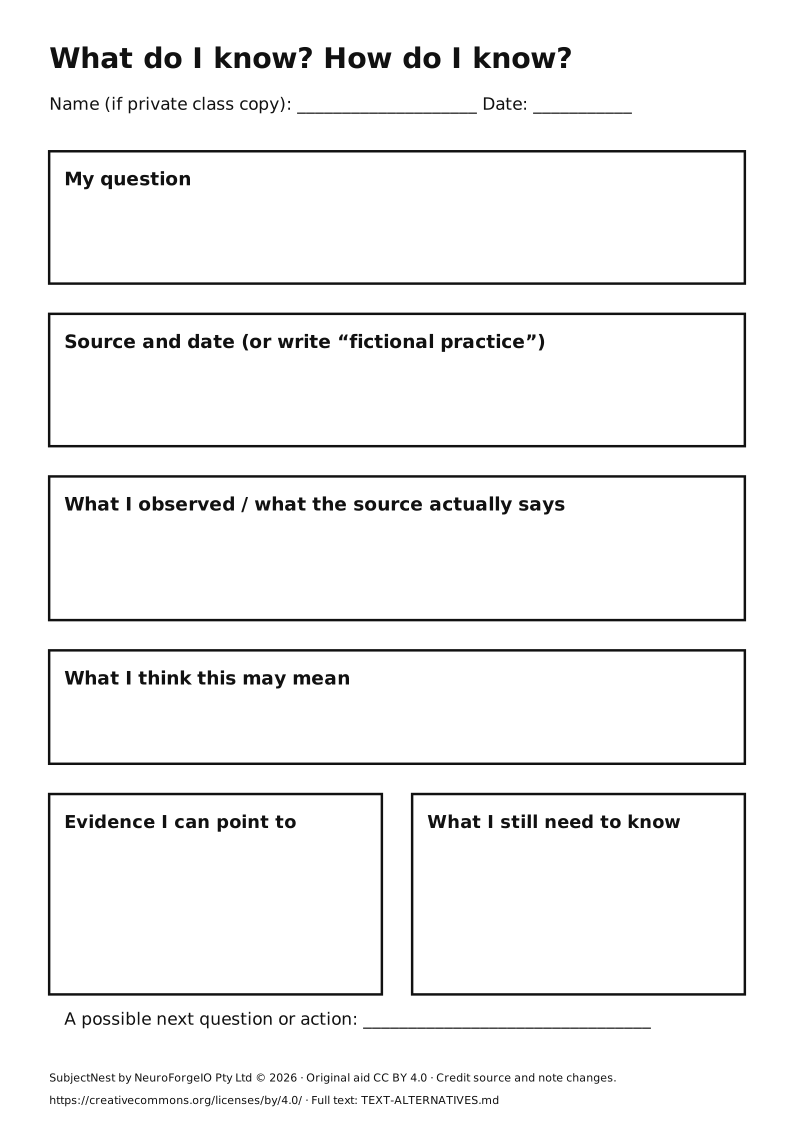
Day 1 — What can a closed sample show? (35 minutes)
- Set boundary · 3 min. Show both closed containers. Say: “We can describe what we see through the wall. We cannot know everything about a sample from its look.” Remind the class of no opening or smelling.
- Model a careful look · 7 min. Place A against plain paper. Say only what is truly visible, for example “I can see grains of more than one visible size” if true. If false, use another real feature. Put it in
observed; ask whether “best for plants” belongs there (it does not). - Child questions · 15 min. Pairs choose a question about visible colour, grain size or layers. They observe A and B from the same seat/distance or an accessible matched view. Each child gives one prediction before a second look and names its clue; prediction stays separate from result.
- Record · 7 min. Make a two-row A/B table with a labelled sketch or precise phrase. Ask: “Which word describes what your eyes found? Which sentence is an idea to investigate later?” Teacher samples 2–3 focus children while others compare with a partner.
- Close · 3 min. Collect one question that cannot be answered through the container. Keep the source/date record for later; mark unknown origin as unknown.
Teaching response: if a child says “B is healthier,” ask what the container actually shows and turn health into a question needing different evidence.
Day 2 — Make a comparison others can repeat (35 minutes)
- Recall · 3 min. Ask: “Yesterday, did we compare containers at the same distance and background?” Point to the record, not memory alone.
- Model a scaffold · 7 min. Put A then B against the same plain paper, in the same light, at the same marked viewing position. Say: “That helps us compare visible features. It is not a test of what caused the differences between soils.”
- Plan and observe · 15 min. Pairs choose one feature, make a prediction, then use a simple
A / B / same or different / evidencetable. An adult moves containers if needed. If light varies, record it as a limit rather than pretending the observation is identical. - Peer repeat · 7 min. Another pair follows the written/diagrammed procedure and states whether they see the same feature. Ask what instructions were missing. Revise the procedure, not the other pair's perception.
- Close · 3 min. Each child names one condition kept similar and one that might still differ. Save both versions of the procedure.
Teaching response: if a comparison uses different backgrounds, repeat it with the same background before drawing a conclusion.
Day 3 — Count or describe what we can actually see (35 minutes)
- Open question · 3 min. Say: “Can our record show a pattern that someone else can check?” Show the A/B table.
- Model a category · 7 min. Choose a real visible feature from your samples, such as
light/dark visible patchorlarge/small visible grainand define it on the page. Say a category is only as useful as its description. Avoid claims about unseen nutrients or minerals. - Observe and mark · 15 min. Learners make two dated drawings or verbal/tactile descriptions using the same category. If distinct visible pieces can be counted reliably, count them in a marked viewing square; otherwise use qualitative words and say why exact counting is not possible. Never fabricate a numerical dataset for a graph.
- Represent · 7 min. Children choose a two-row table, paired labelled sketches or a physical model of observed feature sizes. Ask a partner to identify which mark came from A and which from B.
- Close · 3 min. Ask, “What does your display help a reader notice? What does it leave out?” Record one limit with the display.
Teaching response: an attractive graph with made-up counts is replaced by a truthful sketch/table. The aim is evidence quality, not a chart at any cost.
Day 4 — Compare two records without inventing a cause (35 minutes)
- Recall · 3 min. Show anonymous records from Day 3 with no child names. Ask what each says directly.
- Model uncertainty · 7 min. Say: “Our A record shows __ and B shows __,” using actual observations. Then add: “We cannot conclude from this alone why they differ or which grows plants better.” Put the second thought under
still need to know. - Group discussion · 15 min. Children compare their observations with another pair. They mark
same / different / unclearand give a possible reason for disagreement in viewing conditions, label or category. No group has to force consensus. Teacher asks whether repeating the view would help. - Draw a bounded conclusion · 7 min. Each child composes: “With our sealed samples and this view, we noticed . We still need __ to answer .” They point to a record for the first clause. If a finding differs, record it faithfully.
- Close · 3 min. Collect one safe next question. A plant-growth test is not assigned without school-approved equipment, time and local safety review.
Teaching response: if a child makes a causal claim, ask which step changed one cause. This inquiry compared samples; it did not isolate what made them different.
Day 5 — Explain to a reader, then invite a question (35 minutes)
- Purpose · 3 min. Say: “Make a one-page record a learner who was away could understand. They should see what we looked at and where our idea stops.”
- Show model structure · 7 min. On the board put
question → safe method → observation A/B → conclusion within evidence → next question. Leave data spaces blank until using real records. Demonstrate citing a label/source only if permitted. - Create · 15 min. Learners choose labelled sketch, short report, tactile model with dictated labels or AAC presentation. Include actual source/date if known, observation route and one limit. Save an earlier draft if they revise. No public upload of child work.
- Reader test · 7 min. A partner asks: “Which mark is your evidence? Could another learner repeat the look? What do we not know?” Learner revises one unclear part. Teacher collects individual evidence from a rotating few, others remain
not yet observedif unheard. - Next move · 3 min. If source/observation are mixed, model that distinction next. If method is unclear, repeat the comparison scaffold. If the claim is sound, plan a new authorised question about Earth resources with an appropriate source.
Rights: Original activities © NeuroForgeIO Pty Ltd 2026, SubjectNest, CC BY 4.0; credit, link and note changes. Codes/descriptions retain ACARA's rights. Local educator and safety review pending.