Daily timing: retrieve/notice 3 minutes + explicit model 5 + guided work 8 + individual transfer 6 + exit/record 3 = 25 minutes. Use aids, original grid and assessment. Keep the whole's size fixed when comparing parts. Teacher asks for an explanation in any accessible mode; speech and pencil control are not the mathematical target. National links AC9M4N01 throughout and AC9M4N03 when fraction/decimal equivalence is explicit; both are partial in this fortnight (see README).
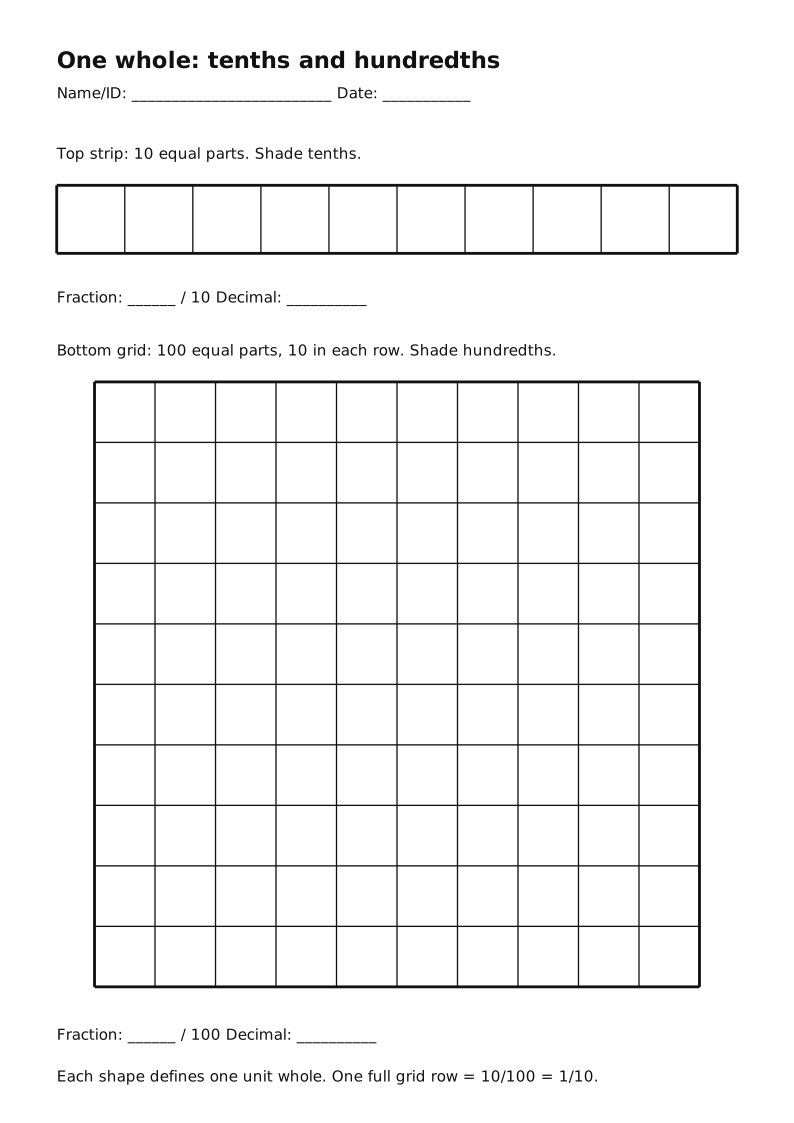
Day 1 — One whole, ten equal parts
Goal: recognise one tenth and write 1/10 = 0.1. Materials: equal-part ten strip and an intentionally unequal teacher sketch, digit cards; music-loop card.
- Notice, 3: Show both strips. “Can each shaded part be called one tenth?” Key: only the strip with ten equal parts; neither number of marks nor colour alone guarantees equality.
- Model, 5: Point across all ten equal cells: “This is one whole. I shade one of ten equal parts: one tenth, 1/10. In decimal notation that is 0.1: zero whole units and one tenth.” Put 0 and 1 in labelled whole/tenths columns.
- Together, 8: Children shade 1/10, unshade, then shade 3/10 on a fresh or erasable strip. Count equal cells, not drawn lines. Use music-loop card: 3 of 10 beat segments = 0.3. Say that the music is a fictional diagram, not measured time.
- Try, 6: Learner chooses a strip with 1 of 10 marked or 1 of 8 marked; selects the true tenth, then writes/selects 0.1. Large tactile/keyboard/AAC route available.
- Check, 3: “What fraction and decimal is one of ten equal cells?” Key: 1/10, 0.1. If 0.01, label tenths/hundredths places without teaching a false rule about digit length; revisit at Day 6.
Day 2 — More tenths and their order
Goal: represent and compare 0.2–0.9 on same-sized wholes. Materials: ten strips, art/transit cards, number line.
- Notice, 3: Retrieve 0.1. “If one more equal tenth is shaded, what fraction and decimal?” Key: 2/10, 0.2.
- Model, 5: Shade 0.7 beside 0.3 on equal strips. “Both wholes match. Seven tenths is greater than three tenths.” Place 0.3 and 0.7 on equal-spaced tenths line, with zero and one labelled.
- Together, 8: Build 0.2, 0.5, 0.9; order by shaded cells and locate on line. Use art-strip 0.7 and transit-board 0.9 cards. Ask what stays fixed: the size of a whole and equal tenth cells.
- Try, 6: Learner draws/selects 0.6 and 0.8, then points to the greater and explains with matched strips. Alternative is two rows of ten tactile cells.
- Check, 3: Order 0.4, 0.9, 0.2. Key: 0.2<0.4<0.9. If learner orders by how much blank space appears, turn strips to same orientation and count filled equal cells.
Day 3 — Ten tenths become one whole
Goal: connect 10/10 with 1.0, not 0.10 at this stage. Materials: ten-strip, whole outline, story-bar card, whole/tenths mat.
- Notice, 3: Show 9/10 shaded. “One more tenth will finish what?” Key: the whole.
- Model, 5: Fill tenth cell 10. “10/10 is one whole. In whole-and-tenths places, 1 whole 0 tenths is 1.0, also written 1.” The notation 0.10 has a different place structure and will be taught when hundredths are introduced; do not use it for ten tenths.
- Together, 8: Learners build 8/10, 9/10, 10/10 and locate 0.8, 0.9, 1.0 in sequence. Use the story-bar card. Ask why 1.0 is at the end of the 0-to-1 interval.
- Try, 6: Present 10 loose tenth pieces. Child reassembles one complete same-sized whole and places digit cards in columns; an adult can move pieces under child instruction.
- Check, 3: “Write two names for a whole made of ten tenths.” Key: 10/10 and 1 or 1.0. If 0.10, contrast ten tenths with ten hundredths once the latter has been built, without treating notation as arbitrary.
Day 4 — More than one whole: 1.1–1.9
Goal: name one whole and additional tenths. Materials: two identical ten-strips per learner, garden/game cards, 1–2 number line.
- Notice, 3: Show one full strip and a second strip with 2/10 shaded. “Is the amount less or more than one?” Key: more; 1.2.
- Model, 5: Build 1.4. “One whole, four tenths. The decimal point separates the whole place from tenths here.” Contrast 1.4 with 0.4 on equal whole outlines. Do not call the point a multiplication symbol.
- Together, 8: Build 1.1, 1.4, 1.8 with same-sized strips, matching garden-design 1.4 and game-map 1.8. Place on the 1.0–2.0 equal-spaced line. Ask “What changes from 1.4 to 1.8?” Key: four more tenths.
- Try, 6: Learner creates 1.6 as one full strip plus six tenths; selects numeral from 1.6, 1.06, 16. Give tactile or text-place mat option.
- Check, 3: One whole plus 3 tenths = ? Key: 1.3. If 1.03, write whole/tenths/hundredths labels and mark the 3 in tenths; hundredths come later.
Day 5 — Tenths on the number line and a first evidence check
Goal: locate and compare decimals across zero, one and two. Materials: tenths line, strips, quick slip, assessment Items 1–3.
- Notice, 3: Cover the label between 0.6 and 0.8. Key: 0.7 if ticks are equally spaced tenths.
- Model, 5: Put 0.9 and 1.1 on the 0–2 line. “I can see 1.0 between them. Counting tenths: 0.9, 1.0, 1.1.” Show matching strip models.
- Together, 8: Learners place 0.3, 1.3, 1.7, 0.7. Compare pairs 0.7/1.3 and 1.3/1.7 with whole first, then tenths. Use only equal-spaced line or tactile marks.
- Try, 6: Child orders 1.2, 0.8, 1.5 and justifies one adjacent pair using strips or line. Key: 0.8<1.2<1.5.
- Check, 3: Individually ask “What lies one tenth after 1.9?” Key: 2.0 (=2). If 1.10, exchange ten tenths for one whole; note this Day 5 response plus assessment Items 1–3 to choose a small-group revisit.
Day 6 — A hundred equal parts
Goal: identify one hundredth and write 1/100 = 0.01. Materials: one 10×10 grid per child, larger visual/tactile version, sports-lap card.
- Notice, 3: Show the same unit whole split into 10 rows, each with 10 equal cells. Ask total number of cells. Key: 100; count 10 rows of 10 rather than guessing.
- Model, 5: Shade one cell. “One of 100 equal parts is one hundredth, 1/100. In decimal places that is 0.01: zero wholes, zero tenths, one hundredth.” Put digits in three labelled columns.
- Together, 8: Shade 2/100, 7/100 and 9/100 on grids. Read 0.02, 0.07, 0.09; contrast 0.02 with 0.2 on same whole. Sports-lap picture has 2/100 of equal cells, not two laps measured in reality.
- Try, 6: Learner selects 0.06 from 0.6, 0.06, 0.60 for six shaded single cells; then makes own six-cell model. Allow row/column coordinate description instead of shading.
- Check, 3: “What fraction and decimal is four small cells of a hundred-grid?” Key: 4/100 = 0.04. If 0.4, shade 40 cells on a second same-sized grid to contrast.
Day 7 — Ten hundredths equal one tenth
Goal: use one complete row to show 10/100 = 1/10 = 0.10 = 0.1. Materials: ten-strip, grid, poster/library cards.
- Notice, 3: Shade a complete row of ten small cells. Ask “How many hundredths? How much of the whole?” Key: 10 hundredths, one tenth.
- Model, 5: Put the one-row grid beside one shaded tenth on a matching whole outline. “Both pictures show the same share of one whole. 10/100 = 1/10; 0.10 = 0.1.” Keep one whole consistently defined.
- Together, 8: Build 20/100=2/10=0.20=0.2 and 40/100=4/10=0.40=0.4. Use poster 10/100 and library-board 40/100. Children verify complete rows, not just count two digits.
- Try, 6: Child chooses 30/100, shades three complete rows and writes both 0.30 and 0.3. Use tactile rows or dictate row coordinates.
- Check, 3: “Is 0.4 greater than 0.40?” Key: no, equal; 4 tenths=40 hundredths. If a learner says 0.40 bigger due to more digits, display 40 cells beside 4 full rows and make equivalence visible.
Day 8 — Tenths plus hundredths in one decimal
Goal: interpret 0.37 as 3 tenths plus 7 hundredths. Materials: grid, place-value mat, mosaic/costume cards.
- Notice, 3: Show 3 whole rows and 7 extra cells. “How many cells of 100?” Key: 37.
- Model, 5: Shade 0.37: “Three tenths =30/100; seven hundredths=7/100. Altogether 37/100, written 0.37.” Speak “thirty-seven hundredths” and “zero point three seven”; avoid “thirty-seven tenths.”
- Together, 8: Build 0.15, 0.27, 0.37 on equal grids. Mosaic 15/100, costume 37/100. Check that digits align as tenths and hundredths rather than counting seven cells as seven tenths.
- Try, 6: Learner receives “six tenths and two hundredths”; builds 6 complete rows +2 cells and writes/selects 0.62, with 62/100. Explain by row/column coordinates if needed.
- Check, 3: “What do the 3 and 7 in 0.37 mean?” Key: 3 tenths and 7 hundredths (37/100). If 3 wholes/7 tenths, locate the decimal point and labelled places.
Day 9 — Compare carefully across decimal places
Goal: compare 0.4 and 0.37, then 1.05 and 1.5 by equal wholes and place value. Materials: two same-sized grids per pair, robot-screen card, number line.
- Notice, 3: Ask “Which is greater, 0.4 or 0.37?” Gather predictions without scoring before models.
- Model, 5: Rewrite 0.4 as 0.40. Shade 40/100 and 37/100 on same-sized grids. “Forty hundredths is three hundredths more than thirty-seven; 0.4 is greater.” Explain zero records zero hundredths beyond four tenths.
- Together, 8: Build 1.05 (one whole+five single cells) and 1.5 (one whole+five full rows). Compare: 1.50>1.05 by 45/100. Use robot-screen card for 1.05; children audit a teacher error “1.05 is more because 05 looks like 5.”
- Try, 6: Learner orders 0.09, 0.9, 0.39 and gives a model or place-value reason. Key: 0.09<0.39<0.9 (=0.90). Adult may read numerals aloud, but child chooses order.
- Check, 3: “Which is greater, 0.6 or 0.59? By how much?” Key: 0.60>0.59 by 0.01. If digits are compared as whole-number strings, use 60/100 versus 59/100.
Day 10 — Transfer to fresh diagrams; choose next teaching
Goal: represent, compare and justify a new tenths/hundredths case. Materials: reserved Cards 13–16, grids, assessment.
- Notice, 3: Revisit “Can I compare two shaded regions if the wholes are different sizes?” Key: not directly by cell count; set equal-sized wholes or describe each as a fraction of its own whole.
- Model, 5: Teacher models an analogous unscored 0.23: two complete rows+3 cells; write 23/100, 0.23. Say how each digit connects to rows/cells. Reserve transfer cards unseen.
- Together, 8: Mixed audit: one diagram 0.4 shown as 4 full rows; a second 0.04 shown as 4 cells. Children identify which teacher label is wrong if swapped and explain. Order 0.4, 0.04, 0.44. Key: 0.04<0.4<0.44.
- Try, 6: Each learner chooses one reserved Card 13–16 and represents its decimal in a second mode. Keys: 0.62, 1.27, 0.4=0.40, or 0.09=9 cells. Record specific card and supports; don't award independence for copied key.
- Check, 3: Show fresh 0.48; ask for fraction and tenths/hundredths. Key: 48/100; 4 tenths+8 hundredths. Use the assessment pattern, not this single item, to plan the next small-group lesson.
Misconception response common to all days
If a child writes 0.7 for seven hundredths, 1.04 for one whole and four tenths, or thinks an extra decimal digit automatically makes a number larger, keep the same whole and make both candidate quantities on concrete grids. Ask them to explain what each digit names, then try a fresh number. If equal-part prerequisite is insecure, reconstruct a whole and its equal sections before decimal notation. Record prompts separately from independently shown understanding. Avoid assigning a child a permanent “visual” or “hands-on” learner label.
Original lessons © NeuroForgeIO Pty Ltd 2026, CC BY 4.0. National curriculum source and ACARA's separate rights in README. Educator review pending.