Daily timing: retrieval/notice 3 minutes + explicit model 5 + guided reading/discussion 7 + learner application 7 + exit/record 3 = 25 minutes. Use the original source packet, advert SVG and assessment. These are fictional examples, not live offers or real reviews. Keep Card D sealed until Day 10. Access may include large/adjustable text, screen reader, teacher read-aloud, visual/tactile emphasis, AAC/sign discussion, keyboard or adult scribe. Record the route and content prompts; independent reading and comprehension after listening are different evidence. Codes and partial scope in README.
Day 1 — Who made this and for whom?
Goal: identify origin, purpose and audience before accepting a claim. Materials: Card A advert and claim/source record.
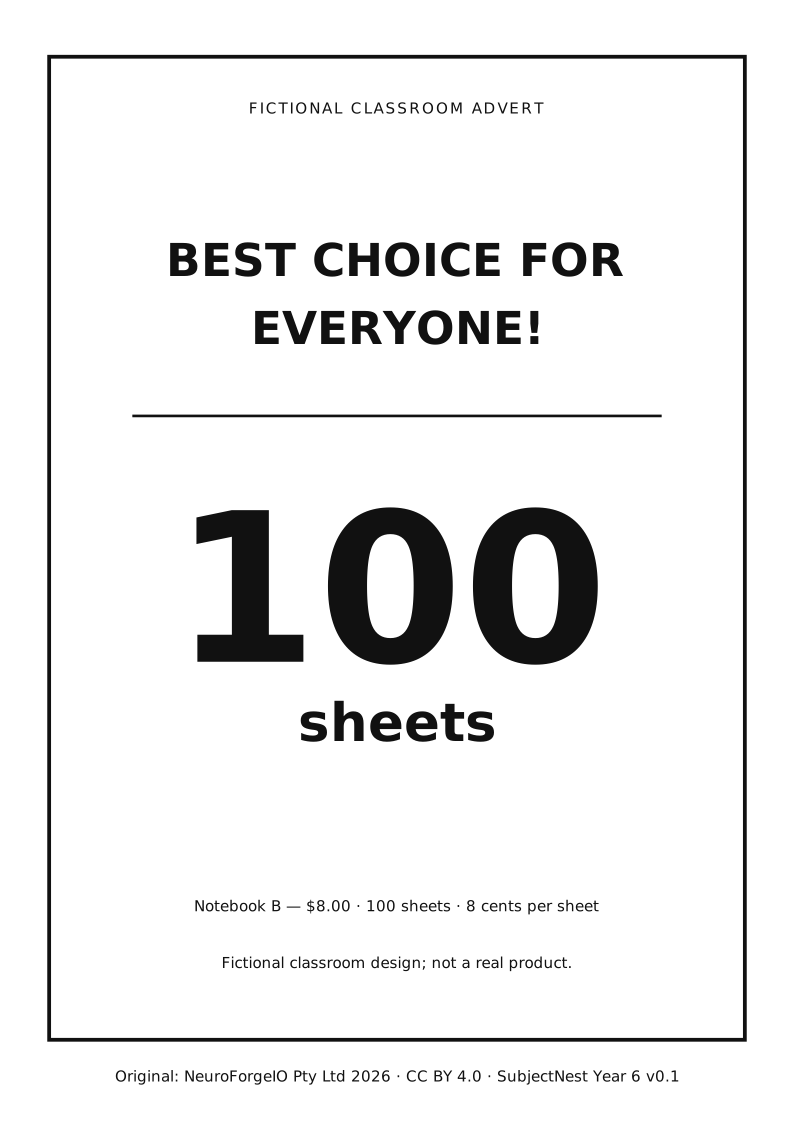
- Notice, 3: Show only “BEST CHOICE FOR EVERYONE!” Ask “What does this line want a reader to think?” Key: prefer/choose whatever is being advertised; the line alone does not name B and is a slogan, not a measurement.
- Model, 5: Reveal the fiction/source line. “This was made for our classroom. It imitates an advert. Its purpose is to persuade a potential buyer. I will check its figures and what it leaves out before deciding.”
- Guide, 7: Read Card A with text/visual access. Circle creator/type, audience and exact claim. Contrast “100 sheets” with “best choice for everyone.” If a child interprets “everyone” literally, ask whose needs are missing.
- Try, 7: Learner fills record fields for source, purpose/audience and claim. An adult can point/scribe only at learner direction. Peer checks exact quoted words against card.
- Check, 3: “Does the headline prove B is best for every person?” Key: no. Next: if yes, contrast a person with a $7 budget and the listed $8 price later; today teach claim versus support.
Day 2 — Objective detail and subjective judgment
Goal: classify a stipulated source detail, opinion and untested prediction without calling all opinions false. Materials: Cards A/B/C.
- Notice, 3: Read “B has 100 sheets” and “B feels perfect.” Key: first is a stipulated card detail; second is subjective.
- Model, 5: Highlight
best,everyone,prefer,I think. “These words can signal judgment. The table's $8 and 100 sheets are details in this invented source. A stated preference can be honest without proving a product quality.” - Guide, 7: Sort six strips: “A costs $6”; “B has 100 sheets”; “Sam prefers a smaller book”; “B will last forever”; “B costs 8 cents per sheet”; “Everyone loves B.” Keys: first two and per-sheet price source-supported; Sam preference explicitly attributed; last two unsupported universal/future claims.
- Try, 7: Learner writes one objective sentence about Card B and one labelled personal viewpoint that cites a reason. Sample: “A costs $6 in the table.” “I would choose A if my budget were $7.” No personal budget disclosure.
- Check, 3: “Is Sam's preference false just because it is subjective?” Key: no; it belongs to a fictional character and is not universal. Next: distinguish attributed view from unsupported statement about everyone.
Day 3 — Read the numbers without overclaiming
Goal: state what the neutral table supports and what it cannot. Materials: Card B, calculator available as access to arithmetic.
- Notice, 3: Ask which listed total is lower. Key: A $6 versus B $8; A costs $2 less upfront.
- Model, 5: Verify unit figures: $6÷60=$0.10; $8÷100=$0.08. “B is two cents cheaper per included sheet, assuming sheets are comparable and used. That is narrower than ‘best for everyone.’”
- Guide, 7: Class tests claims: “B has lower listed unit price” supported; “A has lower upfront total” supported; “B is more durable” unknown; “B always saves money” too broad. Give division support so English reasoning remains target.
- Try, 7: Learner produces two accurate conditional comparison sentences with table evidence: one for a $7 fictional budget, one for a person needing many sheets. Keys: A affordable at $7; B lower per-sheet price if 100 sheets useful/comparable.
- Check, 3: “What detail would we need to compare durability?” Key: quality/use evidence absent from table. Next: ask child to point to the “no data” column before making a claim.
Day 4 — What the design makes easy to notice
Goal: explain visual salience and omission without relying on colour. Materials: SVG advert or exact text/layout description.
- Notice, 3: Ask which information is seen/read first. Key: large headline and “100 sheets”; size and placement draw attention.
- Model, 5: Point to small price line. “An important detail can be accurate but harder to notice. The large slogan draws me toward a choice; it does not change the price or prove universal value.”
- Guide, 7: Compare a neutral re-layout: make $8, 100 sheets and 8c/sheet equal size. Children name what changed in presentation and what did not (numbers/meaning). Discuss omitted durability and user needs.
- Try, 7: Learner sketches, rearranges text blocks or describes an accessible layout showing price and unit price as clearly as sheet count. Label intended audience. Do not grade art skill; grade explanation.
- Check, 3: “Can a font size make a claim true?” Key: no; it changes attention. Next: compare exact words under both layouts.
Day 5 — Three sources, three perspectives
Goal: compare advert, neutral table and attributed fictional preference. Materials: Cards A/B/C, record grid.
- Notice, 3: Retrieve each source type. Keys: advert persuades, table compares listed figures, Sam card voices one invented character's preference.
- Model, 5: “Card A and B mention B's 100 sheets, but A foregrounds one product. Card C asks for a paper check. The sources answer different questions.”
- Guide, 7: Learners fill three rows: claim, support, limit. Teacher asks whether Sam's preference can settle a choice for everyone. Key: no.
- Try, 7: Learner summarises the strongest support for B and one reason someone could reasonably choose A, each tied to a source/criterion. Key: B lower per sheet; A lower upfront/smaller.
- Check, 3: “Which source alone gives listed prices for both options?” Key: B table. Next: if A advert chosen, compare its one-option data with B's two-option columns.
Day 6 — Text structure and persuasive wording
Goal: analyse how heading, claim, figure and missing qualification work together. Materials: Cards A/B and blank four-part template.
- Notice, 3: Ask why the advert puts “BEST” above the small factual line. Key: to influence attention/choice; its position is purposeful.
- Model, 5: Break Card A into headline → salient number → price/unit line → fiction/source line. Contrast B table headings/parallel rows, which support side-by-side comparison.
- Guide, 7: Children reorder four cut-up advert elements and say how meaning changes if price is equally prominent. Discuss why a neutral table still has limits: it omits quality and usage.
- Try, 7: Learner drafts a fair 2-line informational poster using Card B: one headline and one balanced line. Sample: “Compare two notebook options: A $6/60 sheets; B $8/100 sheets. Check what matters to you.”
- Check, 3: “Which text feature helps compare both options directly?” Key: table columns/parallel rows. Next: if learner names only bold letters, trace matching columns.
Day 7 — A conclusion needs a stated criterion
Goal: compare evidence under different constraints without a universal recommendation. Materials: Cards A/B/C, paragraph frame.
- Notice, 3: Ask whether “best” can be answered without saying best for what. Key: no; criteria differ.
- Model, 5: Model two defensible conditional statements: “If immediate budget is $7, A fits the listed price and B does not.” “If 100 comparable sheets will be used, B has lower listed cost per sheet.” Explicitly avoid real personal budgets.
- Guide, 7: Pairs select criteria upfront cost, sheet count, portability, durability. Sort as supported (first two), character preference (portability in Sam's story), or unknown (durability). A criterion can matter even if data are missing.
- Try, 7: Learner writes/dictates one criterion, evidence for two options and one unanswered question. Provide word bank and AAC choices; learner determines conclusion.
- Check, 3: “Can we claim B lasts longer from these cards?” Key: no. Next: write “unknown” rather than guessing, then propose what evidence is needed.
Day 8 — Plan a source-based response
Goal: plan a concise fair comparison for a defined fictional audience. Materials: Card B and paragraph frame.
- Notice, 3: Identify audience as a fictional school design group comparing invented options. No child reports family purchase experiences.
- Model, 5: Plan claim/question, two figures, one missing fact, conditional recommendation. “I will label ‘best for everyone’ as advert language, not adopt it as my conclusion.”
- Guide, 7: Class checks a flawed plan “B is cheapest and lasts forever.” Correction key: A lower upfront; B lower per sheet; no durability evidence. Rebuild balanced plan.
- Try, 7: Learner makes own 4-part plan in writing, AAC, spoken outline or cards. Teacher asks for precise source for each number.
- Check, 3: “What condition will your recommendation name?” Accept: budget, usage or another clearly stated criterion supported/flagged as uncertain. Next: if none, add
if...before drafting.
Day 9 — Draft and revise without a hidden universal claim
Goal: create 3–4 linked sentences with source, comparison, missing information and condition. Materials: plan, Cards A/B/C, revision checklist.
- Notice, 3: Retrieve difference between “B cheaper per sheet” and “B cheaper upfront.” Keys: B per sheet, A upfront.
- Model, 5: Draft: “The fictional advert calls B the best choice for everyone, but the table supports a narrower claim. B is 8 cents per sheet compared with A at 10 cents, while A costs $2 less upfront. The cards give no durability data. If all 100 sheets are useful, B has the lower listed unit price.” Model citation as Card A/B labels.
- Guide, 7: Children mark claim, two figures, limit and condition in the model. Correct teacher's intentional error “B has 60 sheets” using Card B.
- Try, 7: Learner drafts own 3–4 sentences, then revises one for source accuracy or audience clarity. Adult transcription records child words exactly; no forced handwritten paragraph for a learner whose access route differs.
- Check, 3: Ask learner to point to one checked number and one explicitly uncertain claim in own response. Key: source matches and limit named. Next: if missing, return to table before publication.
Day 10 — Transfer to a new fictional advert
Goal: evaluate unseen Card D and explain a conditional decision. Materials: sealed Card D, assessment.
- Notice, 3: Review routine
creator → purpose → exact claim → source detail → limit → conditionwithout revealing new card. - Model, 5: Work an unscored Card A example: the headline is opinion; $8/100 sheets is card detail; no real-user evidence. Keep Card D unseen during model.
- Guide, 7: Reveal Card D. Read independently or via documented access. Ask one common orientation question: “What two pass names appear?” Key: X and Y. Leave main evidence tasks for learner.
- Try, 7: Learner identifies two figures, the universal claim, one omission and a conditional recommendation. Calculator provided if needed; record whether English reasoning was independent and arithmetic supported.
- Check, 3: “Does $1.80 per included entry prove everyone saves with Y?” Key: no; use and upfront/other costs differ. Use assessment and the week's reading/writing samples to choose next teaching.
Response to common errors
When a child treats persuasive wording as a legal violation, return to the narrower task: what the fictional source supports and what evidence is absent. When a child calls an opinion “fake”, teach attribution and reasons. When a child reads the figures correctly but reaches a universal conclusion, add criterion/condition. When read-aloud supports strong reasoning but independent reading is fragile, assess reading separately while preserving access to critical discussion. No single advert analysis proves full English attainment.
Original lessons © NeuroForgeIO Pty Ltd 2026, CC BY 4.0. Curriculum, ACCC source links and ACARA's separate rights in README. Educator/EAL/D review pending.